



Dr. DiRenzo's research program focuses on unifying ecological and evolutionary theory to address fundamental questions in ecology using field, experimental, and quantitative approaches. She enjoys teaching graduate courses related to quantitative ecology, disease ecology, and population/community ecology.
Images
We are cultivating and sharing the creativity, vision, and innovative perspectives that can be found among our graduate student, staff, faculty, and friends.
Filter Total Items: 383

IMG_7664-1.jpeg
Dr. DiRenzo's research program focuses on unifying ecological and evolutionary theory to address fundamental questions in ecology using field, experimental, and quantitative approaches. She enjoys teaching graduate courses related to quantitative ecology, disease ecology, and population/community ecology.

Graziella V. DiRenzo
Dr. DiRenzo joined the MA Cooperative Research Unit in Nov 2020, where she is the Assistant Unit Leader of Wildlife and adjunct faculty in the department of Environmental Conservation at the University of Massachusetts, Amherst. Dr.
Dr. DiRenzo joined the MA Cooperative Research Unit in Nov 2020, where she is the Assistant Unit Leader of Wildlife and adjunct faculty in the department of Environmental Conservation at the University of Massachusetts, Amherst. Dr.
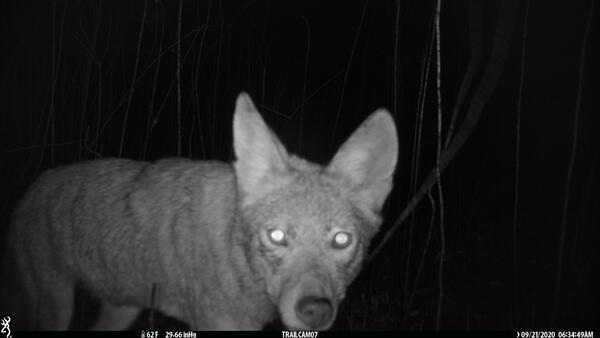
Coyote captured on a trail camera in Arkansas as part of Snapshot USA
Coyote captured on a trail camera in Arkansas as part of Snapshot USACoyote captured on a trail camera in Arkansas as part of Snapshot USA. Snapshot USA. Snapshot USA is a project that is facilitating the collaboration of cooperators to contribute to a national database of public wildlife data; scientists from the Arkansas (B. DeGregorio) and Oklahoma (R. Lonsinger) CRUs are collaborators.
Coyote captured on a trail camera in Arkansas as part of Snapshot USA
Coyote captured on a trail camera in Arkansas as part of Snapshot USACoyote captured on a trail camera in Arkansas as part of Snapshot USA. Snapshot USA. Snapshot USA is a project that is facilitating the collaboration of cooperators to contribute to a national database of public wildlife data; scientists from the Arkansas (B. DeGregorio) and Oklahoma (R. Lonsinger) CRUs are collaborators.

Longleaf pine systems support gopher frog populations
Longleaf pine systems support gopher frog populationsAn open-canopied ephemeral wetland occupied by gopher frogs in the northern Florida Peninsula. Wetlands like these surrounded by sandy upland habitat, such as longleaf pine systems, support gopher frog populations.
Longleaf pine systems support gopher frog populations
Longleaf pine systems support gopher frog populationsAn open-canopied ephemeral wetland occupied by gopher frogs in the northern Florida Peninsula. Wetlands like these surrounded by sandy upland habitat, such as longleaf pine systems, support gopher frog populations.

Ben Luukkonen holding a Canada go
Ben is marking geese with global positioning system transmitters and analyzing banding data to learn what role waterfowl hunters can play in helping to reduce increasing human-goose conflicts.
Ben is marking geese with global positioning system transmitters and analyzing banding data to learn what role waterfowl hunters can play in helping to reduce increasing human-goose conflicts.
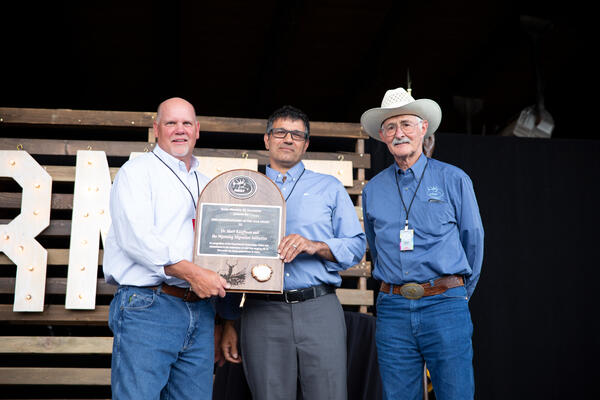
Matt Kauffman, Wyoming Cooperative Fish and Wildlife Research Unit, wins the Rocky Mountain Elk Foundation Conservationist of the Year Award
Matt Kauffman, Wyoming Cooperative Fish and Wildlife Research Unit, wins the Rocky Mountain Elk Foundation Conservationist of the Year AwardMatt Kauffman, Wyoming Cooperative Fish and Wildlife Research Unit, wins the Rocky Mountain Elk Foundation (RMEF) Conservationist of the Year Award. RMEF Chief Conservation officer Blake Henning – left, Dr. Matt Kauffman, center, Dr. Martin Vavra – RMEF Board of Directors -right.
Matt Kauffman, Wyoming Cooperative Fish and Wildlife Research Unit, wins the Rocky Mountain Elk Foundation Conservationist of the Year Award
Matt Kauffman, Wyoming Cooperative Fish and Wildlife Research Unit, wins the Rocky Mountain Elk Foundation Conservationist of the Year AwardMatt Kauffman, Wyoming Cooperative Fish and Wildlife Research Unit, wins the Rocky Mountain Elk Foundation (RMEF) Conservationist of the Year Award. RMEF Chief Conservation officer Blake Henning – left, Dr. Matt Kauffman, center, Dr. Martin Vavra – RMEF Board of Directors -right.
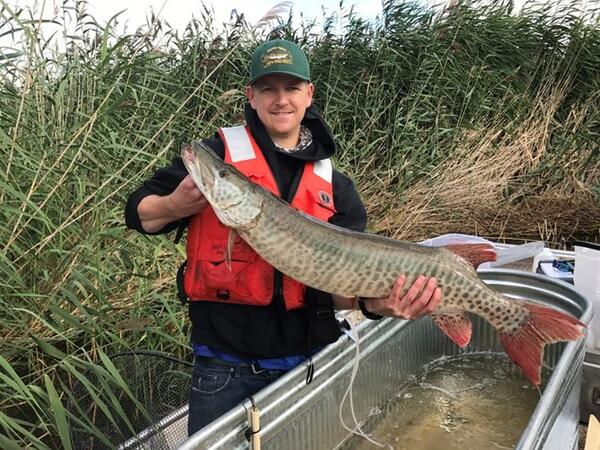
Graduate student holding a muskellunge
Muskellunge (Esox masquinongy) are important apex predators that support recreational fisheries.
Muskellunge (Esox masquinongy) are important apex predators that support recreational fisheries.
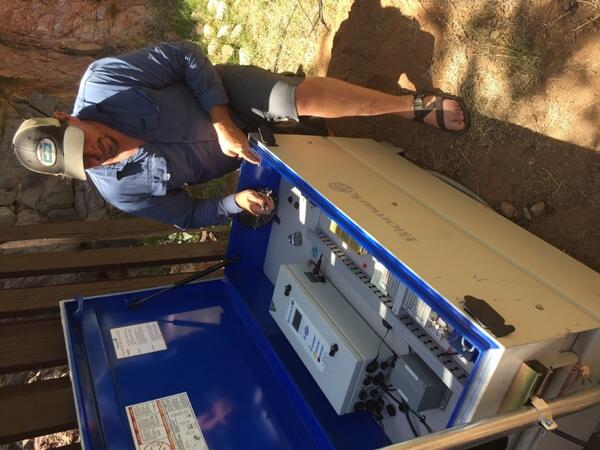
Graduate student working on a Passive Integrated Transponder (PIT) tagging array
Graduate student working on a Passive Integrated Transponder (PIT) tagging arrayBeginning in the 1990’s recovery programs throughout the Colorado River Basin have relied on PIT-tagging (Passive Integrated Transponder) as a way to individually mark fish and allows researchers to track fish over time and eventually provide population estimates.
Graduate student working on a Passive Integrated Transponder (PIT) tagging array
Graduate student working on a Passive Integrated Transponder (PIT) tagging arrayBeginning in the 1990’s recovery programs throughout the Colorado River Basin have relied on PIT-tagging (Passive Integrated Transponder) as a way to individually mark fish and allows researchers to track fish over time and eventually provide population estimates.

Elk with chronic wasting disease
The disease affects white-tailed deer, mule deer, elk, and moose. Chronic wasting disease is contagious and has been detected in 26 states. Chronic wasting disease is a fatal contagious neurological disease that affects free-ranging and captive cervids (members of the deer family) such as elk, moose, white-tailed deer, and mule deer.
The disease affects white-tailed deer, mule deer, elk, and moose. Chronic wasting disease is contagious and has been detected in 26 states. Chronic wasting disease is a fatal contagious neurological disease that affects free-ranging and captive cervids (members of the deer family) such as elk, moose, white-tailed deer, and mule deer.

allison roy.jpg
Ayla Skorupa, a graduate student at the University of Massachusetts, reviews field notes on native mussels with Unit Leader, Allison Roy (Massachusetts CRU). Photograph by Naila Moreira.
Ayla Skorupa, a graduate student at the University of Massachusetts, reviews field notes on native mussels with Unit Leader, Allison Roy (Massachusetts CRU). Photograph by Naila Moreira.

An exploration of the direct and indirect effects of climatic warming
An exploration of the direct and indirect effects of climatic warmingArctic lakes support trophic interactions, biological processes, and critical habitat at all trophic levels; however, climatic warming threatens to alter the structure and function of aquatic communities and overall system production.
An exploration of the direct and indirect effects of climatic warming
An exploration of the direct and indirect effects of climatic warmingArctic lakes support trophic interactions, biological processes, and critical habitat at all trophic levels; however, climatic warming threatens to alter the structure and function of aquatic communities and overall system production.

Bison on Antelope Island, Utah
Bison on Antelope Island, Utah. Utah Division of State Parks manages approximately 500-700 bison. Source: Utah Division of State Parks.
Bison on Antelope Island, Utah. Utah Division of State Parks manages approximately 500-700 bison. Source: Utah Division of State Parks.

Adaptive Management and Monitoring of Pyramid Lake, Nevada UT
Adaptive Management and Monitoring of Pyramid Lake, Nevada UTPyramid Lake, Nevada, is one of the last remaining strongholds for lacustrine Lahontan cutthroat trout; almost all other large lake populations have undergone population declines or extirpation as a result of habitat degradation, overharvest, and water diversions, all compounded by the stocking of nonnative species.
Adaptive Management and Monitoring of Pyramid Lake, Nevada UT
Adaptive Management and Monitoring of Pyramid Lake, Nevada UTPyramid Lake, Nevada, is one of the last remaining strongholds for lacustrine Lahontan cutthroat trout; almost all other large lake populations have undergone population declines or extirpation as a result of habitat degradation, overharvest, and water diversions, all compounded by the stocking of nonnative species.

Chronic wasting disease is an infectious disease
Chronic wasting disease (CWD) is an emerging infectious disease that is fatal to free-ranging and captive animals in Cervidae (the deer family; referred to as “cervids”). Affected animals include deer, elk, moose, and reindeer.
Chronic wasting disease (CWD) is an emerging infectious disease that is fatal to free-ranging and captive animals in Cervidae (the deer family; referred to as “cervids”). Affected animals include deer, elk, moose, and reindeer.

Chronic wasting disease is an infectious disease
Chronic wasting disease (CWD) is an emerging infectious disease that is fatal to free-ranging and captive animals in Cervidae (the deer family; referred to as “cervids”). Affected animals include deer, elk, moose, and reindeer.
Chronic wasting disease (CWD) is an emerging infectious disease that is fatal to free-ranging and captive animals in Cervidae (the deer family; referred to as “cervids”). Affected animals include deer, elk, moose, and reindeer.

Assessing the impact of nutrient enrichment in Utah
Assessing the impact of nutrient enrichment in UtahRivers in the western U.S. rivers are experiencing changes in nutrient loading because of rapid urban development, but the effects of changing nutrient loading on the structure and function of stream ecosystems, especially fish habitat, are not fully understood.
Assessing the impact of nutrient enrichment in Utah
Assessing the impact of nutrient enrichment in UtahRivers in the western U.S. rivers are experiencing changes in nutrient loading because of rapid urban development, but the effects of changing nutrient loading on the structure and function of stream ecosystems, especially fish habitat, are not fully understood.

Chronic wasting disease is an infectious disease
Chronic wasting disease (CWD) is an emerging infectious disease that is fatal to free-ranging and captive animals in Cervidae (the deer family; referred to as “cervids”). Affected animals include deer, elk, moose, and reindeer.
Chronic wasting disease (CWD) is an emerging infectious disease that is fatal to free-ranging and captive animals in Cervidae (the deer family; referred to as “cervids”). Affected animals include deer, elk, moose, and reindeer.

Chronic wasting disease is an infectious disease
Chronic wasting disease (CWD) is an emerging infectious disease that is fatal to free-ranging and captive animals in Cervidae (the deer family; referred to as “cervids”). Affected animals include deer, elk, moose, and reindeer.
Chronic wasting disease (CWD) is an emerging infectious disease that is fatal to free-ranging and captive animals in Cervidae (the deer family; referred to as “cervids”). Affected animals include deer, elk, moose, and reindeer.

White-tailed deer
Distribution map: distribution of chronic wasting disease in North America
Distribution map: distribution of chronic wasting disease in North America

Chronic wasting disease is an infectious disease
Chronic wasting disease (CWD) is an emerging infectious disease that is fatal to free-ranging and captive animals in Cervidae (the deer family; referred to as “cervids”). Affected animals include deer, elk, moose, and reindeer.
Chronic wasting disease (CWD) is an emerging infectious disease that is fatal to free-ranging and captive animals in Cervidae (the deer family; referred to as “cervids”). Affected animals include deer, elk, moose, and reindeer.

Brook floater mussel
A brook floater filter feeding as it is anchored into the sediment of a stream bottom. Habitat loss is a long-recognized problem for many endangered species, and the brook floater is no exception. In-stream alterations that change flow and alter sediment loads can affect downstream locations where freshwater mussels live.
A brook floater filter feeding as it is anchored into the sediment of a stream bottom. Habitat loss is a long-recognized problem for many endangered species, and the brook floater is no exception. In-stream alterations that change flow and alter sediment loads can affect downstream locations where freshwater mussels live.