U.S. flag

An official website of the United States government

Images

We are cultivating and sharing the creativity, vision, and innovative perspectives that can be found among our graduate student, staff, faculty, and friends. 

Filter Total Items: 379
Tom Kwak and Ambar Torres
Tom Kwak and student Ambar Torres Molinari in Puerto Rico

Thomas J. Kwak passed away on November 19, 2021 ​​due to a non-COVID related cardio-pulmonary event while visiting his hometown of Momence, IL. Tom was the Unit Leader at the North Carolina Cooperative Fish and Wildlife Research Unit at NC State (he joined the faculty at NC State in 1999).

Thomas J. Kwak passed away on November 19, 2021 ​​due to a non-COVID related cardio-pulmonary event while visiting his hometown of Momence, IL. Tom was the Unit Leader at the North Carolina Cooperative Fish and Wildlife Research Unit at NC State (he joined the faculty at NC State in 1999).

Graduate students enter fishery data at Apache Lake in Arizona

Graduate students at the Arizona Cooperative Fish and Wildlife Research Unit calibrate gear and test new fish sampling techniques (hydroacoustics, electrofishing boat operation) in Western canyon-bound reservoirs in Arizona.  The research compares Arizona Game and Fish Department (AZGFD) sampling protocols with American Fisheries Society (AFS) standar

Graduate students at the Arizona Cooperative Fish and Wildlife Research Unit calibrate gear and test new fish sampling techniques (hydroacoustics, electrofishing boat operation) in Western canyon-bound reservoirs in Arizona.  The research compares Arizona Game and Fish Department (AZGFD) sampling protocols with American Fisheries Society (AFS) standar

Graduate student researching food preferences of northern Idaho ground squirrels
Phoenix Aguilar McFarlane is a sophomore at the University of Idaho

Phoenix Aguilar McFarlane is a sophomore majoring in Environmental Science at the University of Idaho College of Natural Resources at the USGS Idaho Cooperative Fish and Wildlife Research Program. She came to the Doris Duke Conservation Scholars Program (DDCSP) with a can-do attitude and a passion for volunteering in community service and sustainability projects.

Phoenix Aguilar McFarlane is a sophomore majoring in Environmental Science at the University of Idaho College of Natural Resources at the USGS Idaho Cooperative Fish and Wildlife Research Program. She came to the Doris Duke Conservation Scholars Program (DDCSP) with a can-do attitude and a passion for volunteering in community service and sustainability projects.

Reducing Uncertainties in Eastern Black Rail Conservation

Reducing uncertainties in Eastern black rail conservation. Qualitative value of information to identify field experiments in a resilience-experimentalist adaptive management framework.

Reducing uncertainties in Eastern black rail conservation. Qualitative value of information to identify field experiments in a resilience-experimentalist adaptive management framework.

Field crew in the Adirondacks of New York using detection dogs to find moose scats for a capture-recapture study to estimate
Field Crew in the Adirondacks of New York Estimate Moose Density

Field crew in the Adirondacks of New York using detection dogs to find moose scats for a capture-recapture study to estimate moose density. 

graduate student wearing an orange vest on a research boat
Idaho Graduate Student on a boat studying steelhead

In cooperation with the Idaho Department of Fish and Game (IDFG) the Idaho Unit recently completed a series of research projects to better understand the effects of catch-and-release angling on survival and reproductive success of native trout and steelhead. 

In cooperation with the Idaho Department of Fish and Game (IDFG) the Idaho Unit recently completed a series of research projects to better understand the effects of catch-and-release angling on survival and reproductive success of native trout and steelhead. 

women with hat holding a bridle shiner fish
Lara Katz holds up bridle shiners caught during a river seine net survey

Lara became interested in monitoring rare species as she researched Acadia’s bat community using acoustics and radio-telemetry. Her interests in rare species monitoring and geographic information systems led her to return to the University of Maine to pursue her Master’s degree.

Lara became interested in monitoring rare species as she researched Acadia’s bat community using acoustics and radio-telemetry. Her interests in rare species monitoring and geographic information systems led her to return to the University of Maine to pursue her Master’s degree.

researcher holding a fly rod in yellowstone is standing near a bison along a river with mountains in the backdrop
Daniel Magoulick
Daniel Magoulick
Daniel Magoulick

Dan is from Michigan originally and received his BS from Michigan State University, MS from Eastern Michigan University and PhD from University of Pittsburgh. Dan joined the Arkansas Cooperative Fish and Wildlife Research Unit in 2000, where he is the Assistant Unit Leader and Professor in the Department of Biological Sciences.

Dan is from Michigan originally and received his BS from Michigan State University, MS from Eastern Michigan University and PhD from University of Pittsburgh. Dan joined the Arkansas Cooperative Fish and Wildlife Research Unit in 2000, where he is the Assistant Unit Leader and Professor in the Department of Biological Sciences.

man with dark hair, dark beard, black shirt green backpack on a hill near the coast
Caleb P. Roberts
Caleb P. Roberts
Caleb P. Roberts

Caleb Roberts uses a variety of spatial analyses, data integration approaches, multivariate statistics, nonlinear modeling, and both Bayesian and frequentist statistical approaches. Caleb teaches two courses—Invasion Ecology and Ecosystem Monitoring and Assessment. Dr.

Caleb Roberts uses a variety of spatial analyses, data integration approaches, multivariate statistics, nonlinear modeling, and both Bayesian and frequentist statistical approaches. Caleb teaches two courses—Invasion Ecology and Ecosystem Monitoring and Assessment. Dr.

Two graduate students holding a large gulf sturgeon
Josh Vine and Andrew Carlson hold a sturgeon

Graduate students track the movement of juvenile Gulf sturgeon with acoustic telemetry in the Choctawhatchee River Basin, Florida.

graduate student with a white hat and blue shirt holds a radio-telemetry antennae
Emma Doden holding a radio telemetry antennae to collect data on beaver

Emma has collaborated with multiple agencies and stakeholders to capture and translocate 30 beavers that would otherwise have been euthanized. Emma is pleased that she, along with the beavers, is assisting in conservation and restoration efforts in a sensitive arid system.

Emma has collaborated with multiple agencies and stakeholders to capture and translocate 30 beavers that would otherwise have been euthanized. Emma is pleased that she, along with the beavers, is assisting in conservation and restoration efforts in a sensitive arid system.

graduate student wearing camo and holding cross country skis in the snow
Josh Blouin wearing camo in the woods on a snowy day

Josh’s passion for wildlife and photography have blended well, as his photographs have been published in various outlets and displayed at several galleries. Notably, one of his photographs was selected by a National Geographic editor as a “Top Photo” during the 2017 nature photographer of the year competition.

Josh’s passion for wildlife and photography have blended well, as his photographs have been published in various outlets and displayed at several galleries. Notably, one of his photographs was selected by a National Geographic editor as a “Top Photo” during the 2017 nature photographer of the year competition.

Beaver near the Price River in Utah
Geotagged beaver
Geotagged beaver
Geotagged beaver

Emma Doden, Utah Cooperative Fish and Wildlife Research Unit graduate, assessed the efficacy of translocating beavers to desert restoration sites. Beavers are ecosystem engineers, can serve as a cost-effective, natural alternative to human restoration efforts, and are especially important to arid western ecosystems.

Emma Doden, Utah Cooperative Fish and Wildlife Research Unit graduate, assessed the efficacy of translocating beavers to desert restoration sites. Beavers are ecosystem engineers, can serve as a cost-effective, natural alternative to human restoration efforts, and are especially important to arid western ecosystems.

Beaver dam on the Prices River in Eastern Utah
Beaver dam on the Price River in Eastern Utah

The Utah Cooperative Fish and Wildlife Research Unit is assessing the efficacy of translocating beavers to desert restoration sites. Beavers are ecosystem engineers, can serve as a cost-effective, natural alternative to human restoration efforts, and are especially important to arid western ecosystems.

The Utah Cooperative Fish and Wildlife Research Unit is assessing the efficacy of translocating beavers to desert restoration sites. Beavers are ecosystem engineers, can serve as a cost-effective, natural alternative to human restoration efforts, and are especially important to arid western ecosystems.

Productivity of Black Oystercatchers in Southwest Alaska

The black oystercatcher, a keystone species in nearshore ecosystems, plays an important role in structuring nearshore systems and is highly susceptible to human disturbance. Current inventory and monitoring efforts may not adequately address the information needs for estimating long-term trends for this species.

The black oystercatcher, a keystone species in nearshore ecosystems, plays an important role in structuring nearshore systems and is highly susceptible to human disturbance. Current inventory and monitoring efforts may not adequately address the information needs for estimating long-term trends for this species.

 Standard Fish Sampling Techniques and Environmental DNA for Characterizing Fish Relative Abundance,
Standard Fish Sampling Techniques

Examining environmental deoxyribonucleic acid (eDNA) in water samples has demonstrated promise for identifying fish species present in water bodies. However, whether or not this same approach can be used to assess relative abundance, biomass, and species composition in large (greater than [>] 200-hectare) waterbodies is unclear.

Examining environmental deoxyribonucleic acid (eDNA) in water samples has demonstrated promise for identifying fish species present in water bodies. However, whether or not this same approach can be used to assess relative abundance, biomass, and species composition in large (greater than [>] 200-hectare) waterbodies is unclear.

Dr. DiRenzo joined the USGS in November 2020
IMG_7664-1.jpeg
IMG_7664-1.jpeg
IMG_7664-1.jpeg

Dr. DiRenzo's research program focuses on unifying ecological and evolutionary theory to address fundamental questions in ecology using field, experimental, and quantitative approaches. She enjoys teaching graduate courses related to quantitative ecology, disease ecology, and population/community ecology.

Dr. DiRenzo's research program focuses on unifying ecological and evolutionary theory to address fundamental questions in ecology using field, experimental, and quantitative approaches. She enjoys teaching graduate courses related to quantitative ecology, disease ecology, and population/community ecology.

Graziella V. DiRenzo

Dr. DiRenzo joined the MA Cooperative Research Unit in Nov 2020, where she is the Assistant Unit Leader of Wildlife and adjunct faculty in the department of Environmental Conservation at the University of Massachusetts, Amherst. Dr.

Dr. DiRenzo joined the MA Cooperative Research Unit in Nov 2020, where she is the Assistant Unit Leader of Wildlife and adjunct faculty in the department of Environmental Conservation at the University of Massachusetts, Amherst. Dr.

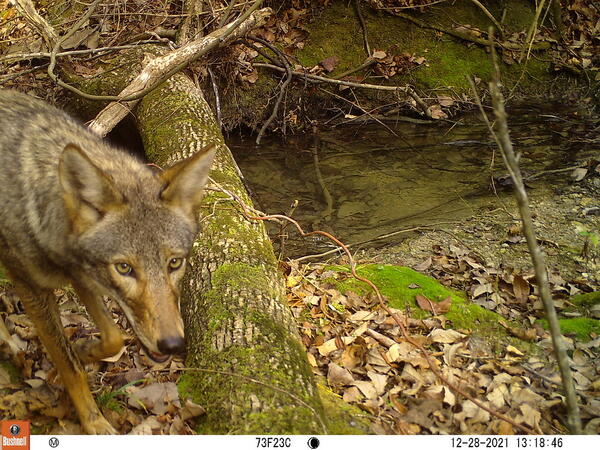
Coyote on trail camera
Coyote captured on a trail camera in Arkansas as part of Snapshot USA

Coyote captured on a trail camera in Arkansas as part of Snapshot USA. Snapshot USA. Snapshot USA is a project that is facilitating the collaboration of cooperators to contribute to a national database of public wildlife data; scientists from the Arkansas (B. DeGregorio) and Oklahoma (R. Lonsinger) CRUs are collaborators.

Coyote captured on a trail camera in Arkansas as part of Snapshot USA. Snapshot USA. Snapshot USA is a project that is facilitating the collaboration of cooperators to contribute to a national database of public wildlife data; scientists from the Arkansas (B. DeGregorio) and Oklahoma (R. Lonsinger) CRUs are collaborators.

An open-canopied ephemeral wetland
Longleaf pine systems support gopher frog populations

An open-canopied ephemeral wetland occupied by gopher frogs in the northern Florida Peninsula. Wetlands like these surrounded by sandy upland habitat, such as longleaf pine systems, support gopher frog populations.

An open-canopied ephemeral wetland occupied by gopher frogs in the northern Florida Peninsula. Wetlands like these surrounded by sandy upland habitat, such as longleaf pine systems, support gopher frog populations.

Was this page helpful?