



2026 Venezuela Sequence Earthquake-Triggered Landslide Hazards
On Wednesday, June 24th, 2026, a pair of earthquakes of Magnitude 7.2 and Magnitude 7.5 occurred in northern Venezuela, west of Caracas. The U.S. Geological Survey (USGS) Ground Failure product estimated that landslides triggered by this earthquake would likely be significant in number and/or spatial extent.
This landslide event page serves to communicate timely science information to our partners. This page includes what is currently understood about the landslides triggered by the event sequence based on preliminary assessments of satellite imagery, and may be subject to change. For more information about the earthquake sequence, refer to the USGS Earthquake Event pages (linked below).
Our thoughts go out to the millions of people affected by the 2026 Venezuela earthquakes and the significant effects from the shaking that continue to impact the region.
Field Photos | Observations | More Information | Publications | Data
How to stay safe:
Landslides can still happen for the next few days to weeks. Aftershocks and heavy rainfall can trigger additional landslide activity. Pay attention to weather alerts. Follow emergency messages from local authorities.
Pay attention to the landslide warning signs. Landslide warning signs include new cracks forming on the ground, leaning trees, new springs, or falling rocks.
Use caution clearing landslides that are blocking roads. Consider consulting a professional geologist or engineer. Removing material may remobilize the landslide. Aftershocks may also trigger additional landslides. Downed power lines or other hazards may be hidden under landslide deposits.
If a landslide has impacted your home, or you see signs of a landslide, contact your local emergency services. Local officials are best able to assess potential danger. If the danger is not immediate, seek guidance from a qualified professional engineering geologist or civil engineer.
Learn more about landslide preparedness.
Landslide Safety
Landslide Preparedness
What we are doing
The USGS is sharing information on likely earthquake and landslide impacts and persistent threats to support the U.S. Government’s response. In the days after the earthquake, the USGS conducted a preliminary assessment of landslide hazards in areas of high landslide likelihood based on USGS shaking and ground failure model estimates (available on the USGS earthquake event pages for the M7.2 and M 7.5). Assessments were conducted based on manual review of high-resolution satellite imagery.
The primary goal was to provide rapid situational awareness for response operations and safety of responders, therefore the focus of the assessment was on assessing transportation impacts, identifying isolated communities, and evaluating sources of ongoing hazards such as landslide dams that may pose downstream flooding hazards. The preliminary assessment was limited to priority areas for response and is not a complete representation of landslides triggered by the two earthquakes. The USGS was unable to assess some of the priority areas due to cloud coverage or lack of available imagery.
The USGS has identified several impacted landslide areas, including:
- buried or damaged structures in Catia La Mar and Playa Grande,
- possible isolated communities due to partially or fully blocked roadways along the coastal road west from Catia La Mar to Puerto Cruz, and inland populations in this area may be cut off from coastal communities,
- structures damaged by localized landslides near Highway 6 north of Maracay, and
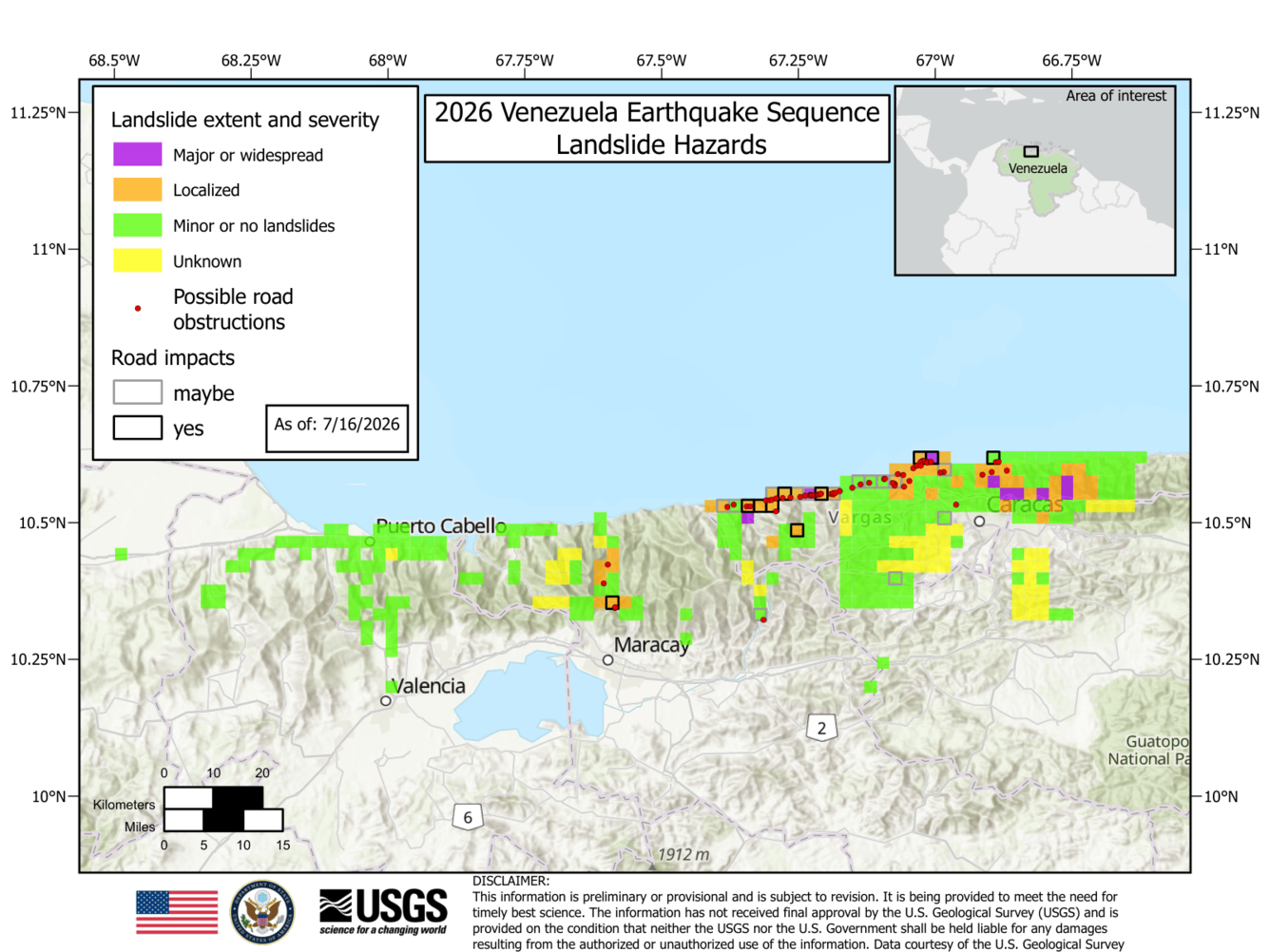
- widespread or major landslides in the coastal mountains above La Guaira to Naiguatá.
Based on the preliminary incomplete assessment (Figure 1), most observed landslide effects were concentrated towards the eastern end of the fault rupture. The observed patterns now better align with the USGS ShakeMap and Ground Failure maps following an update to the fault geometry included in version 9 of those products. However, landslides still do not appear to be as significant as the models predict, especially in the west.
A georeferenced pdf of Figure 1 and the associated geospatial files are available for download as a provisional USGS data release: 2026 Venezuela Earthquakes - Rapid Imagery Assessment for Hazardous Landslides.
Future outlook
Earthquake shaking may make steep slopes more landslide prone for a few months to a few years. Heavy rainfall or aftershocks could trigger more landslides, especially in areas that experienced landslides during the earthquake.
Populated areas downstream of observed widespread landslide activity that may be at risk include Naigutá, Caraballeda, Macuto, and Puerto Cruz. Areas downstream, or downslope, from earthquake-triggered landslides may be at an increased risk from landslides and debris flows for several years. Debris flows are fast-moving, dangerous flows of sediment and water that can travel long distances along stream channels. Some of these areas were affected by deadly and destructive debris flows in 1999.1,2
The USGS did not identify any landslide dams in the areas reviewed, but landslide dams could exist in areas that were not reviewed or that were obscured by cloud cover. Landslide dams are landslides that have blocked a river, causing water to build up. Even if the landslide dam is in a remote area, these can be dangerous if they fail suddenly and cause dangerous flooding downstream.
Preliminary landslide assessment geospatial files: https://doi.org/10.5066/P1MRLOZ7
Contributors to this page include Marísa Macías, Lillian Hanson, Kate Allstadt, Stephen Slaughter, Corina Cerovski-Darriau, Eric Jones, Robert Schmitt, Lauren Schaefer, Erin Jensen, and Elaine Collins.
View the Earthquake Engineering Research Institute’s event page for a compilation of products.
Learn more about landslides.
Learn more about landslide preparedness.
Learn more about the Landslide Hazards Program.
Learn more about USGS Landslide Response.
References
1 Wieczorek, G.F., Larsen, M.C., Eaton, L.S., Morgan, B.A., and Blair, J., 2002, Debris-flow and flooding deposits in coastal Venezuela associated with the storm of December 14-16, 1999 (Version 1.0): U.S. Geological Survey IMAP 2772, 1 map : col. ; 32 x 102 cm., on sheet 102 x 127 cm., folded in envelope 30 x 24 cm. + 1 data sheet (102 x 127 cm.). , https://doi.org/10.3133/i2772.
2 Wieczorek, G.F., Larsen, M.C., Eaton, L.S., Morgan, B.A., and Blair, J.L., 2001, Debris‑flow and flooding hazards associated with the December 1999 storm in coastal Venezuela and strategies for mitigation: U.S. Geological Survey Open‑File Report 01–0144, 1 CD-ROM, https://pubs.usgs.gov/of/2001/ofr-01-0144/.
| Disclaimer: This information is preliminary or provisional and is subject to revision. It is being provided to meet the need for timely best science. The information has not received final approval by the U.S. Geological Survey (USGS) and is provided on the condition that neither the USGS nor the U.S. Government shall be held liable for any damages resulting from the authorized or unauthorized use of the information. |
On Wednesday, June 24th, 2026, a pair of earthquakes of Magnitude 7.2 and Magnitude 7.5 occurred in northern Venezuela, west of Caracas. The U.S. Geological Survey (USGS) Ground Failure product estimated that landslides triggered by this earthquake would likely be significant in number and/or spatial extent.
This landslide event page serves to communicate timely science information to our partners. This page includes what is currently understood about the landslides triggered by the event sequence based on preliminary assessments of satellite imagery, and may be subject to change. For more information about the earthquake sequence, refer to the USGS Earthquake Event pages (linked below).
Our thoughts go out to the millions of people affected by the 2026 Venezuela earthquakes and the significant effects from the shaking that continue to impact the region.
Field Photos | Observations | More Information | Publications | Data
How to stay safe:
Landslides can still happen for the next few days to weeks. Aftershocks and heavy rainfall can trigger additional landslide activity. Pay attention to weather alerts. Follow emergency messages from local authorities.
Pay attention to the landslide warning signs. Landslide warning signs include new cracks forming on the ground, leaning trees, new springs, or falling rocks.
Use caution clearing landslides that are blocking roads. Consider consulting a professional geologist or engineer. Removing material may remobilize the landslide. Aftershocks may also trigger additional landslides. Downed power lines or other hazards may be hidden under landslide deposits.
If a landslide has impacted your home, or you see signs of a landslide, contact your local emergency services. Local officials are best able to assess potential danger. If the danger is not immediate, seek guidance from a qualified professional engineering geologist or civil engineer.
Learn more about landslide preparedness.
Landslide Safety
Landslide Preparedness
What we are doing
The USGS is sharing information on likely earthquake and landslide impacts and persistent threats to support the U.S. Government’s response. In the days after the earthquake, the USGS conducted a preliminary assessment of landslide hazards in areas of high landslide likelihood based on USGS shaking and ground failure model estimates (available on the USGS earthquake event pages for the M7.2 and M 7.5). Assessments were conducted based on manual review of high-resolution satellite imagery.
The primary goal was to provide rapid situational awareness for response operations and safety of responders, therefore the focus of the assessment was on assessing transportation impacts, identifying isolated communities, and evaluating sources of ongoing hazards such as landslide dams that may pose downstream flooding hazards. The preliminary assessment was limited to priority areas for response and is not a complete representation of landslides triggered by the two earthquakes. The USGS was unable to assess some of the priority areas due to cloud coverage or lack of available imagery.
The USGS has identified several impacted landslide areas, including:
- buried or damaged structures in Catia La Mar and Playa Grande,
- possible isolated communities due to partially or fully blocked roadways along the coastal road west from Catia La Mar to Puerto Cruz, and inland populations in this area may be cut off from coastal communities,
- structures damaged by localized landslides near Highway 6 north of Maracay, and
- widespread or major landslides in the coastal mountains above La Guaira to Naiguatá.
Based on the preliminary incomplete assessment (Figure 1), most observed landslide effects were concentrated towards the eastern end of the fault rupture. The observed patterns now better align with the USGS ShakeMap and Ground Failure maps following an update to the fault geometry included in version 9 of those products. However, landslides still do not appear to be as significant as the models predict, especially in the west.
A georeferenced pdf of Figure 1 and the associated geospatial files are available for download as a provisional USGS data release: 2026 Venezuela Earthquakes - Rapid Imagery Assessment for Hazardous Landslides.
Future outlook
Earthquake shaking may make steep slopes more landslide prone for a few months to a few years. Heavy rainfall or aftershocks could trigger more landslides, especially in areas that experienced landslides during the earthquake.
Populated areas downstream of observed widespread landslide activity that may be at risk include Naigutá, Caraballeda, Macuto, and Puerto Cruz. Areas downstream, or downslope, from earthquake-triggered landslides may be at an increased risk from landslides and debris flows for several years. Debris flows are fast-moving, dangerous flows of sediment and water that can travel long distances along stream channels. Some of these areas were affected by deadly and destructive debris flows in 1999.1,2
The USGS did not identify any landslide dams in the areas reviewed, but landslide dams could exist in areas that were not reviewed or that were obscured by cloud cover. Landslide dams are landslides that have blocked a river, causing water to build up. Even if the landslide dam is in a remote area, these can be dangerous if they fail suddenly and cause dangerous flooding downstream.
Preliminary landslide assessment geospatial files: https://doi.org/10.5066/P1MRLOZ7
Contributors to this page include Marísa Macías, Lillian Hanson, Kate Allstadt, Stephen Slaughter, Corina Cerovski-Darriau, Eric Jones, Robert Schmitt, Lauren Schaefer, Erin Jensen, and Elaine Collins.
View the Earthquake Engineering Research Institute’s event page for a compilation of products.
Learn more about landslides.
Learn more about landslide preparedness.
Learn more about the Landslide Hazards Program.
Learn more about USGS Landslide Response.
References
1 Wieczorek, G.F., Larsen, M.C., Eaton, L.S., Morgan, B.A., and Blair, J., 2002, Debris-flow and flooding deposits in coastal Venezuela associated with the storm of December 14-16, 1999 (Version 1.0): U.S. Geological Survey IMAP 2772, 1 map : col. ; 32 x 102 cm., on sheet 102 x 127 cm., folded in envelope 30 x 24 cm. + 1 data sheet (102 x 127 cm.). , https://doi.org/10.3133/i2772.
2 Wieczorek, G.F., Larsen, M.C., Eaton, L.S., Morgan, B.A., and Blair, J.L., 2001, Debris‑flow and flooding hazards associated with the December 1999 storm in coastal Venezuela and strategies for mitigation: U.S. Geological Survey Open‑File Report 01–0144, 1 CD-ROM, https://pubs.usgs.gov/of/2001/ofr-01-0144/.
| Disclaimer: This information is preliminary or provisional and is subject to revision. It is being provided to meet the need for timely best science. The information has not received final approval by the U.S. Geological Survey (USGS) and is provided on the condition that neither the USGS nor the U.S. Government shall be held liable for any damages resulting from the authorized or unauthorized use of the information. |