



Fish & Aquatic Species
Energy & Wildlife
Tools & Technology
Species Management Research Program
The Species Management Research Program provides science that is used by managers, policy makers, and others for decisions that protect, conserve, and enhance healthy fish and wildlife populations across the United States and beyond.
Species We Study
Species We Study

From tiny insects to whales, check out the diversity of plants and animals our scientists study across the world.
Animal Welfare Assurance
Animal Welfare Assurance

The USGS promotes animal welfare and human and animal safety in research, teaching, and training activities.
News
A Celebration of Information for Recreation – National Hunting and Fishing Day
A Celebration of Information for Recreation – National Hunting and Fishing Day
USGS Research Informs Big Game Management—Mule Deer Sensitive to Temperature Extremes and Habitat Quality
USGS Research Informs Big Game Management—Mule Deer Sensitive to Temperature Extremes and Habitat Quality
Supporting Endangered Rusty Patched Bumble Bee Recovery Efforts
Supporting Endangered Rusty Patched Bumble Bee Recovery Efforts
Publications
Estimating greater sage-grouse population sizes within Oregon, 2017–24 Estimating greater sage-grouse population sizes within Oregon, 2017–24
We fit a binomial mixture (N-mixture) model to lek (breeding area) count data to estimate annual population sizes of greater sage-grouse (Centrocercus urophasianus; sage-grouse) within Oregon between 2017 and 2024. Population estimates were delineated among 24 priority areas for conservation, and additional sources of information were considered, including male-to-female sex ratios, lek...
Reply to the discussion by Pilfold “Polar bear mass change confirms hyperphagia follows ringed seal whelping” Reply to the discussion by Pilfold “Polar bear mass change confirms hyperphagia follows ringed seal whelping”
The spring is a critical period when polar bears (Ursus maritimus Phipps, 1774) are thought to have peak access to seals and acquire the majority of their annual energy requirements during a period of hyperphagia. Pagano et al. (Pagano A.M., Atkinson S.N., and Archer L.C. 2025. Arctic Science.11:1-14. doi:10.1139/as-2024-0051) examined the intra-seasonal changes in body mass of 31 polar...
Amphibian diversity of the western Colorado canyonlands including potential threats from nonnative bullfrogs and disease Amphibian diversity of the western Colorado canyonlands including potential threats from nonnative bullfrogs and disease
Throughout the canyons of the Colorado and Uncompahgre Plateaus, water is a limited resource for wildlife, with patchy distribution and seasonal availability. Tributary creeks within these canyons drain into mainstem rivers, providing habitat and breeding sites for native amphibians. Yet, little is known about the diversity and distribution of amphibians that live in these harsh, dynamic
Science
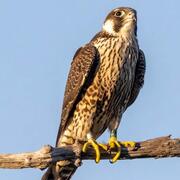
USGS Bird Science by Flyway—Summer 2026 Highlights
Connecting state agencies and biologists to the breadth of partner-driven science that USGS supports in your flyway.
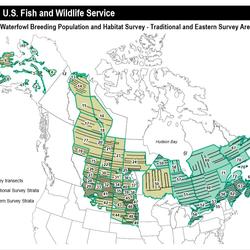
Redesigning the Eastern Breeding Waterfowl Population and Habitat Survey
USGS and partners are revising the design of a key waterfowl survey to increase management efficiency and cost-effectiveness, and inform annual harvest regulations in the U.S. and Canada.

Evaluating the Design of the Waterfowl Breeding Population and Habitat Survey
The Waterfowl Breeding Population and Habitat Survey (WBPHS) is a primary source of waterfowl population status and trend information for management of ducks in North America. The survey has not been reviewed in several decades, and since the last review new analysis approaches and information needs have created a need to reassess the design, scope of inference, and analysis of the survey to...