
U.S. flag

An official website of the United States government

Contaminant Transport and Effects

Filter Total Items: 125

Advanced PFAS Measurement Methods

Environmental Health Program scientists, in collaboration with other USGS scientists, are developing complementary field and laboratory methods and capabilities to detect and quantify a range of target and nontarget per- and polyfluoroalkyl substances (PFAS) and indicator compounds at low levels (parts per trillion) in a variety of environmental matrices. The PFAS Integrated Science Team is...
Advanced PFAS Measurement Methods

Advanced PFAS Measurement Methods

Environmental Health Program scientists, in collaboration with other USGS scientists, are developing complementary field and laboratory methods and capabilities to detect and quantify a range of target and nontarget per- and polyfluoroalkyl substances (PFAS) and indicator compounds at low levels (parts per trillion) in a variety of environmental matrices. The PFAS Integrated Science Team is...
Learn More

Bioaccumulation of Mercury in Fish Varied by Species and Location in the Chesapeake Bay Watershed—Summary of Existing Data and a Roadmap for Integrated Monitoring

Fish mercury data from State monitoring programs and research studies within the Chesapeake Bay were compiled and summarized to provide a comprehensive overview of the variation in fish mercury concentrations among species and habitats within the watershed. These data are put into context with existing health benchmarks for humans, birds, and fish. Scientists also provide a roadmap for an...
Bioaccumulation of Mercury in Fish Varied by Species and Location in the Chesapeake Bay Watershed—Summary of Existing Data and a Roadmap for Integrated Monitoring

Bioaccumulation of Mercury in Fish Varied by Species and Location in the Chesapeake Bay Watershed—Summary of Existing Data and a Roadmap for Integrated Monitoring

Fish mercury data from State monitoring programs and research studies within the Chesapeake Bay were compiled and summarized to provide a comprehensive overview of the variation in fish mercury concentrations among species and habitats within the watershed. These data are put into context with existing health benchmarks for humans, birds, and fish. Scientists also provide a roadmap for an...
Learn More

Mercury Accumulation in Waterbirds (Black Rails) Related to Sediment Chemistry in San Francisco Bay Wetlands

The U.S. Geological Survey (USGS) assessed the effect of sediment chemistry, food web structure, and diet on mercury bioaccumulation in black rails in the San Francisco Bay watershed. Differences in mercury accumulation in the birds were related to differences in sediment chemistry in the wetlands.
Mercury Accumulation in Waterbirds (Black Rails) Related to Sediment Chemistry in San Francisco Bay Wetlands

Mercury Accumulation in Waterbirds (Black Rails) Related to Sediment Chemistry in San Francisco Bay Wetlands

The U.S. Geological Survey (USGS) assessed the effect of sediment chemistry, food web structure, and diet on mercury bioaccumulation in black rails in the San Francisco Bay watershed. Differences in mercury accumulation in the birds were related to differences in sediment chemistry in the wetlands.
Learn More

U.S. Geological Survey Research Scientist Recognized for Advancing Exposure Science

U.S. Geological Survey (USGS) Scientist Dana Kolpin was presented the International Environmental Award by Reciphram celebrating his research on the occurrence, sources, fate, and effects of environmental contaminants such as pharmaceuticals and pesticides.
U.S. Geological Survey Research Scientist Recognized for Advancing Exposure Science

U.S. Geological Survey Research Scientist Recognized for Advancing Exposure Science

U.S. Geological Survey (USGS) Scientist Dana Kolpin was presented the International Environmental Award by Reciphram celebrating his research on the occurrence, sources, fate, and effects of environmental contaminants such as pharmaceuticals and pesticides.
Learn More

Dragonfly Larvae are Effective Bioindicators of Mercury Exposure in Fish and Amphibians—Results of Citizen Science in 100 National Parks and Protected Places

Mercury concentrations were measured in dragonfly larvae across more than 450 sites in 100 national parks and protected places as part of a partnership among Federal agencies, academic researchers, and more than 4,000 citizen scientists. Mercury concentrations in dragonfly larvae were positively correlated with mercury concentrations in fish and amphibians living in the same aquatic environments...
Dragonfly Larvae are Effective Bioindicators of Mercury Exposure in Fish and Amphibians—Results of Citizen Science in 100 National Parks and Protected Places

Dragonfly Larvae are Effective Bioindicators of Mercury Exposure in Fish and Amphibians—Results of Citizen Science in 100 National Parks and Protected Places

Mercury concentrations were measured in dragonfly larvae across more than 450 sites in 100 national parks and protected places as part of a partnership among Federal agencies, academic researchers, and more than 4,000 citizen scientists. Mercury concentrations in dragonfly larvae were positively correlated with mercury concentrations in fish and amphibians living in the same aquatic environments...
Learn More

Framework for Examining Stream Ecosystem Health in Areas of Shale Gas Development—A Multi-Parameter Watershed-Based Case Study in Pennsylvania

In a case study of 25 headwater streams in Pennsylvania, no statistically significant associations were determined between shale gas development and geochemical tracers of produced waters or measures of microbial and macroinvertebrate community composition. Although the results are specific to the region studied, the integrated biological and geochemical framework provides a tool for examining...
Framework for Examining Stream Ecosystem Health in Areas of Shale Gas Development—A Multi-Parameter Watershed-Based Case Study in Pennsylvania

Framework for Examining Stream Ecosystem Health in Areas of Shale Gas Development—A Multi-Parameter Watershed-Based Case Study in Pennsylvania

In a case study of 25 headwater streams in Pennsylvania, no statistically significant associations were determined between shale gas development and geochemical tracers of produced waters or measures of microbial and macroinvertebrate community composition. Although the results are specific to the region studied, the integrated biological and geochemical framework provides a tool for examining...
Learn More

How are Mercury Sources Determined?

USGS scientists use innovative isotopic identification methods to determine mercury sources in air, water, sediments, and wildlife.
How are Mercury Sources Determined?

How are Mercury Sources Determined?

USGS scientists use innovative isotopic identification methods to determine mercury sources in air, water, sediments, and wildlife.
Learn More

Refined Model Provides a Screening Tool to Understand Exposure to Contaminants from Incidental Wastewater Reuse

Refinement of the existing national-scale “de facto reuse incidence in our nation’s consumable supply” (DRINCS) model, complemented by field measurements, provides a screening tool to understand human and wildlife exposure to toxicants and pathogens associated with the incidental reuse of treated wastewater in the Shenandoah River watershed. The model results can be accessed in a companion web...
Refined Model Provides a Screening Tool to Understand Exposure to Contaminants from Incidental Wastewater Reuse

Refined Model Provides a Screening Tool to Understand Exposure to Contaminants from Incidental Wastewater Reuse

Refinement of the existing national-scale “de facto reuse incidence in our nation’s consumable supply” (DRINCS) model, complemented by field measurements, provides a screening tool to understand human and wildlife exposure to toxicants and pathogens associated with the incidental reuse of treated wastewater in the Shenandoah River watershed. The model results can be accessed in a companion web...
Learn More

Sublethal Effects of Contaminants in Aquatic Food Webs—Research Challenges and Considerations for Future Studies

U.S. Geological Survey (USGS) and academic scientists partnered to identify challenges and provide considerations for future scientific study designs to advance our understanding of the often subtle sublethal effects of contaminants on individuals, populations, communities, and entire aquatic food webs.
Sublethal Effects of Contaminants in Aquatic Food Webs—Research Challenges and Considerations for Future Studies

Sublethal Effects of Contaminants in Aquatic Food Webs—Research Challenges and Considerations for Future Studies

U.S. Geological Survey (USGS) and academic scientists partnered to identify challenges and provide considerations for future scientific study designs to advance our understanding of the often subtle sublethal effects of contaminants on individuals, populations, communities, and entire aquatic food webs.
Learn More

Uranium in Springs Sampled Near the Grand Canyon Likely from Natural Sources

Scientists measured nine naturally occurring elements including uranium at 37 spring sites in the Grand Canyon area to establish baseline conditions and to understand the sources of uranium to local springs. Scientists found relatively greater concentrations of uranium at 6 of the 37 springs. A comprehensive geochemical analysis coupled with an understanding of the flow patterns in the area...
Uranium in Springs Sampled Near the Grand Canyon Likely from Natural Sources

Uranium in Springs Sampled Near the Grand Canyon Likely from Natural Sources

Scientists measured nine naturally occurring elements including uranium at 37 spring sites in the Grand Canyon area to establish baseline conditions and to understand the sources of uranium to local springs. Scientists found relatively greater concentrations of uranium at 6 of the 37 springs. A comprehensive geochemical analysis coupled with an understanding of the flow patterns in the area...
Learn More

Variability in Composition of an Oil Spill after more than 30 Years of Natural Attenuation

More than thirty years after an oil spill, hydrocarbons measured in groundwater near Bemidji, Minnesota, have been depleted between 25 and 85 percent. However, some components have remained for many decades and some are expected to remain longer indicating that natural attenuation is an effective but slow process. Compounds that are sufficiently soluble and resistant to biodegradation provide a...
Variability in Composition of an Oil Spill after more than 30 Years of Natural Attenuation

Variability in Composition of an Oil Spill after more than 30 Years of Natural Attenuation

More than thirty years after an oil spill, hydrocarbons measured in groundwater near Bemidji, Minnesota, have been depleted between 25 and 85 percent. However, some components have remained for many decades and some are expected to remain longer indicating that natural attenuation is an effective but slow process. Compounds that are sufficiently soluble and resistant to biodegradation provide a...
Learn More

Is Uranium in Water Resources near the Grand Canyon a Health Hazard?

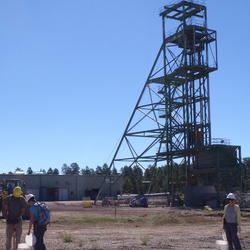
The public is concerned that uranium in natural geologic formations, mine tailings, dusts, water, and other geologic materials can pose a health hazard to humans and wildlife. Our specialized teams of hydrologists, chemists, and geologists working together at a field site in the Grand Canyon region of the United States have shown: Elevated uranium concentrations (above the drinking water standard)...
Is Uranium in Water Resources near the Grand Canyon a Health Hazard?

Is Uranium in Water Resources near the Grand Canyon a Health Hazard?

The public is concerned that uranium in natural geologic formations, mine tailings, dusts, water, and other geologic materials can pose a health hazard to humans and wildlife. Our specialized teams of hydrologists, chemists, and geologists working together at a field site in the Grand Canyon region of the United States have shown: Elevated uranium concentrations (above the drinking water standard)...
Learn More
Was this page helpful?