U.S. flag

An official website of the United States government

Images

Browse images from a wide range of science topics covered by USGS.

Filter Total Items: 985
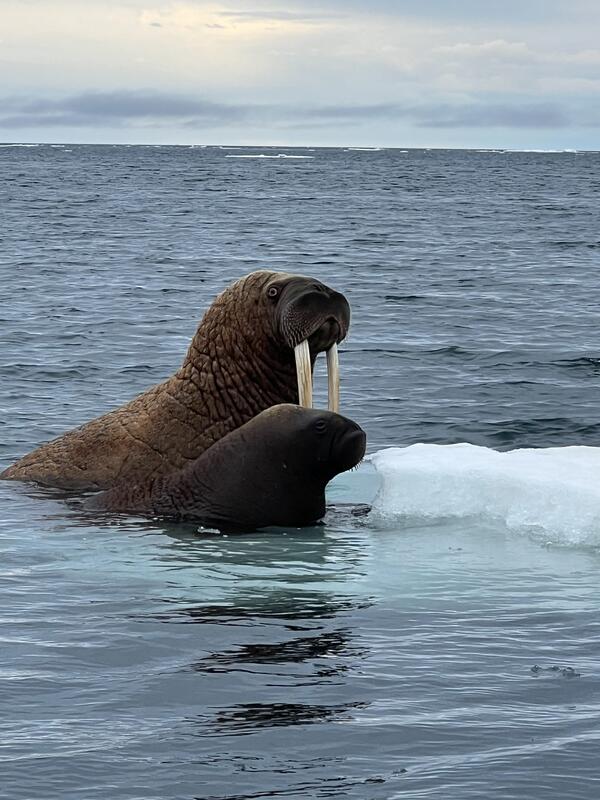
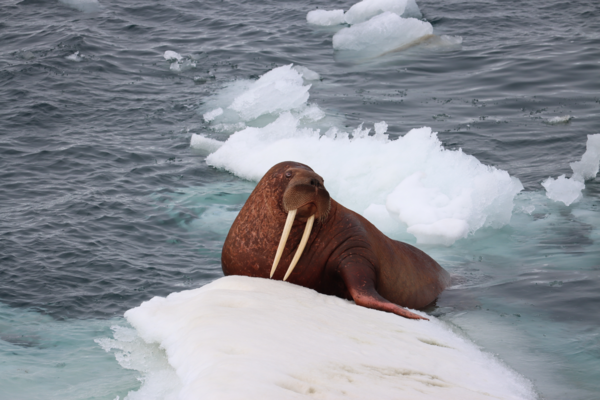
Walrus with large white tusks laying on ice flow.
Adult female Pacific walrus sliding into the water

An adult female Pacific walrus slides into the water as she assesses her surroundings.  The female is 15 years or older based on the length of the tusks.  USGS and the U.S.
An adult female Pacific walrus slides into the water as she assesses her surroundings.  The female is 15 years or older based on the length of the tusks.  USGS and the U.S.
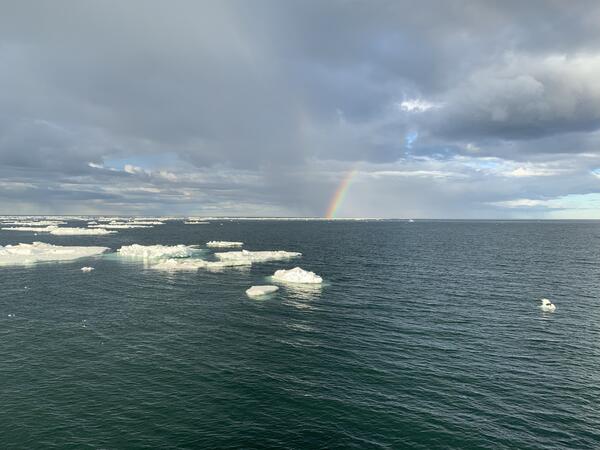
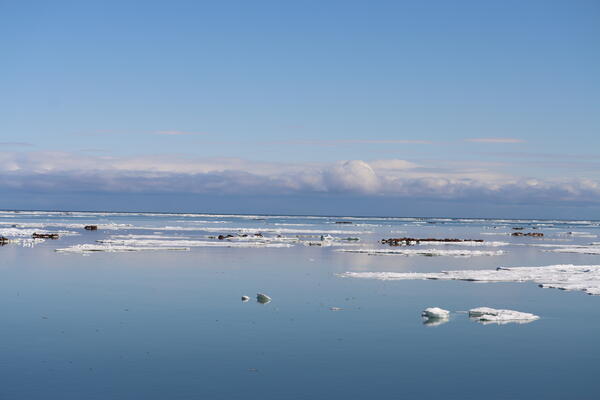
Walrus on ice flows with dark clouds in the background.
Walruses everywhere
Walruses everywhere
Walruses everywhere

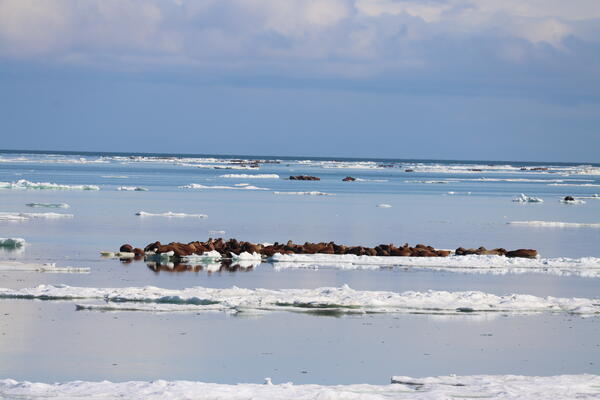
Walrus groups hauled on sea ice as far as the eye can see in the Chukchi Sea.  USGS and the U.S.

Walrus groups hauled on sea ice as far as the eye can see in the Chukchi Sea.  USGS and the U.S.

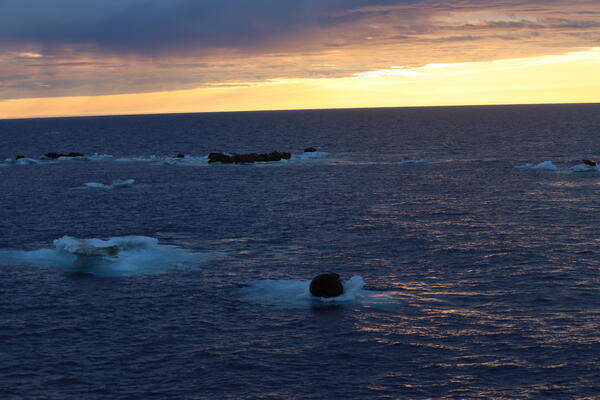
Walrus resting on sea ice and the sun rising in the background.
Arctic sunrise over resting walruses

A dim light shines during the summer Arctic morning in the Chukchi Sea as groups of Pacific walruses rest.  USGS and the U.S.

A dim light shines during the summer Arctic morning in the Chukchi Sea as groups of Pacific walruses rest.  USGS and the U.S.

Orange colored water flowing into the clear Kugaroruk River. Brown vegetation to the left of orange water. Mountains and sky.
An orange tributary mixing into the pristine Kugururok River

Orange streams are increasingly common in the Brooks Range of northern Alaska. The orange stream color reflects oxidized iron, but also often indicates elevated heavy metal concentrations. Our ongoing study aims to document these occurrences and the timing of their onset.

Orange streams are increasingly common in the Brooks Range of northern Alaska. The orange stream color reflects oxidized iron, but also often indicates elevated heavy metal concentrations. Our ongoing study aims to document these occurrences and the timing of their onset.

Close up of orange water in Kugururok River, Alaksa. Shrubs and mountains with blue sky.
Orange water from a tributary of the Kugururok River

Orange streams are increasingly common in the Brooks Range of northern Alaska. The orange stream color reflects oxidized iron, but also often indicates elevated heavy metal concentrations. Our ongoing study aims to document these occurrences and the timing of their onset.

Orange streams are increasingly common in the Brooks Range of northern Alaska. The orange stream color reflects oxidized iron, but also often indicates elevated heavy metal concentrations. Our ongoing study aims to document these occurrences and the timing of their onset.

Kugororuk River showing orange water on left side and clear water on right. Low shrubs with mountains and blue sky.
Limited mixing of orange water and the Kugururok River

Orange streams are increasingly common in the Brooks Range of northern Alaska. The orange stream color reflects oxidized iron, but also often indicates elevated heavy metal concentrations. Our ongoing study aims to document these occurrences and the timing of their onset.

Orange streams are increasingly common in the Brooks Range of northern Alaska. The orange stream color reflects oxidized iron, but also often indicates elevated heavy metal concentrations. Our ongoing study aims to document these occurrences and the timing of their onset.

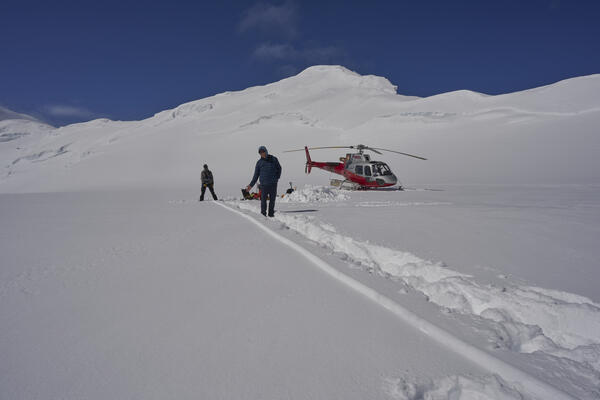
Two people standing in the snow next to a helicopter on top of a mountain.
Snow core to measure accumulation on Kahiltna Glacier

This is a 16 m (52.5-foot) core from Kahiltna Glacier at 3,055 m (10,023 feet), May 26, 2023. Kakiko Ramos-Leon (NPS, on the left) is standing where the core intersected the surface. Eric Ridington (pilot, in the middle) is pointing to the melt layers from summer 2022. The melt layers barely visible as grey stripes in the foreground are from summer 2021.

This is a 16 m (52.5-foot) core from Kahiltna Glacier at 3,055 m (10,023 feet), May 26, 2023. Kakiko Ramos-Leon (NPS, on the left) is standing where the core intersected the surface. Eric Ridington (pilot, in the middle) is pointing to the melt layers from summer 2022. The melt layers barely visible as grey stripes in the foreground are from summer 2021.

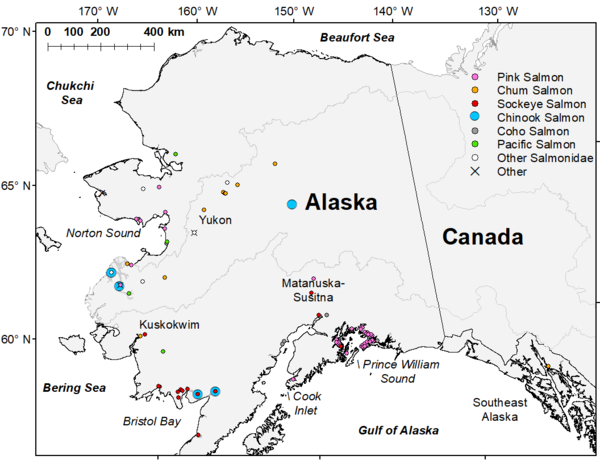
Map of Alaska with various colored round dots showing locations of Pacific salmon carcasses
Map showing the premature mortality observations of Pacific salmon carcasses in Alaska

Map showing the premature mortality observations of Pacific salmon carcasses in Alaska during summer and fall of 2019. Symbol color and shape denote Pacific Salmon species or alternative taxonomic groupings specified in the legend.

Map showing the premature mortality observations of Pacific salmon carcasses in Alaska during summer and fall of 2019. Symbol color and shape denote Pacific Salmon species or alternative taxonomic groupings specified in the legend.

Polar bear walking along Beaufort Sea coast with storm waves breaking behind it
Polar bear walking along Beaufort Sea coast

A polar bear walking along the Beaufort Sea coast with storm waves breaking behind it, filmed during fieldwork at Barter Island, Alaska.

Two scientists wade with an orange inflatable boat in shallow Alaskan wetland
Two scientists wade in shallow wetland in Izembek National Wildlife Refuge, Alaska

USGS research hydrologist Laura Hubbard and Memorial University of Newfoundland's Jordan Wight wade with an orange inflatable boat in shallow wetland as they filter for infectious avian influenza in Izembek National Wildlife Refuge, Alaska.

USGS research hydrologist Laura Hubbard and Memorial University of Newfoundland's Jordan Wight wade with an orange inflatable boat in shallow wetland as they filter for infectious avian influenza in Izembek National Wildlife Refuge, Alaska.

Researchers walk between hundreds of spawning sockeye salmon in shallow lake at Izembek National Wildlife Refuge, Alaska
Scientists walk between hundreds of spawning sockeye salmon in shallow lake at Izembek National Wildlife Refuge, Alaska

USGS Upper Midwest Water Science Center hydrologist Laura Hubbard (right, in yellow coat and PFD) and Jordan Wight (left, Memorial University of Newfoundland, Canada) walk between hundreds of spawning sockeye salmon in shallow lake at Izembek National Wildlife Refuge, Alaska as they filter water for avian influenza virus.

USGS Upper Midwest Water Science Center hydrologist Laura Hubbard (right, in yellow coat and PFD) and Jordan Wight (left, Memorial University of Newfoundland, Canada) walk between hundreds of spawning sockeye salmon in shallow lake at Izembek National Wildlife Refuge, Alaska as they filter water for avian influenza virus.

Scientists scout for brown bears on shore of Alaskan lake at Izembek National Wildlife Refuge, Alaska
Scientists scout for brown bears before starting infectious avian influenza water sampling in Izembek National Wildlife Refuge, Alaska
Scientist standing it hip deep water in Alaska lake with inflatable raft carrying water sampling equipment
Filtering wetland water to sample for infectious avian influenza in Izembek National Wildlife Refuge, Alaska.
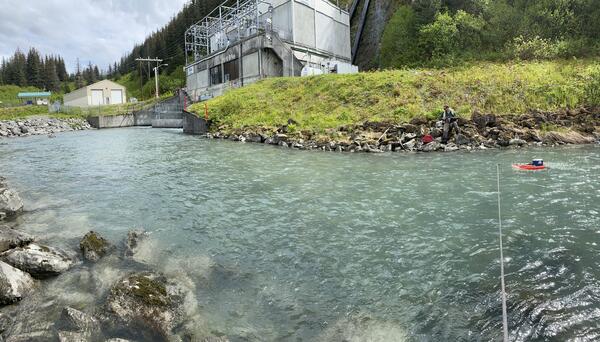
A red measuring device floating in a blue/green river.
Solomon Gulch
Solomon Gulch
Solomon Gulch

USGS staff measuring discharge at the Solomon Gulch Hydropower tailrace, Valdez Alaska.

USGS staff measuring discharge at the Solomon Gulch Hydropower tailrace, Valdez Alaska.

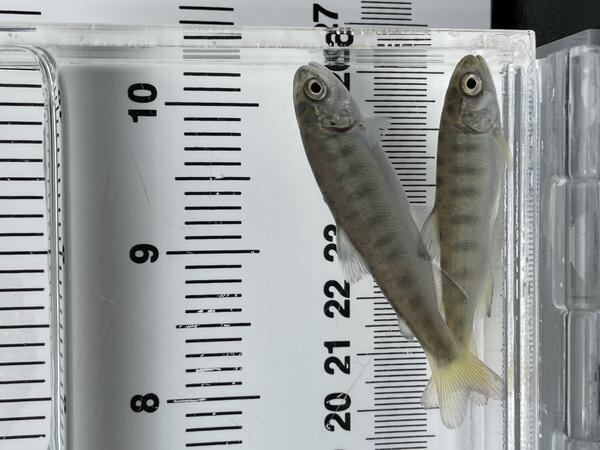
Two small light colored fish in a clear tank filled with water with a ruler behind the tank
Two juvenile coho salmon used in a heat stress experiment

Two juvenile coho salmon (Oncorhynchus kisutch) used in a heat stress experiment. Alaska Department of Fish and Game’s William Jack Hernandez Sport Fish Hatchery, Anchorage, Alaska, USA. 

Two juvenile coho salmon (Oncorhynchus kisutch) used in a heat stress experiment. Alaska Department of Fish and Game’s William Jack Hernandez Sport Fish Hatchery, Anchorage, Alaska, USA. 

Image shows an aerial view of rolling hills and rock formations
Western North Slope Foothills

The Kukpowruk River cuts through folded Cretaceous rocks in the central North Slope. These rocks were assessed by the USGS in 2017 and lie above the rocks assessed in the USGS 2021 Western North Slope assessment.

The Kukpowruk River cuts through folded Cretaceous rocks in the central North Slope. These rocks were assessed by the USGS in 2017 and lie above the rocks assessed in the USGS 2021 Western North Slope assessment.

Was this page helpful?