



Information Systems
How can I find U.S. Bureau of Mines publications?
Are USGS reports copyrighted?
What constitutes the United States? What are the official definitions?
The USGS has developed many tools and techniques for analyzing data and specialized websites for sharing information and products with the public.

What sources were used to create the Boundaries, Structures and Transportation layers in The National Map? What sources were used to create the Boundaries, Structures and Transportation layers in The National Map?
Boundaries: Primary sources include the U.S. Census Bureau, Bureau of Land Management (BLM), International Boundary Commission (IBC) for the Canadian boundary, and the International Boundary and Water Commission (IBWC) for the Mexican boundary. Boundaries include city, county, State, Federal lands, provinces, and territories; as well as cadastral data (where applicable), associated with Public...

What constitutes the United States? What are the official definitions? What constitutes the United States? What are the official definitions?
Geographically (and as a general reference), the United States of America includes all areas considered to be under the sovereignty of the United States, but does not include leased areas. On May 14, 1959, the U.S. Board on Geographic Names issued the following definitions, which defined the Continental United States as "the 49 States on the North American Continent and the District of Columbia...

How can I find U.S. Bureau of Mines publications? How can I find U.S. Bureau of Mines publications?
After 85 years of service, the U.S. Bureau of Mines (USBM) closed in 1996. Certain functions, such as the collection, analysis, and dissemination of minerals information, have been returned to the U.S. Geological Survey (USGS). For information on former USBM programs or publications, please see the following sources: Selected U.S. Bureau of Mines (USBM) Publications via ScienceBase Historical...

How quickly is earthquake information posted to the USGS website and sent out via the Earthquake Notification Service (ENS) and other feeds? How quickly is earthquake information posted to the USGS website and sent out via the Earthquake Notification Service (ENS) and other feeds?
USGS earthquake information mechanisms are all triggered by the same system, so they all receive the information at the same time. The time it takes for the system to receive the information primarily depends on the size and location of the earthquake: An earthquake in California is processed and posted to the system in 2.5 minutes (on average). This is because our seismic network is very...

Where can I see current or past seismograms? Where can I see current or past seismograms?
The USGS Earthquake Hazards Program has helicorders (seismogram displays) available for several areas in the United States and the World. Our research partner IRIS (Incorporated Research Institutions for Seismology) has two applications, the Station Monitor and the Global Seismogram Viewer, for viewing seismograms. IRIS also supplies software that allows users to collect and view seismic data from...

Did I feel an earthquake? Can I report feeling an earthquake? Did I feel an earthquake? Can I report feeling an earthquake?
Report an earthquake experience or related observation through the Did You Feel It? citizen science webpage. The best way to do this is to click on the earthquake that you think you felt on one of the lists on the Earthquakes webpage, and then select the "Tell Us!" link. If you don't see the earthquake you think you felt, use the green "Report an Unknown Event" button on our Did You Feel It? page...
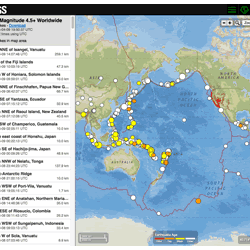
Where can I find current earthquake lists and maps for the world or for a specific area? Where can I find current earthquake lists and maps for the world or for a specific area?
The Earthquake Hazards Program Latest Earthquakes Map displays earthquakes in near-realtime and up to the past 30 days of earthquakes. The interface includes three panels: a list of earthquakes, a map, and a settings/options panel. You can pan and zoom the map to view specific areas. Click on an event on the list or map for additional information and a link to the event page with all the details...

Are there geologic maps or publications for where I live? Are there geologic maps or publications for where I live?
Detailed geologic mapping has not been completed for the entire United States, but maps are available for most locations. Geologic maps at many scales and from many sources are listed in the National Geologic Map Database. Some geologic maps can be purchased in hard copy through the USGS Store. Download digital geologic maps for entire states from the USGS Mineral Resources Online Geospatial Data...

How can I find USGS historical photographs? How can I find USGS historical photographs?
The USGS Photographic Library, located at our library in Denver, Colorado , is an archive of still photographs dating from the 1870s and taken by USGS scientists as part of their field studies. The works of pioneer photographers W.H. Jackson, T.H. O’Sullivan, Carleton Watkins, J.K. Hillers, Thomas Moran, A.J. Russell, E.O. Beaman, and William Bell are represented in the collection. Topics include...

Are USGS reports/publications copyrighted? Are USGS reports/publications copyrighted?
USGS-authored or produced data and information are considered to be in the U.S. public domain and can be freely used without permission. All we ask is that you acknowledge the USGS as the source. While the content of most USGS webpages is in the U.S. public domain, not all information, illustrations, or photographs on our site are. Some non-USGS photographs, images, and/or graphics that appear on...

Is there a way to get alerts about streamflow conditions? Is there a way to get alerts about streamflow conditions?
Yes! The U.S. Geological Survey WaterAlert service provides notifications to your email or phone for changes in water conditions based on thresholds you choose.

How can I obtain river forecasts (flood forecasts)? How can I obtain river forecasts (flood forecasts)?
River forecasts (flood forecasts) are made by the National Weather Service - National Water Prediction Service. The overall map on the website uses color designations to give a quick overview of current conditions. A legend and other information can be selected in the right column. From the main map, click on a station to bring up a box which includes a graph showing current information and a...