



Craig A Stricker, PhD
Craig Stricker is an ecologist at the Fort Collins Science Center that specializes in the application of chemical and isotopic tracers for addressing societally relevant questions related to ecosystem ecology. His research interests are focused on biogeochemistry, food webs, and animal resource allocation and movement.
Geology, Geophysics, and Geochemistry Stable Isotope Laboratory (GSIL)
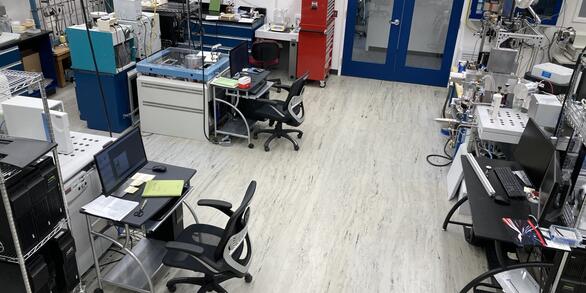
The GSIL is a state-of-the-art facility located on the Denver Federal Center that specializes in the measurement of light stable isotope — Hydrogen (H), Carbon (C), Nitrogen (N), Oxygen (O), and Sulfur (S) — compositions and other chemical and biomarker analytes in matrices relevant to the Earth sciences.
Research Highlights
- Continental-scale nutrient and contaminant delivery by Pacific salmon
- Diet and macronutrient assimilation in an Arctic predator
- Animal tracing with sulfur isotopes
- Effects of protein overconsumption limit dietary adaptation in an apex predator
- Carbon chemistry of peatlands in the southeastern USA
- Design, development, and implementation of IsoBank
- Diet energy density associated with survival, habitat, and population dynamics
As an ecologist at the Fort Collins Science Center, Craig Stricker’s research program focuses on an improved understanding of the roles of hydrology, biogeochemistry, and food web interactions on ecosystem structure and function with the goal of assisting land managers. His expertise in chemical and isotopic tracers offers novel insights in ecosystem ecology and has benefitted multidisciplinary collaborations across a variety of state, federal, and academic institutions. Tracer-based approaches to studying wildlife and ecosystems is a capability unique to Stricker’s research and the Fort Collins Science Center with examples ranging from wildlife nutrition, trophic dynamics, impacts of invasive species, animal movements and phenology, biogeochemistry, and environmental stressors such as fire and drought. The spatial domain of his work ranges from discrete habitats, regional assessments, to continental and oceanic basins, with studies from the sub-tropics to the high Arctic. Results of these projects inform on species life history and fitness to ecosystem health and function, but also offer frameworks for monitoring programs, model development, restoration, and risk assessment.
Professional Experience
2009 - Present, Research Biologist, US Geological Survey, Fort Collins Science Center
2005 - 2008, Research Biologist, US Geological Survey, Geologic Division - Crustal, Geology, and Geochemistry
2002 - 2004, Mendenhall Postdoctoral Fellow, US Geological Survey, Geologic Division - Crustal, Geology, and Geochemistry
Education and Certifications
PhD in Limnology, Michigan State University, 2003
MS in Aquatic Ecology, Central Michigan University, 1997
BS in Biology, Central Michigan University, 1994
Science and Products
Laboratory analyses for fish tissue samples from Lake Koocanusa and Kootenai River Basin, Montana, 2022 (ver. 2.0, May 2025) Laboratory analyses for fish tissue samples from Lake Koocanusa and Kootenai River Basin, Montana, 2022 (ver. 2.0, May 2025)
Silicified wood from around Old Faithful Geyser, Yellowstone National Park Silicified wood from around Old Faithful Geyser, Yellowstone National Park
Modeled Pacific salmon escapement biomass and nutrient and contaminant concentrations across western North America, 1976-2015 (version 2.0, October 2024) Modeled Pacific salmon escapement biomass and nutrient and contaminant concentrations across western North America, 1976-2015 (version 2.0, October 2024)
Total mercury, methylmercury, and isotopic composition in various life stages of boreal chorus frogs (Pseudacris maculata) at two subalpine ponds in the Rocky Mountains, CO, USA, 2015 Total mercury, methylmercury, and isotopic composition in various life stages of boreal chorus frogs (Pseudacris maculata) at two subalpine ponds in the Rocky Mountains, CO, USA, 2015
Mercury concentrations, isotopic composition, biomass, and taxonomy of stream and riparian organisms in the vicinity of Yellow Pine, Idaho, 2015-2016. Mercury concentrations, isotopic composition, biomass, and taxonomy of stream and riparian organisms in the vicinity of Yellow Pine, Idaho, 2015-2016.
Dataset for temporal influences on selenium partitioning, trophic transfer, and exposure in a major U.S. river Dataset for temporal influences on selenium partitioning, trophic transfer, and exposure in a major U.S. river
Geographic distribution of feather δ34S in Europe Geographic distribution of feather δ34S in Europe
Complex life histories alter patterns of mercury exposure and accumulation in a pond-breeding amphibian Complex life histories alter patterns of mercury exposure and accumulation in a pond-breeding amphibian
Animal tracing with sulfur isotopes: Spatial segregation and climate variability in Africa likely contribute to population trends of a migratory songbird Animal tracing with sulfur isotopes: Spatial segregation and climate variability in Africa likely contribute to population trends of a migratory songbird
Diet energy density estimated from isotopes in predator hair associated with survival, habitat, and population dynamics Diet energy density estimated from isotopes in predator hair associated with survival, habitat, and population dynamics
Summer/fall diet and macronutrient assimilation in an Arctic predator Summer/fall diet and macronutrient assimilation in an Arctic predator
Increased mercury and reduced insect diversity in linked stream-riparian food webs downstream of a historical mercury mine Increased mercury and reduced insect diversity in linked stream-riparian food webs downstream of a historical mercury mine
Non-USGS Publications**
**Disclaimer: The views expressed in Non-USGS publications are those of the author and do not represent the views of the USGS, Department of the Interior, or the U.S. Government.
Science and Products
Laboratory analyses for fish tissue samples from Lake Koocanusa and Kootenai River Basin, Montana, 2022 (ver. 2.0, May 2025) Laboratory analyses for fish tissue samples from Lake Koocanusa and Kootenai River Basin, Montana, 2022 (ver. 2.0, May 2025)
Silicified wood from around Old Faithful Geyser, Yellowstone National Park Silicified wood from around Old Faithful Geyser, Yellowstone National Park
Modeled Pacific salmon escapement biomass and nutrient and contaminant concentrations across western North America, 1976-2015 (version 2.0, October 2024) Modeled Pacific salmon escapement biomass and nutrient and contaminant concentrations across western North America, 1976-2015 (version 2.0, October 2024)
Total mercury, methylmercury, and isotopic composition in various life stages of boreal chorus frogs (Pseudacris maculata) at two subalpine ponds in the Rocky Mountains, CO, USA, 2015 Total mercury, methylmercury, and isotopic composition in various life stages of boreal chorus frogs (Pseudacris maculata) at two subalpine ponds in the Rocky Mountains, CO, USA, 2015
Mercury concentrations, isotopic composition, biomass, and taxonomy of stream and riparian organisms in the vicinity of Yellow Pine, Idaho, 2015-2016. Mercury concentrations, isotopic composition, biomass, and taxonomy of stream and riparian organisms in the vicinity of Yellow Pine, Idaho, 2015-2016.
Dataset for temporal influences on selenium partitioning, trophic transfer, and exposure in a major U.S. river Dataset for temporal influences on selenium partitioning, trophic transfer, and exposure in a major U.S. river
Geographic distribution of feather δ34S in Europe Geographic distribution of feather δ34S in Europe
Complex life histories alter patterns of mercury exposure and accumulation in a pond-breeding amphibian Complex life histories alter patterns of mercury exposure and accumulation in a pond-breeding amphibian
Animal tracing with sulfur isotopes: Spatial segregation and climate variability in Africa likely contribute to population trends of a migratory songbird Animal tracing with sulfur isotopes: Spatial segregation and climate variability in Africa likely contribute to population trends of a migratory songbird
Diet energy density estimated from isotopes in predator hair associated with survival, habitat, and population dynamics Diet energy density estimated from isotopes in predator hair associated with survival, habitat, and population dynamics
Summer/fall diet and macronutrient assimilation in an Arctic predator Summer/fall diet and macronutrient assimilation in an Arctic predator
Increased mercury and reduced insect diversity in linked stream-riparian food webs downstream of a historical mercury mine Increased mercury and reduced insect diversity in linked stream-riparian food webs downstream of a historical mercury mine
Non-USGS Publications**
**Disclaimer: The views expressed in Non-USGS publications are those of the author and do not represent the views of the USGS, Department of the Interior, or the U.S. Government.