Niky C Taylor
Niky researches marine and aquatic systems using remote sensing and leads communication projects for USGS and the Department of the Interior.
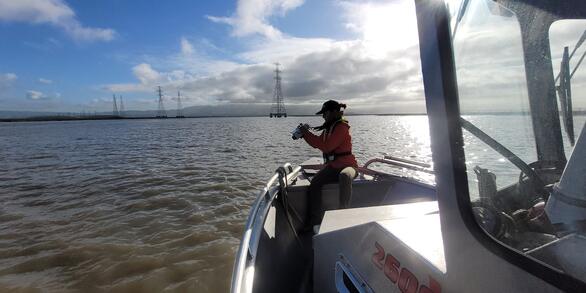
Niky is an ocean scientist by training, with a background in multi- and hyperspectral remote sensing of coastal and estuarine systems. Her research incorporates remote sensing and radiometric measurements of water and land at multiple scales, encompassing everything from ship-based radiometry to airborne and satellite data processing. Niky’s work is largely focused on creating data products that help inform on ecosystem condition and water quality.
Niky also works on science communication, outreach, and education. She currently serves as the lead editor for the Department of the Interior Remote Sensing Activities report supported by the National Land Imaging Program. Niky has also created educational materials on aquatic remote sensing and other topics for USGS, and has taught a variety of introductory oceanography and climate courses.
Professional Experience
Oceanography Instructor - West Valley Community College
Research Mentor - NASA Student Airborne Research Program
Research Assistant - University of New Mexico Institute of Meteoritics
Education and Certifications
MS Ocean Science - UC Santa Cruz - 2021
BS Environmental Science - University of New Mexico - 2017
Science and Products
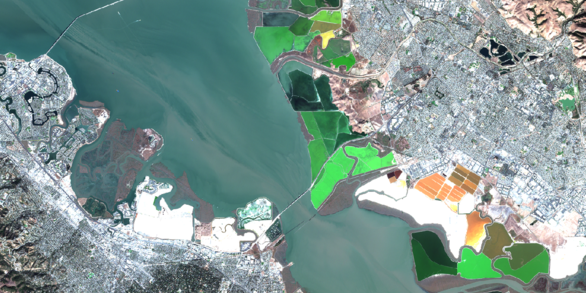
Remote Sensing of Mercury Pollution in South San Francisco Bay
Intertidal biofilm remote sensing paired spectra-biofilm training and validation data, South San Francisco Bay Intertidal biofilm remote sensing paired spectra-biofilm training and validation data, South San Francisco Bay
Intertidal biofilm presence, quantity, nutritional quality, and composition maps derived from AVIRIS-Next Generation 3.7-meter airborne imagery, South San Francisco Bay, California Intertidal biofilm presence, quantity, nutritional quality, and composition maps derived from AVIRIS-Next Generation 3.7-meter airborne imagery, South San Francisco Bay, California
Biofilm Percent Cover Maps in San Francisco Bay, 2020-2022 Biofilm Percent Cover Maps in San Francisco Bay, 2020-2022
Multi-scale spectroscopy to map intertidal microbial biofilm community and trait diversity Multi-scale spectroscopy to map intertidal microbial biofilm community and trait diversity
Unlocking ecological insights from sub-seasonal visible-to-shortwave infrared imaging spectroscopy: The SHIFT campaign Unlocking ecological insights from sub-seasonal visible-to-shortwave infrared imaging spectroscopy: The SHIFT campaign
Variation in leaf reflectance spectra across the California flora partitioned by evolutionary history, geographic origin, and deep time Variation in leaf reflectance spectra across the California flora partitioned by evolutionary history, geographic origin, and deep time
Non-USGS Publications**
**Disclaimer: The views expressed in Non-USGS publications are those of the author and do not represent the views of the USGS, Department of the Interior, or the U.S. Government.
Science and Products
Remote Sensing of Mercury Pollution in South San Francisco Bay
Intertidal biofilm remote sensing paired spectra-biofilm training and validation data, South San Francisco Bay Intertidal biofilm remote sensing paired spectra-biofilm training and validation data, South San Francisco Bay
Intertidal biofilm presence, quantity, nutritional quality, and composition maps derived from AVIRIS-Next Generation 3.7-meter airborne imagery, South San Francisco Bay, California Intertidal biofilm presence, quantity, nutritional quality, and composition maps derived from AVIRIS-Next Generation 3.7-meter airborne imagery, South San Francisco Bay, California
Biofilm Percent Cover Maps in San Francisco Bay, 2020-2022 Biofilm Percent Cover Maps in San Francisco Bay, 2020-2022
Multi-scale spectroscopy to map intertidal microbial biofilm community and trait diversity Multi-scale spectroscopy to map intertidal microbial biofilm community and trait diversity
Unlocking ecological insights from sub-seasonal visible-to-shortwave infrared imaging spectroscopy: The SHIFT campaign Unlocking ecological insights from sub-seasonal visible-to-shortwave infrared imaging spectroscopy: The SHIFT campaign
Variation in leaf reflectance spectra across the California flora partitioned by evolutionary history, geographic origin, and deep time Variation in leaf reflectance spectra across the California flora partitioned by evolutionary history, geographic origin, and deep time
Non-USGS Publications**
**Disclaimer: The views expressed in Non-USGS publications are those of the author and do not represent the views of the USGS, Department of the Interior, or the U.S. Government.