
Vicki S. Blazer, PhD
Vicki startted with the National Fish Health Research Laboratory, Leetown Science Center (now the Eastern Ecological Science Center - Leetown Research Laboratory), Kearneysville, WV in1992. She was previously employed as the Assistant Leader of the Georgia Cooperative Fish and Wildlife Research Unit. She was also on the graduate faculty in the School of Forest Resources, University of Georgia.
She is active in numerous research projects within the Northeast as well as nationally and internationally. She is active in the American Fisheries Society Fish Health Section and a member of other scientific societies. She is an adjunct faculty member at West Virginia University and Penn State and serves on graduate student committees. Research areas include development of microscopic and molecular markers for understanding changes in the health and populations of wild fishes. Areas of focus include endocrine disruption, emerging diseases, fish tumor pathology and assessment at Great Lakes Areas of Concern, land use influences on fish health, reproduction and immunomodulation.
Professional Experience
Postdoctoral Research Associate, College of Veterinary Medicine, University of Georgia
Assistant Leader, Georgia Cooperative Fish and Wildlife Research Unit, School of Forest Resources, University of Georgia
Research Fishery Biologist, Leetown Science Center
Education and Certifications
B.S. in Marine Science and Biology Southampton College, Long Island University.
PhD in Fisheries, Aquaculture and Pathology, Rhode Island University
Affiliations and Memberships*
Adjunct Professor, West Virginia University
Adjunct Professor, Penn State University
Science and Products
New Virus Identified in Melanistic Skin Lesions on Smallmouth Bass from the Chesapeake Bay Watershed
Land-use influences on estrogenic-endocrine disruption in fish within the Chesapeake Bay watershed
Prevalence of Malignant Melanoma in Brown Bullhead from Lake Memphremagog Greater than Expected—Linkages to Contaminant Exposure and Implications for Fish Population Health are Currently Unknown
Point and Non-Point Sources of Endocrine Disrupting Compounds and the Potential Effects on Fish and Frogs in the New Jersey Pinelands
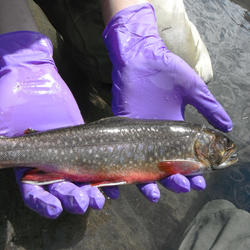
Fishing, Hunting and Subsistence Living Integrated Science Team
Point and Nonpoint Sources of Endocrine Disrupting Compounds and the Potential effects on Fish and Frogs in the New Jersey Pinelands
Immune Function of Wild Smallmouth Bass Collected from Sites within the Chesapeake Bay Watershed, 2016-2021 Immune Function of Wild Smallmouth Bass Collected from Sites within the Chesapeake Bay Watershed, 2016-2021
Water Chemistry and Smallmouth Bass Biological Data From the Potomac River, Dargan, Maryland, 2013-2019 Water Chemistry and Smallmouth Bass Biological Data From the Potomac River, Dargan, Maryland, 2013-2019
Organic and inorganic constituents in surface water and native and non-native fish and frog health data collected from streams, impoundments and wetlands in the New Jersey Pinelands, 2017-2020 (ver. 1.1, August 2022) Organic and inorganic constituents in surface water and native and non-native fish and frog health data collected from streams, impoundments and wetlands in the New Jersey Pinelands, 2017-2020 (ver. 1.1, August 2022)
Data supporting: Draft Genome Sequence of a Novel Calicivirus from a Brown Bullhead (Ameiurus nebulosus) from Lake Memphremagog, VT Data supporting: Draft Genome Sequence of a Novel Calicivirus from a Brown Bullhead (Ameiurus nebulosus) from Lake Memphremagog, VT
Morphometric, Age, Visible Abnormalities, Skin and Liver Neoplasms, and Stable Isotopes in White Sucker Collected in the St. Louis River and Estuary, Minnesota/Wisconsin, 2011-2015 Morphometric, Age, Visible Abnormalities, Skin and Liver Neoplasms, and Stable Isotopes in White Sucker Collected in the St. Louis River and Estuary, Minnesota/Wisconsin, 2011-2015
Morphometric, Age and Concentrations of Perfluoroalkyl Substances in Smallmouth Bass Plasma from Four Sites in the Chesapeake Bay Watershed Morphometric, Age and Concentrations of Perfluoroalkyl Substances in Smallmouth Bass Plasma from Four Sites in the Chesapeake Bay Watershed
Novel adomaviruses associated with blotchy bass syndrome in black basses (Micropterus spp.) Novel adomaviruses associated with blotchy bass syndrome in black basses (Micropterus spp.)
Fishy factors: Recognizing biological variation and its implications for fish immuno(eco)toxicology research Fishy factors: Recognizing biological variation and its implications for fish immuno(eco)toxicology research
Tissue distribution and temporal and spatial assessment of per- and polyfluoroalkyl substances (PFAS) in smallmouth bass (Micropterus dolomieu) in the mid-Atlantic United States Tissue distribution and temporal and spatial assessment of per- and polyfluoroalkyl substances (PFAS) in smallmouth bass (Micropterus dolomieu) in the mid-Atlantic United States
Factors influencing the prevalence of hyperpigmented melanistic lesions in smallmouth bass Micropterus dolomieu in the Susquehanna River Basin, Pennsylvania Factors influencing the prevalence of hyperpigmented melanistic lesions in smallmouth bass Micropterus dolomieu in the Susquehanna River Basin, Pennsylvania
Temporal analysis of water chemistry and smallmouth bass (Micropterus dolomieu) health at two sites with divergent land use in the Susquehanna River watershed, Pennsylvania, USA Temporal analysis of water chemistry and smallmouth bass (Micropterus dolomieu) health at two sites with divergent land use in the Susquehanna River watershed, Pennsylvania, USA
Integrated science for the study of microplastics in the environment—A strategic science vision for the U.S. Geological Survey Integrated science for the study of microplastics in the environment—A strategic science vision for the U.S. Geological Survey
Science and Products
New Virus Identified in Melanistic Skin Lesions on Smallmouth Bass from the Chesapeake Bay Watershed
Land-use influences on estrogenic-endocrine disruption in fish within the Chesapeake Bay watershed
Prevalence of Malignant Melanoma in Brown Bullhead from Lake Memphremagog Greater than Expected—Linkages to Contaminant Exposure and Implications for Fish Population Health are Currently Unknown
Point and Non-Point Sources of Endocrine Disrupting Compounds and the Potential Effects on Fish and Frogs in the New Jersey Pinelands
Fishing, Hunting and Subsistence Living Integrated Science Team
Point and Nonpoint Sources of Endocrine Disrupting Compounds and the Potential effects on Fish and Frogs in the New Jersey Pinelands
Immune Function of Wild Smallmouth Bass Collected from Sites within the Chesapeake Bay Watershed, 2016-2021 Immune Function of Wild Smallmouth Bass Collected from Sites within the Chesapeake Bay Watershed, 2016-2021
Water Chemistry and Smallmouth Bass Biological Data From the Potomac River, Dargan, Maryland, 2013-2019 Water Chemistry and Smallmouth Bass Biological Data From the Potomac River, Dargan, Maryland, 2013-2019
Organic and inorganic constituents in surface water and native and non-native fish and frog health data collected from streams, impoundments and wetlands in the New Jersey Pinelands, 2017-2020 (ver. 1.1, August 2022) Organic and inorganic constituents in surface water and native and non-native fish and frog health data collected from streams, impoundments and wetlands in the New Jersey Pinelands, 2017-2020 (ver. 1.1, August 2022)
Data supporting: Draft Genome Sequence of a Novel Calicivirus from a Brown Bullhead (Ameiurus nebulosus) from Lake Memphremagog, VT Data supporting: Draft Genome Sequence of a Novel Calicivirus from a Brown Bullhead (Ameiurus nebulosus) from Lake Memphremagog, VT
Morphometric, Age, Visible Abnormalities, Skin and Liver Neoplasms, and Stable Isotopes in White Sucker Collected in the St. Louis River and Estuary, Minnesota/Wisconsin, 2011-2015 Morphometric, Age, Visible Abnormalities, Skin and Liver Neoplasms, and Stable Isotopes in White Sucker Collected in the St. Louis River and Estuary, Minnesota/Wisconsin, 2011-2015
Morphometric, Age and Concentrations of Perfluoroalkyl Substances in Smallmouth Bass Plasma from Four Sites in the Chesapeake Bay Watershed Morphometric, Age and Concentrations of Perfluoroalkyl Substances in Smallmouth Bass Plasma from Four Sites in the Chesapeake Bay Watershed
Novel adomaviruses associated with blotchy bass syndrome in black basses (Micropterus spp.) Novel adomaviruses associated with blotchy bass syndrome in black basses (Micropterus spp.)
Fishy factors: Recognizing biological variation and its implications for fish immuno(eco)toxicology research Fishy factors: Recognizing biological variation and its implications for fish immuno(eco)toxicology research
Tissue distribution and temporal and spatial assessment of per- and polyfluoroalkyl substances (PFAS) in smallmouth bass (Micropterus dolomieu) in the mid-Atlantic United States Tissue distribution and temporal and spatial assessment of per- and polyfluoroalkyl substances (PFAS) in smallmouth bass (Micropterus dolomieu) in the mid-Atlantic United States
Factors influencing the prevalence of hyperpigmented melanistic lesions in smallmouth bass Micropterus dolomieu in the Susquehanna River Basin, Pennsylvania Factors influencing the prevalence of hyperpigmented melanistic lesions in smallmouth bass Micropterus dolomieu in the Susquehanna River Basin, Pennsylvania
Temporal analysis of water chemistry and smallmouth bass (Micropterus dolomieu) health at two sites with divergent land use in the Susquehanna River watershed, Pennsylvania, USA Temporal analysis of water chemistry and smallmouth bass (Micropterus dolomieu) health at two sites with divergent land use in the Susquehanna River watershed, Pennsylvania, USA
Integrated science for the study of microplastics in the environment—A strategic science vision for the U.S. Geological Survey Integrated science for the study of microplastics in the environment—A strategic science vision for the U.S. Geological Survey
*Disclaimer: Listing outside positions with professional scientific organizations on this Staff Profile are for informational purposes only and do not constitute an endorsement of those professional scientific organizations or their activities by the USGS, Department of the Interior, or U.S. Government