



The Next Generation Water Observing Program (NGWOS) supports the advancement of water resources observations in order to assess water availability, management, and prediction across the US’s major hydrologic regions.
Victor S Cortes, II
Victor Cortes is a Physical Scientist with the Pennsylvania Water Science Center.
Victor is a Physical Scientist in the Flood Response and Field Innovation Unit (FRU/FIU) of the Pennsylvania Water Science. Recent work includes testing novel field instrumentation, developing a network of rapid deployment flood sensors in Pennsylvania, statistical hydrology and trend analysis within the Delaware River Basin, and topographic surveying for geomorphology projects. Before joining the FIU/FRU and the Hydrologic Investigations section, Victor was a member of the Hydrologic Networks section and maintained a field trip of streamgages with water quality.
Victor is broadly interested in spatial analysis at various scales, advanced topographic surveying techniques, flood science, non-contact and remote sensed streamflow measurement, and testing of emerging technologies in water science.
Science and Products

Pennsylvania Surface-Water Quality Monitoring Network
Pennsylvania’s Statewide Surface-Water Quality Monitoring Network (WQN) currently consists of 124 sites that are sampled between 6 and 20 times a year. Chemical analysis includes nutrient, major ions, and selected metals. Pesticide sampling is conducted twice a year at 5 locations. Biological sampling for benthic macroinvertebrates is conducted annually at 80 sites. The WQN was established to...

Developing a Flood Monitoring Network in Pennsylvania
USGS, in cooperation with the Federal Emergency Management Agency (FEMA) Region 3 and the Pennsylvania Department of Transportation (PennDOT), has developed a flood monitoring network to measure stream level elevations at currently unmonitored locations in Pennsylvania during flooding. These data help emergency response agencies protect life and property during forecasted floods and inform flood...
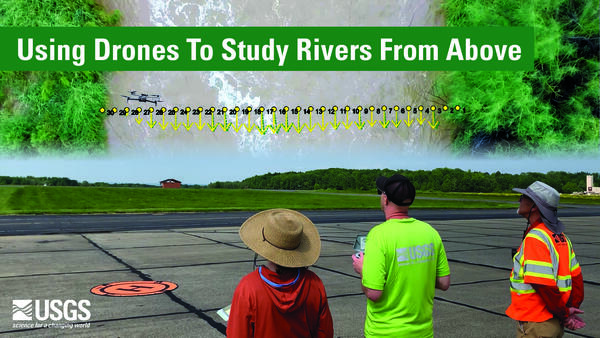
Using Drones To Study Rivers From Above
The Next Generation Water Observing Program (NGWOS) supports the advancement of water resources observations in order to assess water availability, management, and prediction across the US’s major hydrologic regions.
Science and Products
Pennsylvania Surface-Water Quality Monitoring Network
Pennsylvania’s Statewide Surface-Water Quality Monitoring Network (WQN) currently consists of 124 sites that are sampled between 6 and 20 times a year. Chemical analysis includes nutrient, major ions, and selected metals. Pesticide sampling is conducted twice a year at 5 locations. Biological sampling for benthic macroinvertebrates is conducted annually at 80 sites. The WQN was established to...
Developing a Flood Monitoring Network in Pennsylvania
USGS, in cooperation with the Federal Emergency Management Agency (FEMA) Region 3 and the Pennsylvania Department of Transportation (PennDOT), has developed a flood monitoring network to measure stream level elevations at currently unmonitored locations in Pennsylvania during flooding. These data help emergency response agencies protect life and property during forecasted floods and inform flood...
Using Drones To Study Rivers From Above
The Next Generation Water Observing Program (NGWOS) supports the advancement of water resources observations in order to assess water availability, management, and prediction across the US’s major hydrologic regions.
The Next Generation Water Observing Program (NGWOS) supports the advancement of water resources observations in order to assess water availability, management, and prediction across the US’s major hydrologic regions.