
Wesley Daniel, Ph.D.
Wesley Daniel is a Fishery Biologist at the USGS Wetland and Aquatic Research Center, and leads the USGS Nonindigenous Aquatic Species Database.
Science and Products
Filter Total Items: 24
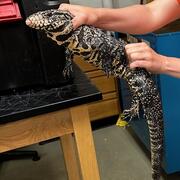
Early detection and rapid response tools for invasive tegu lizards
Scientists at USGS have shown that much of the US is suitable for invasion by tegu lizards, and suitability will likely increase in the future. While tegus can be removed via trapping, it is difficult to monitor every geographic area where tegus could invade. Thus, methods for quickly detecting and removing tegus in new areas are the best way to prevent spread and minimize damage from these...
Developing a Process for Listing Injurious Wildlife Species
This project will develop a transparent process for prioritizing species for listing as injurious, likely to cause damage or harm, under the Lacey Act. Building upon previously developed "horizon scan" and "watchlist" products, this process will identify potentially invasive species that present the greatest risk to lands, waters, and other assets managed by the U.S. Department of the Interior.
Using Multiple Indicators to Assess Stream Condition in the Chesapeake Bay
USGS is working with federal, state and local partners to develop multiple assessments of stream and river conditions in non-tidal areas of the Chesapeake Bay watershed. These assessments will help managers preserve stream health and improve biological conditions in impaired streams as the human population and climate continue to change in this region.
Assessing Risk Communication in the Pet and Aquarium Trade: An Analysis of Outreach and Engagement Efforts
WARC researchers evaluated whether outreach campaigns targeting pet owners are effectively reaching their desired audiences, namely pet owners who might unintentionally or purposefully release their pet into the wild.
Future Aquatic Invaders of the Northeast U.S.: How Climate Change, Human Vectors, and Natural History Could Bring Southern and Western Species North
Researchers will evaluate the potential of aquatic species to invade the Northeast U.S. Following the identification of appropriate target species by regional stakeholders, researchers will gather data from the NAS database and develop models to determine habitat suitability for each species.
Integration of Environmental DNA (eDNA) Data into the USGS Nonindigenous Aquatic Species Database
USGS and Department of the Interior partners have added a new, advanced capability to the early detection and rapid response tool set – the integration of environmental DNA and sighting data in the USGS Nonindigenous Aquatic Species database.
Filter Total Items: 25
Composite relative risk indices for dreissenid mussel introductions in the Missouri River Basin: scripts and output Composite relative risk indices for dreissenid mussel introductions in the Missouri River Basin: scripts and output
This data product develops a composite relative risk index (CRR) for watersheds within the Missouri River Basin, a region in the U.S. on the front line of dreissenid spread. The CRR is developed using datasets in order to account for the direct and indirect damages from a potential infestation along with the risk of an infestation occurring with a HUC10 watershed. Included are indices...
Horizon Scan for Vertebrates in Trade Horizon Scan for Vertebrates in Trade
This is a dataset summarizing filtering criteria and rapid risk assessments for ~25,000 species undertaken during a data-driven horizon scan of imported fish, amphibians, reptiles, birds, and mammals. The files represented in this dataset are the following: 1) 'species_filtering_metadata_table.xlsx' is the tabular summary of all intake list species names and the reason for inclusion...
Data release: Flood and Storm Tracker (FaST) data Data release: Flood and Storm Tracker (FaST) data
This product summarizes data used in the analysis portion of our Flood and Storm Tracker (FaST) manuscript (see larger work citation). The dataset titled HUCsppMatrices2012-2022.csv has each Hydraulic Unit Code (HUC) with an introduced taxon in each storm and the HUC it connected to by flood waters (lateral or longitudinal). The dataset titled ConnectionPoints_2012-2022.csv has each...
Risk assessments of animal species, plant species, and disease in the United States available online between 1990 and 2023 Risk assessments of animal species, plant species, and disease in the United States available online between 1990 and 2023
Risk assessments describe the risk of a species’ invasion in a location, and many risk assessments have been produced by different institutions for various reasons. However, information is sporadically located online, increasing the difficulty of developing comprehensive lists of species with risk assessments or comparing assessment results across species in locations of interest...
Assessing risk communication in the pet and aquarium trade Assessing risk communication in the pet and aquarium trade
This product summarizes data for the web engine search analysis and the outreach materials analysis from our report entitled, Assessing Risk Communication in the Pet and Aquarium Trade: An Analysis of Outreach and Engagement Efforts. The web engine search data include internet search results from Google and Bing. Materials analysis data include a matrix of questions that were used to...
Boat ramp locations in the United States of America Boat ramp locations in the United States of America
The dataset provides point locations of many boat ramp locations in the United States accessible to the public.
Filter Total Items: 39
Invasive hitchhiking organisms on aquarium plants: An emerging pathway of introduction Invasive hitchhiking organisms on aquarium plants: An emerging pathway of introduction
The aquarium trade is a global industry responsible for the movement of live plants and animals, but it also serves as a major pathway for the introduction and spread of aquatic invasive species. Invasive species contribute to biodiversity loss, disrupt ecosystems, and can have widespread economic and societal impacts. A significant but poorly understood invasion risk in the plant...
Authors
Kathryn O'Shaughnessy, Wesley Daniel, Zoey Hendrickson, Samantha N. Smith, Ashley McDonald, Charles Martin
Invasive species in the aquarium trade: Survey of attitudes, behaviors, and knowledge among US participants Invasive species in the aquarium trade: Survey of attitudes, behaviors, and knowledge among US participants
Although the aquarium trade is an important pathway for direct and indirect non-native species introductions into freshwater systems, knowledge and attitudes of participants in the trade regarding alien species issues is largely undocumented. Therefore, we administered a survey to investigate attitudes and behaviors of aquarists and non-aquarists regarding the aquarium trade as a pathway...
Authors
Joseph V. Brown, William Kelso, Diaz Rodrigo, Wesley Daniel, Haley M. Brassard, Michael Kaller
Identifying gaps in regulatory prevention measures for nonindigenous aquatic species in the United States Identifying gaps in regulatory prevention measures for nonindigenous aquatic species in the United States
Nonindigenous aquatic species (NAS) present in trade can become costly invaders once introduced and established in a new environment. Preventing NAS introduction is considered the most effective strategy to avoid potential negative ecological, economic, and human health impacts associated with certain species. The United States government enacts regulatory prevention measures carried out...
Authors
Zoey Hendrickson, Charles Martin, Wesley Daniel
Understanding and managing introduction pathways into protected areas in a changing climate Understanding and managing introduction pathways into protected areas in a changing climate
The Kunming-Montreal Global Biodiversity Framework 2030 calls for the conservation of 30% of the world’s ecosystems, focusing on protecting areas vital to biodiversity, identifying and managing invasive species introduction pathways, and minimizing the impacts of climate change on biodiversity. While protected areas (PAs) have historically limited the introduction, establishment, and...
Authors
Deah Lieurance, Susan Canavan, Katelyn T. Faulkner, Kathryn A. O’Shaughnessy, Julie Lockwood, Elliott Parsons, Julian D. Avery, Wesley Daniel
Don’t move a mussel: The role of key environmental drivers and management scale in assessing spatial variation in dreissenid spread risk in the Missouri River Basin Don’t move a mussel: The role of key environmental drivers and management scale in assessing spatial variation in dreissenid spread risk in the Missouri River Basin
The spread of non-native freshwater mussels in North America is a growing threat that has already resulted in substantial ecological and economic damage to infested areas. A primary vector by which invasive mussels spread is watercraft that are transported over land from an infested waterbody to an uninfested waterbody. Management efforts such as watercraft inspection and detection...
Authors
Joseph Raymond, Lucas Bair, Timothy D. Counihan, Wesley Daniel, Sofie Duntugan, Matthew Neilson, Michael Springborn
Vertebrates in trade that pose high invasion risk to the United States Vertebrates in trade that pose high invasion risk to the United States
The United States imports thousands of live vertebrate species annually as part of legal trade. Escapes and releases from captivity are major pathways of invasion, however, the risk posed by the thousands of imported vertebrate species has not been systematically assessed. We conducted a horizon scan that used a data-driven climate match to filter a list of nearly 15,000 taxa drawn from...
Authors
Wesley Daniel, Helen Sofaer, Catherine Jarnevich, Richard Erickson, Brett DeGregorio, Peder Scott Engelstad, Jonathan A. Freedman, Susan Canavan, Emily M. Dean, Michael J Adams, Charmayne L. Anderson, Mindy Barnett, Marybeth Brey, Kyle J. Brumm, Matthew S. Bunting, Emily Caffrey, Laura Cardador, Jacoby Carter, Phillip Cassey, Duane Chapman, Natalie Claunch, Timothy D. Counihan, Kristin P. Davis, Anant Deshwal, Andrew K. Douglas, Corey Dunn, Chase Ehlo, Katie Everett, Jason M. Gleditsch, Andrew Grosse, Zoey Hendrickson, Steven Hess, Jeffrey Hill, Nick Holmes, Ana Longo, Julie Lockwood, Doran M. Mason, Ashley McDonald, Matthew Neilson, Kristen Reaver, Robert Reed, Caleb Roberts, Jane Rogosch, Christina Romagosa, James Russell, Annie Simpson, Scott Smith, Jinelle Sperry, Quenton Tuckett, Kurt VerCauteren, J. Hardin Waddle, Christian Wanamaker, John Willson, Arden Williams, Deah Lieurance
webDR: Spatial exploration of invasion risk of dreissenid mussels in the Missouri River Basin at the HUC10 watershed scale webDR: Spatial exploration of invasion risk of dreissenid mussels in the Missouri River Basin at the HUC10 watershed scale
The spread of non-native dreissenid mussels across North America has resulted in significant ecological and economic damage. Management efforts implementing early detection efforts (including watercraft inspections) may help reduce potential spread and new introductions, but optimizing effective deployment of these efforts in a resource-constrained environment is challenging. Raymond et...
High-throughput calculations of climatch scores High-throughput calculations of climatch scores
Matching climate envelopes allows people to examine how potential invasive species may match habitats. This repository contains code for using the climatchR package for high-throughput calculations of climatch scores for species using GBIF data. Climatch is based upon the climatch algorithm as implemented through the climatchR package.
climatchR: An implementation of Climatch in R climatchR: An implementation of Climatch in R
Matching climate envelopes of allows people to examine how potential invasive species may match habitats. The Australian government created Climatch to do allow for these comparisons. However, this webpage does not allow for readily scripting climate matching. Hence, the authors created climatchR, an R package (R Core Team 2020) implementing the climatch method in R. This was created to...
Science and Products
Filter Total Items: 24
Early detection and rapid response tools for invasive tegu lizards
Scientists at USGS have shown that much of the US is suitable for invasion by tegu lizards, and suitability will likely increase in the future. While tegus can be removed via trapping, it is difficult to monitor every geographic area where tegus could invade. Thus, methods for quickly detecting and removing tegus in new areas are the best way to prevent spread and minimize damage from these...
Developing a Process for Listing Injurious Wildlife Species
This project will develop a transparent process for prioritizing species for listing as injurious, likely to cause damage or harm, under the Lacey Act. Building upon previously developed "horizon scan" and "watchlist" products, this process will identify potentially invasive species that present the greatest risk to lands, waters, and other assets managed by the U.S. Department of the Interior.
Using Multiple Indicators to Assess Stream Condition in the Chesapeake Bay
USGS is working with federal, state and local partners to develop multiple assessments of stream and river conditions in non-tidal areas of the Chesapeake Bay watershed. These assessments will help managers preserve stream health and improve biological conditions in impaired streams as the human population and climate continue to change in this region.
Assessing Risk Communication in the Pet and Aquarium Trade: An Analysis of Outreach and Engagement Efforts
WARC researchers evaluated whether outreach campaigns targeting pet owners are effectively reaching their desired audiences, namely pet owners who might unintentionally or purposefully release their pet into the wild.
Future Aquatic Invaders of the Northeast U.S.: How Climate Change, Human Vectors, and Natural History Could Bring Southern and Western Species North
Researchers will evaluate the potential of aquatic species to invade the Northeast U.S. Following the identification of appropriate target species by regional stakeholders, researchers will gather data from the NAS database and develop models to determine habitat suitability for each species.
Integration of Environmental DNA (eDNA) Data into the USGS Nonindigenous Aquatic Species Database
USGS and Department of the Interior partners have added a new, advanced capability to the early detection and rapid response tool set – the integration of environmental DNA and sighting data in the USGS Nonindigenous Aquatic Species database.
Filter Total Items: 25
Composite relative risk indices for dreissenid mussel introductions in the Missouri River Basin: scripts and output Composite relative risk indices for dreissenid mussel introductions in the Missouri River Basin: scripts and output
This data product develops a composite relative risk index (CRR) for watersheds within the Missouri River Basin, a region in the U.S. on the front line of dreissenid spread. The CRR is developed using datasets in order to account for the direct and indirect damages from a potential infestation along with the risk of an infestation occurring with a HUC10 watershed. Included are indices...
Horizon Scan for Vertebrates in Trade Horizon Scan for Vertebrates in Trade
This is a dataset summarizing filtering criteria and rapid risk assessments for ~25,000 species undertaken during a data-driven horizon scan of imported fish, amphibians, reptiles, birds, and mammals. The files represented in this dataset are the following: 1) 'species_filtering_metadata_table.xlsx' is the tabular summary of all intake list species names and the reason for inclusion...
Data release: Flood and Storm Tracker (FaST) data Data release: Flood and Storm Tracker (FaST) data
This product summarizes data used in the analysis portion of our Flood and Storm Tracker (FaST) manuscript (see larger work citation). The dataset titled HUCsppMatrices2012-2022.csv has each Hydraulic Unit Code (HUC) with an introduced taxon in each storm and the HUC it connected to by flood waters (lateral or longitudinal). The dataset titled ConnectionPoints_2012-2022.csv has each...
Risk assessments of animal species, plant species, and disease in the United States available online between 1990 and 2023 Risk assessments of animal species, plant species, and disease in the United States available online between 1990 and 2023
Risk assessments describe the risk of a species’ invasion in a location, and many risk assessments have been produced by different institutions for various reasons. However, information is sporadically located online, increasing the difficulty of developing comprehensive lists of species with risk assessments or comparing assessment results across species in locations of interest...
Assessing risk communication in the pet and aquarium trade Assessing risk communication in the pet and aquarium trade
This product summarizes data for the web engine search analysis and the outreach materials analysis from our report entitled, Assessing Risk Communication in the Pet and Aquarium Trade: An Analysis of Outreach and Engagement Efforts. The web engine search data include internet search results from Google and Bing. Materials analysis data include a matrix of questions that were used to...
Boat ramp locations in the United States of America Boat ramp locations in the United States of America
The dataset provides point locations of many boat ramp locations in the United States accessible to the public.
Filter Total Items: 39
Invasive hitchhiking organisms on aquarium plants: An emerging pathway of introduction Invasive hitchhiking organisms on aquarium plants: An emerging pathway of introduction
The aquarium trade is a global industry responsible for the movement of live plants and animals, but it also serves as a major pathway for the introduction and spread of aquatic invasive species. Invasive species contribute to biodiversity loss, disrupt ecosystems, and can have widespread economic and societal impacts. A significant but poorly understood invasion risk in the plant...
Authors
Kathryn O'Shaughnessy, Wesley Daniel, Zoey Hendrickson, Samantha N. Smith, Ashley McDonald, Charles Martin
Invasive species in the aquarium trade: Survey of attitudes, behaviors, and knowledge among US participants Invasive species in the aquarium trade: Survey of attitudes, behaviors, and knowledge among US participants
Although the aquarium trade is an important pathway for direct and indirect non-native species introductions into freshwater systems, knowledge and attitudes of participants in the trade regarding alien species issues is largely undocumented. Therefore, we administered a survey to investigate attitudes and behaviors of aquarists and non-aquarists regarding the aquarium trade as a pathway...
Authors
Joseph V. Brown, William Kelso, Diaz Rodrigo, Wesley Daniel, Haley M. Brassard, Michael Kaller
Identifying gaps in regulatory prevention measures for nonindigenous aquatic species in the United States Identifying gaps in regulatory prevention measures for nonindigenous aquatic species in the United States
Nonindigenous aquatic species (NAS) present in trade can become costly invaders once introduced and established in a new environment. Preventing NAS introduction is considered the most effective strategy to avoid potential negative ecological, economic, and human health impacts associated with certain species. The United States government enacts regulatory prevention measures carried out...
Authors
Zoey Hendrickson, Charles Martin, Wesley Daniel
Understanding and managing introduction pathways into protected areas in a changing climate Understanding and managing introduction pathways into protected areas in a changing climate
The Kunming-Montreal Global Biodiversity Framework 2030 calls for the conservation of 30% of the world’s ecosystems, focusing on protecting areas vital to biodiversity, identifying and managing invasive species introduction pathways, and minimizing the impacts of climate change on biodiversity. While protected areas (PAs) have historically limited the introduction, establishment, and...
Authors
Deah Lieurance, Susan Canavan, Katelyn T. Faulkner, Kathryn A. O’Shaughnessy, Julie Lockwood, Elliott Parsons, Julian D. Avery, Wesley Daniel
Don’t move a mussel: The role of key environmental drivers and management scale in assessing spatial variation in dreissenid spread risk in the Missouri River Basin Don’t move a mussel: The role of key environmental drivers and management scale in assessing spatial variation in dreissenid spread risk in the Missouri River Basin
The spread of non-native freshwater mussels in North America is a growing threat that has already resulted in substantial ecological and economic damage to infested areas. A primary vector by which invasive mussels spread is watercraft that are transported over land from an infested waterbody to an uninfested waterbody. Management efforts such as watercraft inspection and detection...
Authors
Joseph Raymond, Lucas Bair, Timothy D. Counihan, Wesley Daniel, Sofie Duntugan, Matthew Neilson, Michael Springborn
Vertebrates in trade that pose high invasion risk to the United States Vertebrates in trade that pose high invasion risk to the United States
The United States imports thousands of live vertebrate species annually as part of legal trade. Escapes and releases from captivity are major pathways of invasion, however, the risk posed by the thousands of imported vertebrate species has not been systematically assessed. We conducted a horizon scan that used a data-driven climate match to filter a list of nearly 15,000 taxa drawn from...
Authors
Wesley Daniel, Helen Sofaer, Catherine Jarnevich, Richard Erickson, Brett DeGregorio, Peder Scott Engelstad, Jonathan A. Freedman, Susan Canavan, Emily M. Dean, Michael J Adams, Charmayne L. Anderson, Mindy Barnett, Marybeth Brey, Kyle J. Brumm, Matthew S. Bunting, Emily Caffrey, Laura Cardador, Jacoby Carter, Phillip Cassey, Duane Chapman, Natalie Claunch, Timothy D. Counihan, Kristin P. Davis, Anant Deshwal, Andrew K. Douglas, Corey Dunn, Chase Ehlo, Katie Everett, Jason M. Gleditsch, Andrew Grosse, Zoey Hendrickson, Steven Hess, Jeffrey Hill, Nick Holmes, Ana Longo, Julie Lockwood, Doran M. Mason, Ashley McDonald, Matthew Neilson, Kristen Reaver, Robert Reed, Caleb Roberts, Jane Rogosch, Christina Romagosa, James Russell, Annie Simpson, Scott Smith, Jinelle Sperry, Quenton Tuckett, Kurt VerCauteren, J. Hardin Waddle, Christian Wanamaker, John Willson, Arden Williams, Deah Lieurance
webDR: Spatial exploration of invasion risk of dreissenid mussels in the Missouri River Basin at the HUC10 watershed scale webDR: Spatial exploration of invasion risk of dreissenid mussels in the Missouri River Basin at the HUC10 watershed scale
The spread of non-native dreissenid mussels across North America has resulted in significant ecological and economic damage. Management efforts implementing early detection efforts (including watercraft inspections) may help reduce potential spread and new introductions, but optimizing effective deployment of these efforts in a resource-constrained environment is challenging. Raymond et...
High-throughput calculations of climatch scores High-throughput calculations of climatch scores
Matching climate envelopes allows people to examine how potential invasive species may match habitats. This repository contains code for using the climatchR package for high-throughput calculations of climatch scores for species using GBIF data. Climatch is based upon the climatch algorithm as implemented through the climatchR package.
climatchR: An implementation of Climatch in R climatchR: An implementation of Climatch in R
Matching climate envelopes of allows people to examine how potential invasive species may match habitats. The Australian government created Climatch to do allow for these comparisons. However, this webpage does not allow for readily scripting climate matching. Hence, the authors created climatchR, an R package (R Core Team 2020) implementing the climatch method in R. This was created to...