
Wesley Daniel, Ph.D.
Wesley Daniel is a Fishery Biologist at the USGS Wetland and Aquatic Research Center, and leads the USGS Nonindigenous Aquatic Species Database.
Science and Products
Filter Total Items: 24
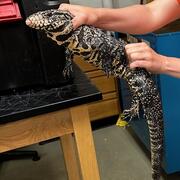
Early detection and rapid response tools for invasive tegu lizards
Scientists at USGS have shown that much of the US is suitable for invasion by tegu lizards, and suitability will likely increase in the future. While tegus can be removed via trapping, it is difficult to monitor every geographic area where tegus could invade. Thus, methods for quickly detecting and removing tegus in new areas are the best way to prevent spread and minimize damage from these...
Developing a Process for Listing Injurious Wildlife Species
This project will develop a transparent process for prioritizing species for listing as injurious, likely to cause damage or harm, under the Lacey Act. Building upon previously developed "horizon scan" and "watchlist" products, this process will identify potentially invasive species that present the greatest risk to lands, waters, and other assets managed by the U.S. Department of the Interior.
Using Multiple Indicators to Assess Stream Condition in the Chesapeake Bay
USGS is working with federal, state and local partners to develop multiple assessments of stream and river conditions in non-tidal areas of the Chesapeake Bay watershed. These assessments will help managers preserve stream health and improve biological conditions in impaired streams as the human population and climate continue to change in this region.
Assessing Risk Communication in the Pet and Aquarium Trade: An Analysis of Outreach and Engagement Efforts
WARC researchers evaluated whether outreach campaigns targeting pet owners are effectively reaching their desired audiences, namely pet owners who might unintentionally or purposefully release their pet into the wild.
Future Aquatic Invaders of the Northeast U.S.: How Climate Change, Human Vectors, and Natural History Could Bring Southern and Western Species North
Researchers will evaluate the potential of aquatic species to invade the Northeast U.S. Following the identification of appropriate target species by regional stakeholders, researchers will gather data from the NAS database and develop models to determine habitat suitability for each species.
Integration of Environmental DNA (eDNA) Data into the USGS Nonindigenous Aquatic Species Database
USGS and Department of the Interior partners have added a new, advanced capability to the early detection and rapid response tool set – the integration of environmental DNA and sighting data in the USGS Nonindigenous Aquatic Species database.
Filter Total Items: 27
Aqua INHABIT species potential distribution across the contiguous United States Aqua INHABIT species potential distribution across the contiguous United States
This is a dataset containing the potential distribution of 103 invasive species found in or adjacent to freshwater environments. We developed habitat suitability models for invasive freshwater species selected by resource management agencies and other managers. We adapted the modeling workflow described in Jarnevich et al. (2024, https://doi.org/10.3897/neobiota.96.134842). We developed...
Game fishes of the United States Game fishes of the United States
Game fish, sport fish, or regulated fish species are popular among recreational anglers. These species are managed by states, jurisdictions, or territories to limit their harvest and maintain healthy fish stocks. Game fish have significant economic importance and represent an essential component of fish communities. This game fish classification serves as the first public designation of...
Composite relative risk indices for dreissenid mussel introductions in the Missouri River Basin: scripts and output Composite relative risk indices for dreissenid mussel introductions in the Missouri River Basin: scripts and output
This data product develops a composite relative risk index (CRR) for watersheds within the Missouri River Basin, a region in the U.S. on the front line of dreissenid spread. The CRR is developed using datasets in order to account for the direct and indirect damages from a potential infestation along with the risk of an infestation occurring with a HUC10 watershed. Included are indices...
Horizon Scan for Vertebrates in Trade Horizon Scan for Vertebrates in Trade
This is a dataset summarizing filtering criteria and rapid risk assessments for ~25,000 species undertaken during a data-driven horizon scan of imported fish, amphibians, reptiles, birds, and mammals. The files represented in this dataset are the following: 1) 'species_filtering_metadata_table.xlsx' is the tabular summary of all intake list species names and the reason for inclusion...
Data release: Flood and Storm Tracker (FaST) data Data release: Flood and Storm Tracker (FaST) data
This product summarizes data used in the analysis portion of our Flood and Storm Tracker (FaST) manuscript (see larger work citation). The dataset titled HUCsppMatrices2012-2022.csv has each Hydraulic Unit Code (HUC) with an introduced taxon in each storm and the HUC it connected to by flood waters (lateral or longitudinal). The dataset titled ConnectionPoints_2012-2022.csv has each...
Risk assessments of animal species, plant species, and disease in the United States available online between 1990 and 2023 Risk assessments of animal species, plant species, and disease in the United States available online between 1990 and 2023
Risk assessments describe the risk of a species’ invasion in a location, and many risk assessments have been produced by different institutions for various reasons. However, information is sporadically located online, increasing the difficulty of developing comprehensive lists of species with risk assessments or comparing assessment results across species in locations of interest...
Filter Total Items: 42
Current and near-future conditions of aquatic spatial data for use in ecological models in the United States Current and near-future conditions of aquatic spatial data for use in ecological models in the United States
To address increasing demand for ecological models of aquatic species that can inform the management of national freshwater resources, we leveraged manager input to develop suites of environmental data layers characterizing freshwater habitats for the contiguous United States. Using the National Hydrography Dataset, these new data cover lentic and lotic systems under current and near...
Authors
Grace C. Henderson, Peder Engelstad, Cameron J. Reimer, Shelby K. LeClare, Linnea S. Fraser, Demetra A. Williams, Keana S. Shadwell, Wesley M. Daniel, Ian A. Pfingsten, Catherine S. Jarnevich
Future aquatic invaders of the Northeast U.S.: How climate change, human vectors, and natural history could bring southern and western species north Future aquatic invaders of the Northeast U.S.: How climate change, human vectors, and natural history could bring southern and western species north
As environmental conditions change, land managers are increasingly concerned about the potential for new aquatic invasive species to move into their jurisdictions. Because managers may have limited resources, detecting invasive species early is important as prevention is more effective and less costly than ongoing mitigation of established populations. Tools built to assist early...
Authors
Catherine S. Jarnevich, Peder Engelstad, Shelby K. LeClare, Richard D. Inman, Ian A. Pfingsten, Wesley M. Daniel
Global framework for communication of biological invasion risks Global framework for communication of biological invasion risks
Biological invasions, driven by the spread of non-native species, have become a critical global issue because of their far-reaching ecological and socioeconomic impacts. Effective communication of the risks of biological invasions is essential for implementing robust policy and legislation and gaining public support for conservation efforts. However, current policies often suffer from
Authors
Lorenzo Vilizzi, Vettath R. Suresh, Daniela Giannetto, Jeffrey E. Hill, Wesley M. Daniel, João G. Monteiro, Lennart Edsman, Hassan Sh Elmi, Ahmed Ibrahim Awale, Elnaz Najafi-Majd, Ramazan Mammadov, Sapto Andriyono, Djumanto, Mohammad Noor Azmai, Abdulwakil Saba, Belma K. Stroil, Avdul Adrović, Anna Vila-Gispert, Dani Boix, Oldřich Kopecký, Vilém Pavlu, Dragana Milošević, Danka Caković, Henrik Holbech, Kim Lundgreen, Juliane Lukas, Harald Ahnelt, Merike Linnamägi, Mehis Rohtla, David Almeida, Roberto Mendoza, Allan S. Gilles, Richard Thomas D. Pavia, Elisabeth Knudsen, Leivur J. Hansen, Philippe Goulletquer, Amelia Curd, Ivan Špelić, Jón E. Jónsson, Höskuldur Thráinsson, Angela Boggero, Mihails Pupins, Artūrs Škute, Lukas Petrulaitis, Ilona Jukonienė, Gábor Herczeg, Árpád Ferincz, Hugo Verreycken, Rob S.E.W. Leuven, Martin Malmstrøm, Gaute Velle, Trobjon Makhkamov, Akramjon Yuldashev, Dariusz Pietraszewski, Lidia Marszał, João Canning-Clode, Mariele Pasuch de Camargo, Cristina Preda, Daniyar Memedemin, Rigers Bakiu, Silvia Bakiu, Kristína S. Švolíková, Barbora Števove, Luka Duniš, Petra Kristan, Predrag Simonović, Radoslav Dekić, Riikka Puntila-Dodd, Miia Jauni, Karin H. Olsson, Kieu Anh Ta, Thuyet D. Bui, Baran Yoğurtçuoğlu, Sevan Ağdamar, Bahadir Yuldashov, Peyzulla Khydyrov, Leonidas Vardakas, Nicholas Koutsikos, Costas Perdikaris, Dzmitry Lukashanets, Oleg Borodin, Eliza Uzunova, Dimitriy Dashinov, Georgii Lazkov, Myskalai Ganybaeva, Daniya Ualiyeva, Raushan Zharmukhametova, Milica Ristovska, Aleksandra Cvetkovska Gjorgjievska, Burenbaatar Ganbaatar, Solongo Khadbaatar, Vadim E. Panov, Oleh Marenkov, Nurali Saidov, Mekhrovar Okhonniyozov, Yuriy Kvach, Volodymyr Yuryshynets, Marine Arakelyan, Hasmik Khachatryan, Levan Mumladze, Bella Japoshvili, Renanel Pickholtz, Tal Gavriel, Usman Atique, Muhammad Altaf, Sonia Iqbal, Zainab Al-Wazzan, Sahar Chebaane, Mohammad Hamid Hamdard, Abdul Rahman Osmani, Seyed Daryoush Moghaddas, Jamileh Javidpour, Mariyam Nashath, Faruhana Abdullah, Hari Prasad Sharma, Bharat Babu Shrestha, Vandana Vibhakaran, Shams M. Galib, Md. Abdul Gofur Khan, Udaya Priyantha Epa, Nadiya Cassim, Mahanama De Zoysa, Ratcha Chaichana, Kamalaporn Kanongdate, Nyein Chan, La Minn Ko Ko, Jigdrel Dorji, Chhimi Dorji, Khaml Inkhavilay, Chanhvilay Somvongsa, Kim Soben, Yutha Nida, Yohannes B. Tesfay, Bikila W. Dullo, Chulhong Oh, Youngjun Park, Shan Li, Hui Wei, Akihiko Koyama, Atsuhiko Isobe, Marina Piria
Invasive hitchhiking organisms on aquarium plants: An emerging pathway of introduction Invasive hitchhiking organisms on aquarium plants: An emerging pathway of introduction
The aquarium trade is a global industry responsible for the movement of live plants and animals, but it also serves as a major pathway for the introduction and spread of aquatic invasive species. Invasive species contribute to biodiversity loss, disrupt ecosystems, and can have widespread economic and societal impacts. A significant but poorly understood invasion risk in the plant...
Authors
Kathryn A. O'Shaughnessy, Wesley M. Daniel, Zoey C.W. Hendrickson, Samantha N. Smith, Ashley M. McDonald, Charles W. Martin
Invasive species in the aquarium trade: Survey of attitudes, behaviors, and knowledge among US participants Invasive species in the aquarium trade: Survey of attitudes, behaviors, and knowledge among US participants
Although the aquarium trade is an important pathway for direct and indirect non-native species introductions into freshwater systems, knowledge and attitudes of participants in the trade regarding alien species issues is largely undocumented. Therefore, we administered a survey to investigate attitudes and behaviors of aquarists and non-aquarists regarding the aquarium trade as a pathway...
Authors
Joseph V. Brown, William E. Kelso, Diaz Rodrigo, Wesley Daniel, Haley M. Brassard, Michael D. Kaller
Identifying gaps in regulatory prevention measures for nonindigenous aquatic species in the United States Identifying gaps in regulatory prevention measures for nonindigenous aquatic species in the United States
Nonindigenous aquatic species (NAS) present in trade can become costly invaders once introduced and established in a new environment. Preventing NAS introduction is considered the most effective strategy to avoid potential negative ecological, economic, and human health impacts associated with certain species. The United States government enacts regulatory prevention measures carried out...
Authors
Zoey Hendrickson, Charles M. Martin, Wesley Daniel
webDR: Spatial exploration of invasion risk of dreissenid mussels in the Missouri River Basin at the HUC10 watershed scale webDR: Spatial exploration of invasion risk of dreissenid mussels in the Missouri River Basin at the HUC10 watershed scale
The spread of non-native dreissenid mussels across North America has resulted in significant ecological and economic damage. Management efforts implementing early detection efforts (including watercraft inspections) may help reduce potential spread and new introductions, but optimizing effective deployment of these efforts in a resource-constrained environment is challenging. Raymond et...
High-throughput calculations of climatch scores High-throughput calculations of climatch scores
Matching climate envelopes allows people to examine how potential invasive species may match habitats. This repository contains code for using the climatchR package for high-throughput calculations of climatch scores for species using GBIF data. Climatch is based upon the climatch algorithm as implemented through the climatchR package.
climatchR: An implementation of Climatch in R climatchR: An implementation of Climatch in R
Matching climate envelopes of allows people to examine how potential invasive species may match habitats. The Australian government created Climatch to do allow for these comparisons. However, this webpage does not allow for readily scripting climate matching. Hence, the authors created climatchR, an R package (R Core Team 2020) implementing the climatch method in R. This was created to...
Science and Products
Filter Total Items: 24
Early detection and rapid response tools for invasive tegu lizards
Scientists at USGS have shown that much of the US is suitable for invasion by tegu lizards, and suitability will likely increase in the future. While tegus can be removed via trapping, it is difficult to monitor every geographic area where tegus could invade. Thus, methods for quickly detecting and removing tegus in new areas are the best way to prevent spread and minimize damage from these...
Developing a Process for Listing Injurious Wildlife Species
This project will develop a transparent process for prioritizing species for listing as injurious, likely to cause damage or harm, under the Lacey Act. Building upon previously developed "horizon scan" and "watchlist" products, this process will identify potentially invasive species that present the greatest risk to lands, waters, and other assets managed by the U.S. Department of the Interior.
Using Multiple Indicators to Assess Stream Condition in the Chesapeake Bay
USGS is working with federal, state and local partners to develop multiple assessments of stream and river conditions in non-tidal areas of the Chesapeake Bay watershed. These assessments will help managers preserve stream health and improve biological conditions in impaired streams as the human population and climate continue to change in this region.
Assessing Risk Communication in the Pet and Aquarium Trade: An Analysis of Outreach and Engagement Efforts
WARC researchers evaluated whether outreach campaigns targeting pet owners are effectively reaching their desired audiences, namely pet owners who might unintentionally or purposefully release their pet into the wild.
Future Aquatic Invaders of the Northeast U.S.: How Climate Change, Human Vectors, and Natural History Could Bring Southern and Western Species North
Researchers will evaluate the potential of aquatic species to invade the Northeast U.S. Following the identification of appropriate target species by regional stakeholders, researchers will gather data from the NAS database and develop models to determine habitat suitability for each species.
Integration of Environmental DNA (eDNA) Data into the USGS Nonindigenous Aquatic Species Database
USGS and Department of the Interior partners have added a new, advanced capability to the early detection and rapid response tool set – the integration of environmental DNA and sighting data in the USGS Nonindigenous Aquatic Species database.
Filter Total Items: 27
Aqua INHABIT species potential distribution across the contiguous United States Aqua INHABIT species potential distribution across the contiguous United States
This is a dataset containing the potential distribution of 103 invasive species found in or adjacent to freshwater environments. We developed habitat suitability models for invasive freshwater species selected by resource management agencies and other managers. We adapted the modeling workflow described in Jarnevich et al. (2024, https://doi.org/10.3897/neobiota.96.134842). We developed...
Game fishes of the United States Game fishes of the United States
Game fish, sport fish, or regulated fish species are popular among recreational anglers. These species are managed by states, jurisdictions, or territories to limit their harvest and maintain healthy fish stocks. Game fish have significant economic importance and represent an essential component of fish communities. This game fish classification serves as the first public designation of...
Composite relative risk indices for dreissenid mussel introductions in the Missouri River Basin: scripts and output Composite relative risk indices for dreissenid mussel introductions in the Missouri River Basin: scripts and output
This data product develops a composite relative risk index (CRR) for watersheds within the Missouri River Basin, a region in the U.S. on the front line of dreissenid spread. The CRR is developed using datasets in order to account for the direct and indirect damages from a potential infestation along with the risk of an infestation occurring with a HUC10 watershed. Included are indices...
Horizon Scan for Vertebrates in Trade Horizon Scan for Vertebrates in Trade
This is a dataset summarizing filtering criteria and rapid risk assessments for ~25,000 species undertaken during a data-driven horizon scan of imported fish, amphibians, reptiles, birds, and mammals. The files represented in this dataset are the following: 1) 'species_filtering_metadata_table.xlsx' is the tabular summary of all intake list species names and the reason for inclusion...
Data release: Flood and Storm Tracker (FaST) data Data release: Flood and Storm Tracker (FaST) data
This product summarizes data used in the analysis portion of our Flood and Storm Tracker (FaST) manuscript (see larger work citation). The dataset titled HUCsppMatrices2012-2022.csv has each Hydraulic Unit Code (HUC) with an introduced taxon in each storm and the HUC it connected to by flood waters (lateral or longitudinal). The dataset titled ConnectionPoints_2012-2022.csv has each...
Risk assessments of animal species, plant species, and disease in the United States available online between 1990 and 2023 Risk assessments of animal species, plant species, and disease in the United States available online between 1990 and 2023
Risk assessments describe the risk of a species’ invasion in a location, and many risk assessments have been produced by different institutions for various reasons. However, information is sporadically located online, increasing the difficulty of developing comprehensive lists of species with risk assessments or comparing assessment results across species in locations of interest...
Filter Total Items: 42
Current and near-future conditions of aquatic spatial data for use in ecological models in the United States Current and near-future conditions of aquatic spatial data for use in ecological models in the United States
To address increasing demand for ecological models of aquatic species that can inform the management of national freshwater resources, we leveraged manager input to develop suites of environmental data layers characterizing freshwater habitats for the contiguous United States. Using the National Hydrography Dataset, these new data cover lentic and lotic systems under current and near...
Authors
Grace C. Henderson, Peder Engelstad, Cameron J. Reimer, Shelby K. LeClare, Linnea S. Fraser, Demetra A. Williams, Keana S. Shadwell, Wesley M. Daniel, Ian A. Pfingsten, Catherine S. Jarnevich
Future aquatic invaders of the Northeast U.S.: How climate change, human vectors, and natural history could bring southern and western species north Future aquatic invaders of the Northeast U.S.: How climate change, human vectors, and natural history could bring southern and western species north
As environmental conditions change, land managers are increasingly concerned about the potential for new aquatic invasive species to move into their jurisdictions. Because managers may have limited resources, detecting invasive species early is important as prevention is more effective and less costly than ongoing mitigation of established populations. Tools built to assist early...
Authors
Catherine S. Jarnevich, Peder Engelstad, Shelby K. LeClare, Richard D. Inman, Ian A. Pfingsten, Wesley M. Daniel
Global framework for communication of biological invasion risks Global framework for communication of biological invasion risks
Biological invasions, driven by the spread of non-native species, have become a critical global issue because of their far-reaching ecological and socioeconomic impacts. Effective communication of the risks of biological invasions is essential for implementing robust policy and legislation and gaining public support for conservation efforts. However, current policies often suffer from
Authors
Lorenzo Vilizzi, Vettath R. Suresh, Daniela Giannetto, Jeffrey E. Hill, Wesley M. Daniel, João G. Monteiro, Lennart Edsman, Hassan Sh Elmi, Ahmed Ibrahim Awale, Elnaz Najafi-Majd, Ramazan Mammadov, Sapto Andriyono, Djumanto, Mohammad Noor Azmai, Abdulwakil Saba, Belma K. Stroil, Avdul Adrović, Anna Vila-Gispert, Dani Boix, Oldřich Kopecký, Vilém Pavlu, Dragana Milošević, Danka Caković, Henrik Holbech, Kim Lundgreen, Juliane Lukas, Harald Ahnelt, Merike Linnamägi, Mehis Rohtla, David Almeida, Roberto Mendoza, Allan S. Gilles, Richard Thomas D. Pavia, Elisabeth Knudsen, Leivur J. Hansen, Philippe Goulletquer, Amelia Curd, Ivan Špelić, Jón E. Jónsson, Höskuldur Thráinsson, Angela Boggero, Mihails Pupins, Artūrs Škute, Lukas Petrulaitis, Ilona Jukonienė, Gábor Herczeg, Árpád Ferincz, Hugo Verreycken, Rob S.E.W. Leuven, Martin Malmstrøm, Gaute Velle, Trobjon Makhkamov, Akramjon Yuldashev, Dariusz Pietraszewski, Lidia Marszał, João Canning-Clode, Mariele Pasuch de Camargo, Cristina Preda, Daniyar Memedemin, Rigers Bakiu, Silvia Bakiu, Kristína S. Švolíková, Barbora Števove, Luka Duniš, Petra Kristan, Predrag Simonović, Radoslav Dekić, Riikka Puntila-Dodd, Miia Jauni, Karin H. Olsson, Kieu Anh Ta, Thuyet D. Bui, Baran Yoğurtçuoğlu, Sevan Ağdamar, Bahadir Yuldashov, Peyzulla Khydyrov, Leonidas Vardakas, Nicholas Koutsikos, Costas Perdikaris, Dzmitry Lukashanets, Oleg Borodin, Eliza Uzunova, Dimitriy Dashinov, Georgii Lazkov, Myskalai Ganybaeva, Daniya Ualiyeva, Raushan Zharmukhametova, Milica Ristovska, Aleksandra Cvetkovska Gjorgjievska, Burenbaatar Ganbaatar, Solongo Khadbaatar, Vadim E. Panov, Oleh Marenkov, Nurali Saidov, Mekhrovar Okhonniyozov, Yuriy Kvach, Volodymyr Yuryshynets, Marine Arakelyan, Hasmik Khachatryan, Levan Mumladze, Bella Japoshvili, Renanel Pickholtz, Tal Gavriel, Usman Atique, Muhammad Altaf, Sonia Iqbal, Zainab Al-Wazzan, Sahar Chebaane, Mohammad Hamid Hamdard, Abdul Rahman Osmani, Seyed Daryoush Moghaddas, Jamileh Javidpour, Mariyam Nashath, Faruhana Abdullah, Hari Prasad Sharma, Bharat Babu Shrestha, Vandana Vibhakaran, Shams M. Galib, Md. Abdul Gofur Khan, Udaya Priyantha Epa, Nadiya Cassim, Mahanama De Zoysa, Ratcha Chaichana, Kamalaporn Kanongdate, Nyein Chan, La Minn Ko Ko, Jigdrel Dorji, Chhimi Dorji, Khaml Inkhavilay, Chanhvilay Somvongsa, Kim Soben, Yutha Nida, Yohannes B. Tesfay, Bikila W. Dullo, Chulhong Oh, Youngjun Park, Shan Li, Hui Wei, Akihiko Koyama, Atsuhiko Isobe, Marina Piria
Invasive hitchhiking organisms on aquarium plants: An emerging pathway of introduction Invasive hitchhiking organisms on aquarium plants: An emerging pathway of introduction
The aquarium trade is a global industry responsible for the movement of live plants and animals, but it also serves as a major pathway for the introduction and spread of aquatic invasive species. Invasive species contribute to biodiversity loss, disrupt ecosystems, and can have widespread economic and societal impacts. A significant but poorly understood invasion risk in the plant...
Authors
Kathryn A. O'Shaughnessy, Wesley M. Daniel, Zoey C.W. Hendrickson, Samantha N. Smith, Ashley M. McDonald, Charles W. Martin
Invasive species in the aquarium trade: Survey of attitudes, behaviors, and knowledge among US participants Invasive species in the aquarium trade: Survey of attitudes, behaviors, and knowledge among US participants
Although the aquarium trade is an important pathway for direct and indirect non-native species introductions into freshwater systems, knowledge and attitudes of participants in the trade regarding alien species issues is largely undocumented. Therefore, we administered a survey to investigate attitudes and behaviors of aquarists and non-aquarists regarding the aquarium trade as a pathway...
Authors
Joseph V. Brown, William E. Kelso, Diaz Rodrigo, Wesley Daniel, Haley M. Brassard, Michael D. Kaller
Identifying gaps in regulatory prevention measures for nonindigenous aquatic species in the United States Identifying gaps in regulatory prevention measures for nonindigenous aquatic species in the United States
Nonindigenous aquatic species (NAS) present in trade can become costly invaders once introduced and established in a new environment. Preventing NAS introduction is considered the most effective strategy to avoid potential negative ecological, economic, and human health impacts associated with certain species. The United States government enacts regulatory prevention measures carried out...
Authors
Zoey Hendrickson, Charles M. Martin, Wesley Daniel
webDR: Spatial exploration of invasion risk of dreissenid mussels in the Missouri River Basin at the HUC10 watershed scale webDR: Spatial exploration of invasion risk of dreissenid mussels in the Missouri River Basin at the HUC10 watershed scale
The spread of non-native dreissenid mussels across North America has resulted in significant ecological and economic damage. Management efforts implementing early detection efforts (including watercraft inspections) may help reduce potential spread and new introductions, but optimizing effective deployment of these efforts in a resource-constrained environment is challenging. Raymond et...
High-throughput calculations of climatch scores High-throughput calculations of climatch scores
Matching climate envelopes allows people to examine how potential invasive species may match habitats. This repository contains code for using the climatchR package for high-throughput calculations of climatch scores for species using GBIF data. Climatch is based upon the climatch algorithm as implemented through the climatchR package.
climatchR: An implementation of Climatch in R climatchR: An implementation of Climatch in R
Matching climate envelopes of allows people to examine how potential invasive species may match habitats. The Australian government created Climatch to do allow for these comparisons. However, this webpage does not allow for readily scripting climate matching. Hence, the authors created climatchR, an R package (R Core Team 2020) implementing the climatch method in R. This was created to...