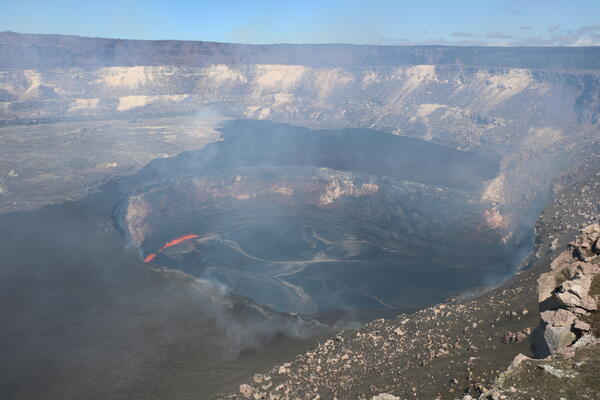
This view shows the north rim of Kīlauea Caldera, with the Hawaiian Volcano Observatory and Hawai‘i Volcanoes National Park's Jaggar Museum perched at the rim for ideal views of summit activity. Mauna Kea is in the distance, partially obscured by clouds, and Mauna Loa's Northeast Rift Zone extends off the left edge of the photo.
Images
Kīlauea images of eruptive activity, field work, and more.
This view shows the north rim of Kīlauea Caldera, with the Hawaiian Volcano Observatory and Hawai‘i Volcanoes National Park's Jaggar Museum perched at the rim for ideal views of summit activity. Mauna Kea is in the distance, partially obscured by clouds, and Mauna Loa's Northeast Rift Zone extends off the left edge of the photo.
HVO geologist wore protective gear during collection of fresh lava
HVO geologist wore protective gear during collection of fresh lavaOn December 30, 2015, an HVO geologist wore protective gear during collection of a fresh lava sample for chemical analysis from a pāhoehoe breakout along scattered Pu‘u ‘Ō‘ō lava flows. Inset image caption: Metadata is written on a bag that holds a sample taken from pāhoehoe that was collected on August 18, 2006.
HVO geologist wore protective gear during collection of fresh lava
HVO geologist wore protective gear during collection of fresh lavaOn December 30, 2015, an HVO geologist wore protective gear during collection of a fresh lava sample for chemical analysis from a pāhoehoe breakout along scattered Pu‘u ‘Ō‘ō lava flows. Inset image caption: Metadata is written on a bag that holds a sample taken from pāhoehoe that was collected on August 18, 2006.
Volcanic ash deposit at base of Uwēkahuna Bluff below Jaggar Museum. Photo by T.A. Jaggar on July 29, 1913. Ash deposit buried by lava flow in 1919. Standing man is circled. From HVO Record Book courtesy of Bishop Museum.
Recent activity highlights Kīlauea's restless nature
Recent activity highlights Kīlauea's restless natureKīlauea Volcano's summit lava lake dropped from nearly overflowing on April 26, 2015 (left), to about 62 m (203 ft) below the newly created (by multiple overflows) vent rim on May 15, 2015 (right). USGS photos.
Recent activity highlights Kīlauea's restless nature
Recent activity highlights Kīlauea's restless natureKīlauea Volcano's summit lava lake dropped from nearly overflowing on April 26, 2015 (left), to about 62 m (203 ft) below the newly created (by multiple overflows) vent rim on May 15, 2015 (right). USGS photos.
Kīlauea Volcano's summit lava lake continued to drop today (May 15, 2015).
Kīlauea's summit lava lake, which was about 12 m (40 ft) below the ...
Kīlauea's summit lava lake, which was about 12 m (40 ft) below the ...Kīlauea Volcano's summit lava lake, which was about 12 m (40 ft) below the vent rim on April 25 (left), overflowed the vent rim for the first time at about 9:40 p.m., HST, on April 28. As of noon on April 29 (right), the lava lake had overflowed the vent rim several more times. These Webcam images capture the summit vent before and after the overflows.
Kīlauea's summit lava lake, which was about 12 m (40 ft) below the ...
Kīlauea's summit lava lake, which was about 12 m (40 ft) below the ...Kīlauea Volcano's summit lava lake, which was about 12 m (40 ft) below the vent rim on April 25 (left), overflowed the vent rim for the first time at about 9:40 p.m., HST, on April 28. As of noon on April 29 (right), the lava lake had overflowed the vent rim several more times. These Webcam images capture the summit vent before and after the overflows.
A small explosion from Kīlauea's summit lava lake in Apr. 2015 was ...
A small explosion from Kīlauea's summit lava lake in Apr. 2015 was ...Rocks from the crater wall fell into the summit lava lake and generated an explosion that threw large fragments of molten lava onto the rim of Halema‘uma‘u Crater, 85 m (280 ft) above the lake. Gas in the lava lake was rapidly released during the 10:20 am explosive event, causing the lava lake surface to drop a few meters (yards) after the explosion.
A small explosion from Kīlauea's summit lava lake in Apr. 2015 was ...
A small explosion from Kīlauea's summit lava lake in Apr. 2015 was ...Rocks from the crater wall fell into the summit lava lake and generated an explosion that threw large fragments of molten lava onto the rim of Halema‘uma‘u Crater, 85 m (280 ft) above the lake. Gas in the lava lake was rapidly released during the 10:20 am explosive event, causing the lava lake surface to drop a few meters (yards) after the explosion.
Geologist collects a sample of slow-moving lava flow, Kīlauea
Geologist collects a sample of slow-moving lava flow, KīlaueaHVO geologists get fresh lava samples as close to the vent as possible. Once the sample is scooped from the pāhoehoe lobe, it is quickly quenched in a bucket of water to stop the growth of any crystals and to preserve the composition of the liquid lava.
Geologist collects a sample of slow-moving lava flow, Kīlauea
Geologist collects a sample of slow-moving lava flow, KīlaueaHVO geologists get fresh lava samples as close to the vent as possible. Once the sample is scooped from the pāhoehoe lobe, it is quickly quenched in a bucket of water to stop the growth of any crystals and to preserve the composition of the liquid lava.
Kīlauea's summit eruption in Halema‘uma‘u turns seven
Kīlauea's summit eruption in Halema‘uma‘u turns sevenThe lava lake within Halema‘uma‘u Crater at the summit of Kīlauea on February 1, 2014.
Kīlauea's summit eruption in Halema‘uma‘u turns seven
Kīlauea's summit eruption in Halema‘uma‘u turns sevenThe lava lake within Halema‘uma‘u Crater at the summit of Kīlauea on February 1, 2014.
Satellite image around front of Kīlauea's ERZ lava flow
Satellite image around front of Kīlauea's ERZ lava flowThis satellite image was captured on Tuesday, March 3, 2015 by the Landsat 8 satellite. Although this is a false-color image, the color map has been chosen to mimic what the human eye would expect to see. Bright red pixels depict areas of very high temperatures and show active lava. White areas are clouds.
Satellite image around front of Kīlauea's ERZ lava flow
Satellite image around front of Kīlauea's ERZ lava flowThis satellite image was captured on Tuesday, March 3, 2015 by the Landsat 8 satellite. Although this is a false-color image, the color map has been chosen to mimic what the human eye would expect to see. Bright red pixels depict areas of very high temperatures and show active lava. White areas are clouds.
Satellite image around front of Kīlauea's ERZ lava flow
Satellite image around front of Kīlauea's ERZ lava flowThis satellite image was captured on Saturday, February 14, by the Advanced Land Imager instrument onboard NASA's Earth Observing 1 satellite. The image is provided courtesy of NASA's Jet Propulsion Laboratory. Although this is a false-color image, the color map has been chosen to mimic what the human eye would expect to see.
Satellite image around front of Kīlauea's ERZ lava flow
Satellite image around front of Kīlauea's ERZ lava flowThis satellite image was captured on Saturday, February 14, by the Advanced Land Imager instrument onboard NASA's Earth Observing 1 satellite. The image is provided courtesy of NASA's Jet Propulsion Laboratory. Although this is a false-color image, the color map has been chosen to mimic what the human eye would expect to see.
Image of area around front of Kīlauea's ERZ lava flow
Image of area around front of Kīlauea's ERZ lava flowThis large-scale map uses a satellite image acquired in March 2014 (provided by Digital Globe) as a base to show the area around the front of Kīlauea's active East Rift Zone lava flow. The area of the flow on February 5 is shown in pink, while widening and advancement of the flow as of February 10 is shown in red.
Image of area around front of Kīlauea's ERZ lava flow
Image of area around front of Kīlauea's ERZ lava flowThis large-scale map uses a satellite image acquired in March 2014 (provided by Digital Globe) as a base to show the area around the front of Kīlauea's active East Rift Zone lava flow. The area of the flow on February 5 is shown in pink, while widening and advancement of the flow as of February 10 is shown in red.
This large-scale map shows the distal part of Kīlauea's active East Rift Zone lava flow in relation to nearby Puna communities. The area of the flow on February 5 is shown in pink, while widening and advancement of the flow as of February 10 is shown in red.
This small-scale map shows Kīlauea's active East Rift Zone lava flow in relation to lower Puna. The area of the flow on February 5 is shown in pink, while widening and advancement of the flow as of February 10 is shown in red.
This large-scale map shows the distal part of Kīlauea's active East Rift Zone lava flow in relation to nearby Puna communities. The area of the flow on January 29 is shown in pink, while widening and advancement of the flow as of February 5 is shown in red.
Image of area around front of Kīlauea's ERZ lava flow
Image of area around front of Kīlauea's ERZ lava flowThis large-scale map uses a satellite image acquired in March 2014 (provided by Digital Globe) as a base to show the area around the front of Kīlauea's active East Rift Zone lava flow. The area of the flow on January 29 is shown in pink, while widening and advancement of the flow as of February 5 is shown in red.
Image of area around front of Kīlauea's ERZ lava flow
Image of area around front of Kīlauea's ERZ lava flowThis large-scale map uses a satellite image acquired in March 2014 (provided by Digital Globe) as a base to show the area around the front of Kīlauea's active East Rift Zone lava flow. The area of the flow on January 29 is shown in pink, while widening and advancement of the flow as of February 5 is shown in red.
This small-scale map shows Kīlauea's active East Rift Zone lava flow in relation to lower Puna. The area of the flow on January 29 is shown in pink, while widening and advancement of the flow as of February 5 is shown in red.
This large-scale map shows the distal part of Kīlauea's active East Rift Zone lava flow in relation to nearby Puna communities. The area of the flow on January 22 is shown in pink, while widening and advancement of the flow as of January 29 is shown in red.
This small-scale map shows Kīlauea's active East Rift Zone lava flow in relation to lower Puna. The area of the flow on January 22 is shown in pink, while widening and advancement of the flow as of January 29 is shown in red.
This large-scale map shows the distal part of Kīlauea's active East Rift Zone lava flow in relation to nearby Puna communities. The area of the flow on January 22 is shown in pink, while widening and advancement of the flow as of January 29 is shown in red.
Image of area around front of Kīlauea's ERZ lava flow
Image of area around front of Kīlauea's ERZ lava flowThis large-scale map uses a satellite image acquired in March 2014 (provided by Digital Globe) as a base to show the area around the front of Kīlauea's active East Rift Zone lava flow. The area of the flow on January 26 is shown in pink, while widening and advancement of the flow based on today's overflight (January 29), is shown in red.
Image of area around front of Kīlauea's ERZ lava flow
Image of area around front of Kīlauea's ERZ lava flowThis large-scale map uses a satellite image acquired in March 2014 (provided by Digital Globe) as a base to show the area around the front of Kīlauea's active East Rift Zone lava flow. The area of the flow on January 26 is shown in pink, while widening and advancement of the flow based on today's overflight (January 29), is shown in red.