U.S. flag

An official website of the United States government

Multimedia

Images

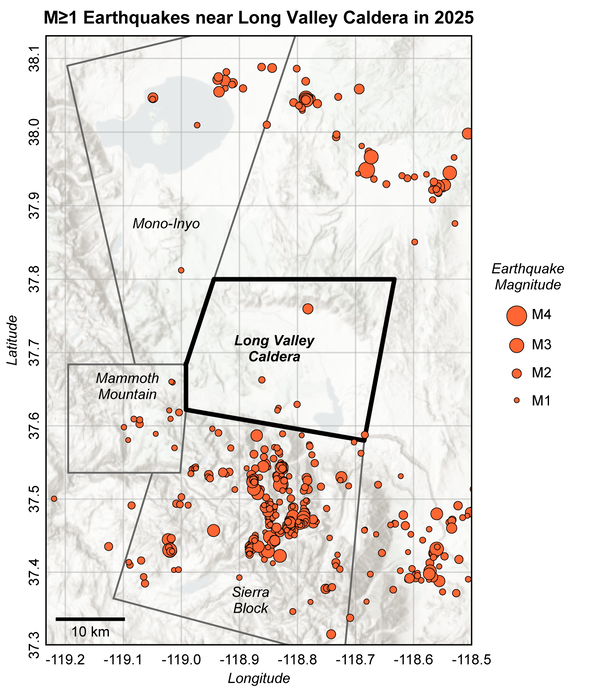
This map shows the Mono Lake - Long Valley region and part of the Sierra Nevada to the south. The landscape is shown in shades of gray while earthquakes are depicted with orange dots scaled according to the earthquake's magnitude. Black lines indicate where seismic monitoring boxes are drawn around Mono Lake, the Long Valley Caldera, the Sierra Nevada, and Mammoth Mountain.
Map of the Long Valley region with earthquakes from 2025

Locations of earthquakes of at least magnitude 1.0 in 2025 and the outlines of the boxes CalVO uses to count earthquakes around Long Valley. Only 6 earthquakes were located inside the Long Valley Caldera box. (Earthquake location data from Northern California Seismic Network.) Figure by Alicia Hotovec-Ellis, USGS. 

Locations of earthquakes of at least magnitude 1.0 in 2025 and the outlines of the boxes CalVO uses to count earthquakes around Long Valley. Only 6 earthquakes were located inside the Long Valley Caldera box. (Earthquake location data from Northern California Seismic Network.) Figure by Alicia Hotovec-Ellis, USGS. 

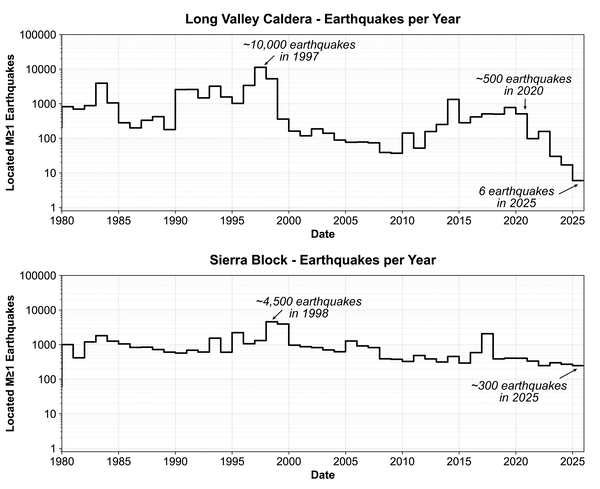
Two line graphs show the yearly number of earthquakes over since 1980 in the Long Valley Caldera and the Sierra Nevada south of the caldera. Several annotations write out the numbers of earthquakes in a few years, including 2025.
Earthquakes per year from 1980-2026 in Long Valley and the nearby Sierra Nevada

Graphs of the number of earthquakes located each year since 1980 in the Long Valley Caldera and nearby Sierra Block monitoring boxes. Note that the number of earthquakes on the left shown on a logarithmic scale, which means they increase an order of magnitude with each "step." Figure by Alicia Hotovec-Ellis, USGS.

Graphs of the number of earthquakes located each year since 1980 in the Long Valley Caldera and nearby Sierra Block monitoring boxes. Note that the number of earthquakes on the left shown on a logarithmic scale, which means they increase an order of magnitude with each "step." Figure by Alicia Hotovec-Ellis, USGS.

Rock outcrops showing rhyolite lava flow textures from Long Valley and Yellowstone calderas
Rhyolite lava flow textures from Long Valley and Yellowstone calderas

Rhyolite lava flow textures from Long Valley and Yellowstone calderas.  A) Photograph of well-developed spherulites in a lava flow from Long Valley Caldera in Eastern California. This high-silica rhyolite flow is very similar to the Central Plateau Member rhyolites of the Yellowstone Plateau Volcanic Field and exhibits many of the same textures.

Rhyolite lava flow textures from Long Valley and Yellowstone calderas.  A) Photograph of well-developed spherulites in a lava flow from Long Valley Caldera in Eastern California. This high-silica rhyolite flow is very similar to the Central Plateau Member rhyolites of the Yellowstone Plateau Volcanic Field and exhibits many of the same textures.

A broad, flat plain covered in dull green sagebrush stretches away from the viewer in this panorama. The photo is being taken from a rocky hill, with snow-capped, sharp peaks on the far side of the plain and low raised hills on the right side of the photo. One geologist is sitting on the rocks at lower right and one geologist is standing and giving a peace sign.
Panoramic view of the Long Valley Caldera from its north side

This panorama of the Long Valley Caldera, looking from north to south, shows its broad central plain, post-caldera rhyolite flows and uplift on the right, and eastern Sierra Nevada in the background. USGS photo by Jessica Ball.

This panorama of the Long Valley Caldera, looking from north to south, shows its broad central plain, post-caldera rhyolite flows and uplift on the right, and eastern Sierra Nevada in the background. USGS photo by Jessica Ball.

A geologist crouches next to a rhyolite outcrop and points to an egg-shaped mass of radiating pink minerals about the size of a cantaloupe. The rest of the rock is pocked with other egg to grapefruit sized pink crystal masses, interspersed with chunky fragments of black glassy lava.
Large spherulites in Hot Creek rhyolite lava in the Long Valley Caldera

The presence of spherulites indicates that a lava flow cooled quickly, and their mineralogy holds clues to its precise cooling history. USGS photo by Jessica Ball

View of a huge valley and distant mountain range. The valley is covered with sagebrush and rock outcrops
Long Valley Caldera, California

This panoramic view of the Long Valley Caldera was taken from a lava dome on the north rim of the caldera. USGS photo by Jessica Ball

This panoramic view of the Long Valley Caldera was taken from a lava dome on the north rim of the caldera. USGS photo by Jessica Ball

Was this page helpful?