interior of SNIF multi-GAS enclosure on Mount St. Helens, Washington
interior of SNIF multi-GAS enclosure on Mount St. Helens, WashingtonInterior of the SNIF multi-GAS enclosure on Mount St. Helens, Washington


Official websites use .gov
A .gov website belongs to an official government organization in the United States.

Secure .gov websites use HTTPS
A lock () or https:// means you’ve safely connected to the .gov website. Share sensitive information only on official, secure websites.

Images of Yellowstone.

Interior of the SNIF multi-GAS enclosure on Mount St. Helens, Washington
Interior of the SNIF multi-GAS enclosure on Mount St. Helens, Washington

View of Twin Peaks (left-most prominent peak), Mt. Hague (second-left-most prominent peak), and Mt.
View of Twin Peaks (left-most prominent peak), Mt. Hague (second-left-most prominent peak), and Mt.

Granite Peak (center) as seen from the north flank of Tempest Mountain. Note: The photographer did not approach this mountain goat. Instead, the mountain goat, which has likely learned to associate human behavior as a source of sodium (a common problem throughout the region), approached the photographer. USGS photo by Stanley Mordensky, August 2020.
Granite Peak (center) as seen from the north flank of Tempest Mountain. Note: The photographer did not approach this mountain goat. Instead, the mountain goat, which has likely learned to associate human behavior as a source of sodium (a common problem throughout the region), approached the photographer. USGS photo by Stanley Mordensky, August 2020.

Sheep Mountain, in the Gallatin Range, as seen from the north along the Sky Rim Trail near Sunlight Creek (to the left is approximately east, and to the right is approximately west). Note the layered stratigraphy of the sedimentary rocks dipping to the west. USGS photo by Stanley Mordensky, August 2020.
Sheep Mountain, in the Gallatin Range, as seen from the north along the Sky Rim Trail near Sunlight Creek (to the left is approximately east, and to the right is approximately west). Note the layered stratigraphy of the sedimentary rocks dipping to the west. USGS photo by Stanley Mordensky, August 2020.
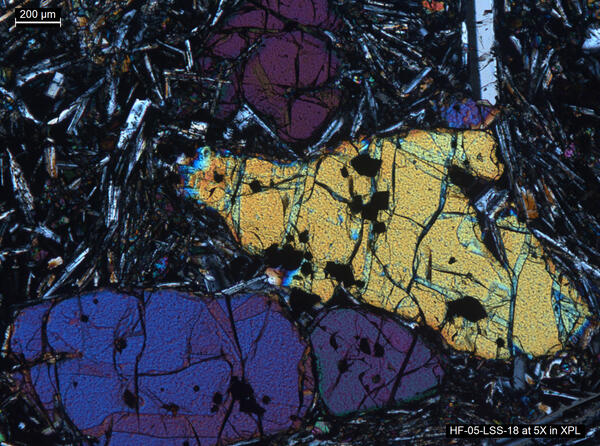
Thin section image of a lava sample from Yellowstone using a polarizing microscope. The mineral assemblage is representative of many of Yellowstone’s basaltic rocks. The three large and colored crystals (known as phenocrysts) in the center of the image are the mineral olivine.
Thin section image of a lava sample from Yellowstone using a polarizing microscope. The mineral assemblage is representative of many of Yellowstone’s basaltic rocks. The three large and colored crystals (known as phenocrysts) in the center of the image are the mineral olivine.

In the first few minutes of Steamboat's eruptions, it has often been measured well over 300 ft. with a few exceptional eruptions measured by visitors at over 400 ft.! In this example, done using a rangefinder by a Yellowstone National Park ranger, it comes in at 334.9 ft. For comparison, the Lower Falls of the Yellowstone is about 308 ft.
In the first few minutes of Steamboat's eruptions, it has often been measured well over 300 ft. with a few exceptional eruptions measured by visitors at over 400 ft.! In this example, done using a rangefinder by a Yellowstone National Park ranger, it comes in at 334.9 ft. For comparison, the Lower Falls of the Yellowstone is about 308 ft.

National Park Service scientist using a camera paired with a GPS receiver to obtain images of Castle Geyser, Yellowstone National Park, in June 2019.
National Park Service scientist using a camera paired with a GPS receiver to obtain images of Castle Geyser, Yellowstone National Park, in June 2019.

Sapphire Pool, in Biscuit Basin, steams on a stormy morning. A few “biscuits” remain along the pool’s southern edge (center right of photo) – violent geyser eruptions destroyed hundreds of the features when the pool’s plumbing system changed after being jarred by the 1959 Hebgen Lake earthquake. National Park Service photo by Jacob W. Frank, July 20, 2020.
Sapphire Pool, in Biscuit Basin, steams on a stormy morning. A few “biscuits” remain along the pool’s southern edge (center right of photo) – violent geyser eruptions destroyed hundreds of the features when the pool’s plumbing system changed after being jarred by the 1959 Hebgen Lake earthquake. National Park Service photo by Jacob W. Frank, July 20, 2020.

Comet NEOWISE is seen with the Roosevelt Arch in the foreground at the north Entrance of Yellowstone National Park. The town of Gardiner, Montana, is in the background.
Comet NEOWISE is seen with the Roosevelt Arch in the foreground at the north Entrance of Yellowstone National Park. The town of Gardiner, Montana, is in the background.

Panoramic photo of Hayden Valley looking east toward the Yellowstone River from the Mary Mountain trail.
Panoramic photo of Hayden Valley looking east toward the Yellowstone River from the Mary Mountain trail.

A small stream, Violet Creek, winds its way through Hayden Valley in Yellowstone National Park.
A small stream, Violet Creek, winds its way through Hayden Valley in Yellowstone National Park.

Comparison of photos from Giant and Castle Geysers separated by almost 150 years. These images suggest almost no changes to the geyser structure implying that large geysers form over thousands of years.
Comparison of photos from Giant and Castle Geysers separated by almost 150 years. These images suggest almost no changes to the geyser structure implying that large geysers form over thousands of years.

Photo of geologic units of the Absaroka volcanic province in northeastern Yellowstone National Park that shows volcaniclastic sandstones grading up into a conglomerate, followed by another sequence of sandstone to conglomerate. These repeating layers of the same-looking material make it difficult to assign them to a specific volcanic group.
Photo of geologic units of the Absaroka volcanic province in northeastern Yellowstone National Park that shows volcaniclastic sandstones grading up into a conglomerate, followed by another sequence of sandstone to conglomerate. These repeating layers of the same-looking material make it difficult to assign them to a specific volcanic group.

A view into the Absaroka Mountains in northeastern Yellowstone National Park. While the Absarokas of today look a little different due to glacial activity, these are the same mountains that existed over the last 53 million years, well before the arrival of the Yellowstone hot spot.
A view into the Absaroka Mountains in northeastern Yellowstone National Park. While the Absarokas of today look a little different due to glacial activity, these are the same mountains that existed over the last 53 million years, well before the arrival of the Yellowstone hot spot.

Newly identified ash flow sheets within the Yellowstone–Snake River Plain volcanic province (Y-SRP). The small inset in the center shows the track of the Yellowstone hotspot and its associated eruptive centers in light gray (M—McDermitt; OH—Owyhee-Humboldt; BJ—Bruneau-Jarbidge; TF—Twin Falls; P—Picabo; H—Heise; Y—Yellowstone).
Newly identified ash flow sheets within the Yellowstone–Snake River Plain volcanic province (Y-SRP). The small inset in the center shows the track of the Yellowstone hotspot and its associated eruptive centers in light gray (M—McDermitt; OH—Owyhee-Humboldt; BJ—Bruneau-Jarbidge; TF—Twin Falls; P—Picabo; H—Heise; Y—Yellowstone).

Geologists from Montana State University study an outcrop of diorite (a silicic igneous rock that cooled slowly beneath the ground). An outcrop of this size is important because it is easier to see any structural relations along with rock composition.
Geologists from Montana State University study an outcrop of diorite (a silicic igneous rock that cooled slowly beneath the ground). An outcrop of this size is important because it is easier to see any structural relations along with rock composition.
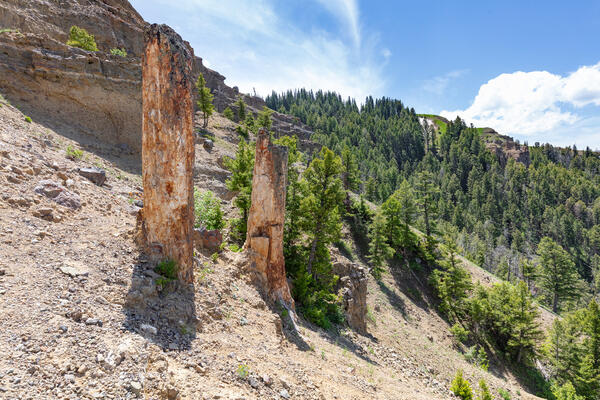
Two standing petrified (silicified) trees on Specimen Ridge in northeastern Yellowstone National Park. Photo by Jacob W. Frank, Yellowstone National Park (https://www.flickr.com/photos/yellowstonenps/50016729252).
Two standing petrified (silicified) trees on Specimen Ridge in northeastern Yellowstone National Park. Photo by Jacob W. Frank, Yellowstone National Park (https://www.flickr.com/photos/yellowstonenps/50016729252).

Petrified trees on Specimen Ridge, Yellowstone National Park. NPS photo by Jake Frank, June 13, 2020.
Petrified trees on Specimen Ridge, Yellowstone National Park. NPS photo by Jake Frank, June 13, 2020.

Simplified Geologic Map of Yellowstone, modified from USGS I-711 by Marli Miller, University of Oregon. All rock material resulting from the major caldera-forming eruptions are labelled at Qt, where the dashed caldera boundary highlights the scale of these events. Older volcanic, sedimentary and metamorphic rocks are found outside of this boundary.
Simplified Geologic Map of Yellowstone, modified from USGS I-711 by Marli Miller, University of Oregon. All rock material resulting from the major caldera-forming eruptions are labelled at Qt, where the dashed caldera boundary highlights the scale of these events. Older volcanic, sedimentary and metamorphic rocks are found outside of this boundary.

A Light Detection and Ranging (LiDAR) shaded relief image overlaid on an aerial imagery basemap. The Sulphur Hills, part of the Sour Creek Resurgent Dome, are visible in the upper half of the image, while the floodplain and meanders of Pelican Creek are visible at the bottom.
A Light Detection and Ranging (LiDAR) shaded relief image overlaid on an aerial imagery basemap. The Sulphur Hills, part of the Sour Creek Resurgent Dome, are visible in the upper half of the image, while the floodplain and meanders of Pelican Creek are visible at the bottom.

Geology of Yellowstone Map zoomed into the Lower Geyser Basin. This view shows a park-wide geologic map overlaid on a shaded relief layer from a digital elevation model. Red diamonds and black circles show geysers and gas sample locations, respectively.
Geology of Yellowstone Map zoomed into the Lower Geyser Basin. This view shows a park-wide geologic map overlaid on a shaded relief layer from a digital elevation model. Red diamonds and black circles show geysers and gas sample locations, respectively.