



Alaska Science Center Public Outreach and Communication
The USGS Alaska Science Center (ASC) issues official communications about research findings, events, and program activities. Our staff regularly participate in seminars, classroom education programs, collaborative science, and conduct Tribal community outreach.
Get to Know the Alaska Science Center
Alaska Science Center Seminar Series
USGS Alaska Q&A Series
Newsletters
Indigenous Community Engagement
Science Information Services
Ask USGS
USGS Map Store
Education Materials
Careers with USGS
Community Presentations and Outreach Events
2026
USGS presents new statistical methods for estimating spatial variation in animal survival: Alaska Science Center Research Wildlife Biologist Joe Eisaguirre was invited to present on using thinned and time-marginalized spatial point process to estimate spatial variation in animal survival at the American Statistical Association’s Section on Statistics and the Environment 2026 workshop, 8-9 October in Houston, TX. Understanding how key demographic parameters, such as survival or mortality risk, are essential for better informing management of wildlife. Although the locations of live animals across landscapes are frequently conceptualized as point pattern data, using spatial point processes to estimate how the locations of dead animals occur has been rarely explored. The methods presented offer new ways to use the vast quantities of wildlife telemetry data that have been, and continue to be, collected to better understand the ecology and inform management of wildlife populations.
USGS participates in the Academies of Anchorage Freshman Career Expo: On October 2, 2026, Kim Kloecker with the USGS Alaska Science Center will participate in the Academies of Anchorage career expo for freshman students. The Career expo is sponsored by the Anchorage School District (ASD) and provides an opportunity for students to explore different career pathways. USGS will have an information booth in the Natural Resource industry area with hands on activities about USGS Ecosystem science in Alaska. Students will have an opportunity to meet and network with scientists and learn about careers, internships, and employment. The event helps students explore real-life opportunities and choose their Academies of Anchorage career pathway. There will be over 3,000 ASD students in attendance.
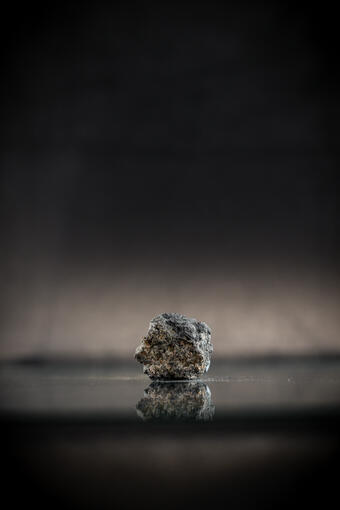
USGS presents work on critical minerals in Alaska: USGS Alaska Science Center geologists Doug Kreiner and George Case will present work on critical minerals in Alaska and the nation at the Society of Economic Geologists conference in Salt Lake City, Utah from September 30-October 3. The conference provides an opportunity for USGS scientists to share critical minerals work with industry and academic stakeholders. Kreiner and Case will both present work on mappable criteria for critical mineral bearing system in the support of Earth MRI and graphite potential across the Nation. Kreiner will additionally serve on a panel titled, “Exploring Career Paths in Economic Geology.” The panel is focused on providing information to students and early career geologists to engage them on workforce development and opportunities.
USGS and USFWS provide HPAI training to Alaska Tribal representative: The US Fish and Wildlife Service (USFWS) Izembek National Wildlife Refuge and USGS Alaska Science Center will host a representative of Qawalangin Tribe of Unalaska this week for training on the sampling of wild birds for highly pathogenic avian influenza (HPAI). The Qawalangin Tribe of Unalaska has requested this training to help build Tribal sampling capacity for HPAI within the Aleutian/Pribilof Islands Region. The USFWS Izembek National Wildlife Refuge and USGS Alaska Science Center have partnered on annual sampling of wild birds for HPAI viruses within this region for 16 consecutive years.
USGS participated in BLM's Water Discovery Days: Alaska Science Center biologists taught 4th grade students how to collect, observe, and sort stream macroinvertebrates. They learned that macroinvertebrates are easy to observe and collect, can be used as an indicator of stream health, and that they display a wide variety of adaptations for living in the water. Water Discovery Days, an annual event sponsored by the Bureau of Land Management Campbell Creek Science Center brings students together to engage in hands-on watershed education. This year, the four-day event welcomed 730 participants from 10 Anchorage schools.
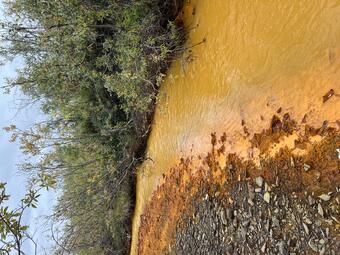
Presentation to the Zender Environmental Health and Research Group: Alaska Science Center Research Fish Biologist Mike Carey will co-present with Jon O’Donnell of NPS at a water quality training seminar hosted by the Zender Environmental Health and Research Group on September 16, 2026. The mission of Zender Environmental Health and Research Group, a non-profit 501(c)3 organization, is to assist underserved communities in developing programmatic capacity and community resiliency in environmental health issues. The presentation will describe an ongoing project examining rusting rivers that have undergone abrupt changes in color (orange), reflecting a dramatic shift in water quality. The project is a collaboration of USGS (Mike Carey, Josh Koch, Carson Baughman), NPS (Jon O’Donnell, Ken Hill), and Univ. of California Davis (Brett Poulin).
Meet a USGS Hydrologic Technician Field Assistant: Alaska Science Center Hydrologic Technician Field Assistant Amy Chiuchiolo will present “Meet a USGS Hydrologic Technician Field Assistant” to two groups of 60 seventh grade students at the Kyrene Aprende Middle School in Chandler, Arizona as part of the USGS Virtual Classroom Visit program. The presentation will cover Amy’s pathway into her science career, science done by the USGS, water resources and stream gaging, and what a day in her job is like.
USGS Participates in the Alaska Migratory Bird Co-management Council Meeting: Alaska Science Center scientists Danielle Gerik, Sarah Schoen, and Christina Ahlstrom will participate in the upcoming Alaska Migratory Bird Co-Management Council Meeting in Anchorage on August 19-20. The USGS team will participate in council discussions and present updates on current USGS activities related to migratory birds, as well as more in-depth updates on harmful algal bloom toxins in relation to recent seabird die-offs, and surveillance of highly pathogenic avian influenza. Formed in 2000, the Alaska Migratory Bird Co-Management Council is a collaborative partnership between the U.S. Fish and Wildlife Service, the Alaska Department of Fish and Game, and Alaska Native councils and communities across the state. The council's primary purpose is to conserve migratory birds by developing recommendations for Alaska Native subsistence harvest in Alaska.
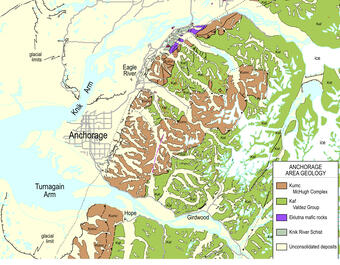
USGS Participates in Media Briefing: ASC Associate Center Director for Geology, Doug Kreiner, will participate in a media briefing on the release of the Cooperative National Geologic Map version 2.0 on Tuesday August 18th, 2026. Major updates in this version include the addition of the Alaska state geologic map database published by Wilson et al., 2015, and the state geologic map of Hawaii. Doug will provide context around the inclusion of the Alaska state map into the national database. Local media from Hawaii and Alaska have been invited to attend the briefing.
USGS Presents to the Yukon Fisheries Technician Training: Alaska Science Center Research Fish Biologist Vanessa von Biela was invited to lead a session on Pacific salmon heat stress monitoring and die-off response at the Yukon River Drainage Fisheries Association's annual training for field technicians June 15-18. Vanessa will join a slate of expert instructors from agencies, non-profits, and the University of Alaska Fairbanks traveling to St. Mary's and Emmonak, Alaska. The training is designed to prepare people for seasonal jobs with agencies, tribes, and local organizations that conduct monitoring and research projects across the Yukon River watershed. The Yukon River is one of the largest rivers in North America (~3,000km) with headwaters in Canada, cutting across all of Alaska, and reaching the Bering Sea. A combination of long-term Chinook salmon declines since the 1990s, a recent abrupt Chinook salmon and chum salmon crash beginning in 2020, and summer salmon run timing during warm water temperatures have led USGS to spend the last decade developing tools and an understanding of heat stress with partners. Differences in Pacific salmon trends across Alaska (some places reaching record high returns and other record low returns), are a kitchen table issue for rural Alaskans that have subsistence fishing priorities on federal lands based on the Alaska National Interest Lands Conservation Act.
Scientist to Present as Part of the Strait Science Lecture Series: Andy Ramey of the USGS Alaska Science Center will present 'Avian Influenza in Alaska wildlife' online as part of the Strait Science Lecture series on June 3, 2026. In his talk, Andy will convey where highly pathogenic avian influenza (HPAI) comes from, why this disease has become more common among Alaska wildlife since 2022, and how recent USGS research has elucidated patterns of viral dissemination and exposure.
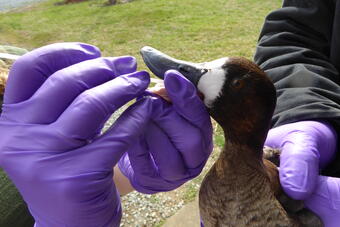
USGS Presents at the Alaska Harmful Algal Bloom Network Meeting. USGS Biologist Sarah Schoen was invited to present at an Alaska Harmful Algal Bloom (AHAB) Network virtual meeting on May 14, 2026. The AHAB network, which includes a diverse group of state, federal, university, Tribal, and community stakeholders, was formed in 2017 to provide a statewide approach to HAB awareness, research, monitoring, and response in Alaska. Schoen was asked to give an overview of the symptoms of domoic acid and saxitoxin ingestion in seabirds.
USGS Participates in the Prince William Sound Natural History Symposium: USGS scientists, Sue Karl and Rob Witter will present at the upcoming Prince William Sound Natural History Symposium, held May 11–12 in Whittier, Alaska hosted by the Prince William Sound Stewardship Foundation. Sue Karl will present “The Geology of Prince William Sound” providing an overview of the region’s complex tectonic and glacial history. Rob Witter will deliver a talk titled “Alaska’s natural seismographs in lakes and fjords, plus a brief update on Barry Arm landslides,” highlighting how lake and fjord sediments capture past seismic events.
USGS Presents to the Strait Science Seminar Series: The University of Alaska Northwest Campus hosts a monthly community outreach seminar series to communicate ongoing studies and scientific findings to Bering Strait coastal communities. USGS biologist Sarah Schoen has been invited to present a virtual talk about harmful algal bloom toxins and seabirds in Alaska on April 30th.
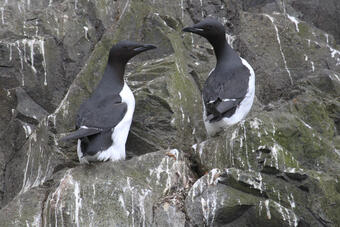
Scientist to Deliver USGS Friday’s Findings Webinar: On 24 April 2026, USGS Alaska Science Center Research Wildlife Geneticist, Andy Ramey, will deliver a presentation on highly pathogenic avian influenza (HPAI) as part of the Friday's Findings Webinar Series to celebrate the 2nd Annual USGS Wildlife Health Awareness Day. This presentation will highlight the impacts of HPAI to wildlife health and the ways in which the USGS works with diverse partners to fill data gaps that inform stakeholder management and mitigation decisions
USGS Geologist presents Critical Minerals Research: George Case and GEMSC Scientist Rebecca Stokes helped organize and will present MRP funded graphite research at the 2026 Graphite Summit in Sri Lanka, April 25 - May 1, 2026. George will give a keynote talk that summarizes recent and ongoing graphite resource assessment research work by the USGS. The purpose of the summit is to identify and advance research priorities related to natural graphite, a U.S. critical mineral essential for lithium-ion batteries, fuel cells, and other advanced materials. This workshop will represent the first formal collaboration between the United States and Sri Lanka focused on graphite research and will take place at a critical moment for global critical-mineral exploration, supply-chain resilience, and technology development.
USGS scientist presents at Wildlife Disease Seminar at the University of Wyoming: On April 15, 2026, Alaska Science Center scientist Christina Ahlstrom will give a virtual guest lecture on avian influenza to students in the University of Wyoming’s Wildlife Disease and Conservation course. The presentation will give an overview of avian influenza viruses in wild birds, with a focus on research conducted in Alaska.
USGS Biologist Presents Marine Ecosystem Science to Anchorage School District Natural Resource Academy Students: On April 13, 2026, Kim Kloecker with the USGS Alaska Science Center will visit Dimond High School's Natural Resource Academy students. The Anchorage School District provides Natural Resources & Environmental Management education through its Academies of Anchorage initiative. The curriculum focuses on STEM, environmental science, and career paths, featuring hands-on, project-based learning. This creates more informed citizens and gives students an opportunity to solve real problems. Kim will present hands-on activities related to sea otters and nearshore ecology as well as discussing career options and pathways with Ms. Walker's classes. There will be ~100 students in attendance throughout the school day.
USGS attends and presents at the Alaska Chapter of The Wildlife Society meeting: USGS scientists from the Alaska Science Center are attending the Alaska Chapter of The Wildlife Society meeting this week, in Anchorage, Alaska. The topics of USGS presentations include the spread of mule deer into Alaska to inform monitoring and disease surveillance plans, behavioral flexibility and fitness tradeoffs for migratory caribou experiencing environmental change, development of a genotyping-in-thousands by sequencing (GT-seq) panel for identifying individuals and estimating relatedness among Alaska black bears (Ursus americanus), and validation of antler- and movement-based estimation of reproduction in barren-ground caribou using video camera collars. ASC scientist Joe Eisaguirre also instructed a workshop on Bayesian modeling for wildlife researchers.
USGS Geologists Participate in Elementary STEM Night: On March 27th, 2026, Alaska Science Center geologists George Case and Richard Lease will present at the Trailside Elementary STEM night. They will use hands-on activities to demonstrate how rocks deform to build mountains and showcase minerals in Alaska and how they are used in our homes and everyday products. They will also provide an overview of the various career paths within the USGS and scientific skill sets used by USGS scientists. Students and parents of kindergarten through 5th graders will be invited to the evening event.
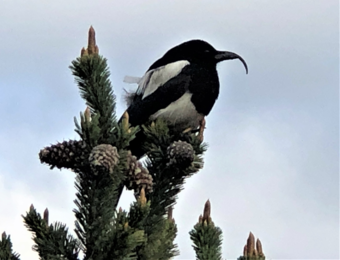
USGS Presents at public lecture series hosted by Nature Victoria: Alaska Science Center biologist Danielle Gerik was invited to give a virtual presentation on March 25, 2026, hosted by Nature Victoria, on avian keratin disorder (AKD) research. In her presentation, titled ‘Beak deformities in wild birds: unraveling the mystery of avian keratin disorder in Alaska and beyond’, Gerik will discuss efforts to track this disease globally through participatory science and will identify which bird species might be most at risk. She will also share recent findings on the emergence of AKD in Red-tailed Hawks in the Pacific Northwest.
USGS Discusses Cloud Computing to Monitor Whales: USGS Alaska Science Center research wildlife biologist Anthony Fischbach and intern Nyx Etheridge met with the NOAA Geospatial Artificial Intelligence For Animals | NOAA Fisheries team lead Christin Khan to discuss NOAA's use of cloud computing to monitor whales apparent in satellite imagery. Both NOAA and the USGS collect commercial satellite imagery under the auspices of the Civil Applications Committee to address requirements of the Marine Mammal Protection Act. USGS has developed methods to monitor walrus herds resting on shore by interpreting satellite imagery (see Fischbach et al. 2025 for details). Fish and Wildlife Service and at the Eskimo Walrus Commission have requested that USGS expand the monitoring of walrus herds on shore from the Chukchi Sea all the way down through the Bering Sea. In order to scale up the walrus monitoring effort and to align with Departmental directives, USGS is transitioning the satellite imagery interpretation workflows to cloud computing managed by the USGS High Performance Computing Center on Amazon Web Services cloud facilities. By consulting with the NOAA team, USGS hopes to ease this transition to cloud computing.
USGS Attends the Barrow Whaling Captain’s Association meeting: Todd Atwood attended the Barrow Whaling Captain’s Association (BWCA) meeting on March 24 and solicited input on field activities planned for 2026. The polar bear research program plans its field effort with input from the BWCA to avoid disturbing subsistence activities.
USGS Presents to the Alaska Chapter of the American Fisheries Society: On March 24, 2026, USGS Alaska Science Center scientist Mike Carey will present a talk entitled “The Rusting of Arctic Rivers: Potential loss of spawning habitat in the Arctic due to rusting rivers.” The presentation will give an overview of the recently observed phenomenon of rusting rivers in the Arctic and examine the overlap between the degraded water quality of rivers and fish spawning habitat. This research is a collaboration among USGS, NPS, and University of California Davis
USGS Presents at Curiosity Unleashed STEAM Event: USGS biologist Sarah Traiger will run STEM activity focused on sea otter foraging at “Curiosity Unleashed” in Juneau, a STEAM event for K-5 families on March 16, 2026. Traiger will have a spotting scope, photos of sea otters foraging, and shells of species sea otters eat, and datasheets for families to look at. Traiger will lead families in learning about how scientists study sea otter diet and strategies sea otters use in their foraging.

USGS Presents at the 2026 Seismological Society of America Annual Meeting. Alaska Science Center Research Geologist Rob Witter will attend and present Alaska Earthquake Hazards Project research on April 15, 2026, in Pasadena, California. The presentation will highlight novel evidence for earthquake shaking over the past ~4000 years from Allison Lake, near Valdez, Alaska. The research applies a variety of geophysical and geological analyses to document a sequence of 10 thick (5-40 cm) turbidites sampled in a 13-m long sediment core; analyses aim to differentiate seismically triggered deposits from flood-related sedimentary features. Research objectives aim to use sedimentary evidence in Allison Lake to quantitatively estimate seismic shaking parameters that caused earthquake-induced submarine landslides in nearby Port Valdez.
USGS Presents Alaska Goose Population Studies to the Pacific Flyway Council Study Committee: Alaska Science Center biologist Vijay Patil delivered a remote presentation on Alaska goose population studies at the Pacific Flyway Council Study Committee Meeting on March 11, 2026. The presentation summarized recent USGS-led monitoring and analyses that support state and federal partners in setting annual harvest regulations by estimating population growth, productivity, harvest rates, and annual survival, and identifying factors that influence those parameters. Study Committee meetings bring together representative biologists from state and federal agencies throughout the flyway to identify emerging issues, develop annual workplans, and prepare management plan recommendations for the Flyway Council as a whole.
USGS Presents at the Alaska Seabird Working Group Meeting. USGS scientists Sarah Schoen and Andy Ramey will attend and present at the Alaska Seabird Working Group (virtual) meeting on March 19th. The Alaska Seabird Working Group is a newly reformed interagency and cross-programmatic group of biologists who are actively working on seabird issues in Alaska. The group has members from the U.S. Fish and Wildlife Service (USFWS) Migratory Bird Management, USFWS Refuges, USFWS Ecological Services, National Oceanic and Atmospheric Administration Alaska Fisheries Science Center, Department of the Interior Pacific Seabird Program, Alaska Department of Fish and Game, and USGS Alaska Science Center. Schoen and Ramey were invited to present on harmful algal bloom toxins and highly pathogenic avian influenza, respectively, during avian mortality events in Alaska.

USGS Presents at the Southern Sea Otter Research Update Meeting: Alaska Science Center biologist, Kim Kloecker, will give a presentation at the Southern Sea Otter Research Update Meeting in Santa Cruz, California March 26-27. The presentation will highlight recent changes and current capabilities of the ASC nearshore marine research program, provide overviews of current studies, and invite discussion for proposed studies. This biennial meeting brings together federal, state, tribal, academic, private, and NGO managers, researchers, and conservationists to provide updates and improve collaboration to further sea otter research important to their management and stewardship under the MMPA.
USGS Presents to the American Water Resources Association: On March 4th, 2026, Alaska Science Center Research Hydrologist, Josh Koch will give a virtual presentation for the Alaska Section of the American Water Resources Association lunch and learn series, titled “Tracking acid seeps in the Arctic from subsurface source through rusting rivers”. The presentation will give an overview of the recently observed phenomenon of rivers turning orange in the Arctic, with a focus on the subsurface processes releasing metals to seeps and rivers.
USGS Presents at the Cordilleran Tectonics Workshop: Four ASC and one GGGSC scientist will attend the Cordilleran Tectonics Workshop hosted by the Yukon Geological Survey in Whitehorse, Yukon, from February 27–March 1, 2026. They will share new research on northern Cordillera geology, including fault displacement, basin development, chromite–PGE ophiolites, critical mineral systems, and faulting around the Pogo Au‑Bi‑Te deposit. This is an annual gathering of industry, academic, national and state/territory surveys to collaboratively share work in the northern Cordillera of North America providing an avenue of cross-border collaboration to develop international solutions to geologic problems directly affecting the understanding of mineral and energy resources in Alaska.
USGS Presents to the North Slope Regional Advisory Council: Alaska Science Center Research Fish Biologist, Sarah Laske, will virtually present to the North Slope Regional Advisory Council. The presentation will highlight findings from a recent study looking at indicators of mercury concentration in subsistence species, Lake Trout. The meeting is open to the public, February 24-25, 2026 at 9:00 am at the Inupiat Heritage Center, Utqiagvik, AK.
USGS Presents to Department of Geology at California State Polytechnic University at Humboldt: On February 10, 2026, Alaska Science Center Research Hydrologist, Josh Koch will give a virtual presentation for the Humboldt's Geology Colloquium, titled “Tracking acid seeps in the Arctic from subsurface source through rusting rivers”. The presentation will give an overview of the recently observed phenomenon of rivers turning orange in the Arctic, with a focus on the subsurface processes releasing metals to seeps and rivers.
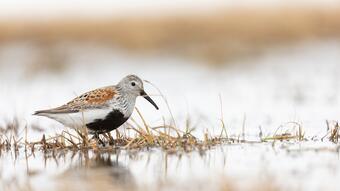
USGS Hosts Annual Alaska Shorebird Group and Boreal Partners in Flight Meetings: The Alaska Science Center will host the 31st Alaska Shorebird Group meeting on February 23, 2026 and the 34th Boreal Partners in Flight meeting on February 24, 2026 in Anchorage, Alaska. Each hybrid meeting will include approximately 50–75 attendees representing state, federal, and provincial agencies, universities, NGOs, private industry, and the public. USGS scientists will provide project updates and participate in discussions about monitoring efforts and research priorities for Alaska's shorebird and landbird populations. These annual meetings provide opportunities for collaboration and help inform conservation planning and resource management across Alaska.
USGS Geologist presents at Virtual Series: On February 6th at 4:30 pm AKST, George Case will present a talk titled "USGS Assessment of Known and Undiscovered Graphite Resources: Approaches, Data, and Tools for Value-Added Outcomes" as part of the Sri Lanka Graphite Virtual Series. The talk will provide an overview of USGS methods and approaches to conducting resource assessments of critical minerals such as battery graphite.
USGS Attends the Polar Bear Technical Committee Meeting: USGS scientist, Todd Atwood will virtually attend the Polar Bear Technical Committee (PBTC) meeting on February 2-5. The PBTC supports the Polar Bear Administrative Committee (PBAC) by reviewing scientific research and Indigenous Traditional Knowledge and providing the PBAC with an annual status assessment of the polar bear subpopulations in Canada. USGS will provide an update on a collaborative US-Canada study to estimate the abundance of Beaufort Sea polar bears.
USGS Presents at the Alaska Marine Science Symposium: Alaska Science Center scientists will present at the Alaska Marine Science Symposium in Anchorage, January 26-30, 2026. The annual meeting has brought together scientists, educators, resource managers, students, and the public for over 30 years to discuss the latest research and challenges in Alaska’s marine ecosystems. USGS Presentation topics include the use of satellite imagery and deep learning to count polar bears, satellites to count walrus at coastal haulouts, collaborative science around seabirds as indicators of marine ecosystem health, a synthesis of freshwater and marine indicators likely to influence 2026 salmon returns to the Yukon and Kuskokwim rivers, tracking recovery from sea star wasting disease, and the carrying capacity of sea otters in the Aleutian Islands.