Orange streams are increasingly common in the Brooks Range of northern Alaska. The orange stream color reflects oxidized iron, but also often indicates elevated heavy metal concentrations. Our ongoing study aims to document these occurrences and the timing of their onset.
Images
Browse images from a wide range of science topics covered by USGS. All items in this gallery are considered public domain unless otherwise noted.
Orange streams are increasingly common in the Brooks Range of northern Alaska. The orange stream color reflects oxidized iron, but also often indicates elevated heavy metal concentrations. Our ongoing study aims to document these occurrences and the timing of their onset.
The confluence of the Anakok Creek, Sheep Creek, and the Salmon River
The confluence of the Anakok Creek, Sheep Creek, and the Salmon RiverOrange streams are increasingly common in the Brooks Range of northern Alaska. The orange stream color reflects oxidized iron, but also often indicates elevated heavy metal concentrations. Our ongoing study aims to document these occurrences and the timing of their onset.
The confluence of the Anakok Creek, Sheep Creek, and the Salmon River
The confluence of the Anakok Creek, Sheep Creek, and the Salmon RiverOrange streams are increasingly common in the Brooks Range of northern Alaska. The orange stream color reflects oxidized iron, but also often indicates elevated heavy metal concentrations. Our ongoing study aims to document these occurrences and the timing of their onset.
Orange streams are increasingly common in the Brooks Range of northern Alaska. The orange stream color reflects oxidized iron, but also often indicates elevated heavy metal concentrations. Our ongoing study aims to document these occurrences and the timing of their onset.
Mixing of an orange tributary with clearer waters of the Anaktok Creek
Mixing of an orange tributary with clearer waters of the Anaktok CreekOrange streams are increasingly common in the Brooks Range of northern Alaska. The orange stream color reflects oxidized iron, but also often indicates elevated heavy metal concentrations. Our ongoing study aims to document these occurrences and the timing of their onset.
Mixing of an orange tributary with clearer waters of the Anaktok Creek
Mixing of an orange tributary with clearer waters of the Anaktok CreekOrange streams are increasingly common in the Brooks Range of northern Alaska. The orange stream color reflects oxidized iron, but also often indicates elevated heavy metal concentrations. Our ongoing study aims to document these occurrences and the timing of their onset.
Orange staining on snow in a braidplain of the Nakolikurok Creek
Orange staining on snow in a braidplain of the Nakolikurok CreekOrange streams are increasingly common in the Brooks Range of northern Alaska. The orange stream color reflects oxidized iron, but also often indicates elevated heavy metal concentrations. Our ongoing study aims to document these occurrences and the timing of their onset.
Orange staining on snow in a braidplain of the Nakolikurok Creek
Orange staining on snow in a braidplain of the Nakolikurok CreekOrange streams are increasingly common in the Brooks Range of northern Alaska. The orange stream color reflects oxidized iron, but also often indicates elevated heavy metal concentrations. Our ongoing study aims to document these occurrences and the timing of their onset.
Orange water and snow in a braidplain of the Nakolikurok Creek
Orange water and snow in a braidplain of the Nakolikurok CreekOrange streams are increasingly common in the Brooks Range of northern Alaska. The orange stream color reflects oxidized iron, but also often indicates elevated heavy metal concentrations. Our ongoing study aims to document these occurrences and the timing of their onset.
Orange water and snow in a braidplain of the Nakolikurok Creek
Orange water and snow in a braidplain of the Nakolikurok CreekOrange streams are increasingly common in the Brooks Range of northern Alaska. The orange stream color reflects oxidized iron, but also often indicates elevated heavy metal concentrations. Our ongoing study aims to document these occurrences and the timing of their onset.
Orange staining on snow below a seep on the Nakolikurok Creek
Orange staining on snow below a seep on the Nakolikurok CreekOrange streams are increasingly common in the Brooks Range of northern Alaska. The orange stream color reflects oxidized iron, but also often indicates elevated heavy metal concentrations. Our ongoing study aims to document these occurrences and the timing of their onset.
Orange staining on snow below a seep on the Nakolikurok Creek
Orange staining on snow below a seep on the Nakolikurok CreekOrange streams are increasingly common in the Brooks Range of northern Alaska. The orange stream color reflects oxidized iron, but also often indicates elevated heavy metal concentrations. Our ongoing study aims to document these occurrences and the timing of their onset.
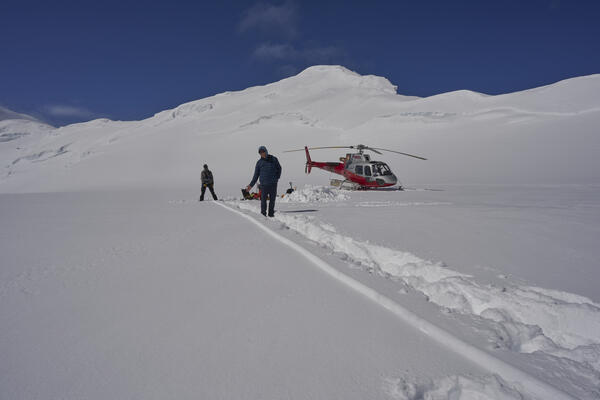
Snow core to measure accumulation on Kahiltna Glacier
Snow core to measure accumulation on Kahiltna GlacierThis is a 16 m (52.5-foot) core from Kahiltna Glacier at 3,055 m (10,023 feet), May 26, 2023. Kakiko Ramos-Leon (NPS, on the left) is standing where the core intersected the surface. Eric Ridington (pilot, in the middle) is pointing to the melt layers from summer 2022. The melt layers barely visible as grey stripes in the foreground are from summer 2021.
Snow core to measure accumulation on Kahiltna Glacier
Snow core to measure accumulation on Kahiltna GlacierThis is a 16 m (52.5-foot) core from Kahiltna Glacier at 3,055 m (10,023 feet), May 26, 2023. Kakiko Ramos-Leon (NPS, on the left) is standing where the core intersected the surface. Eric Ridington (pilot, in the middle) is pointing to the melt layers from summer 2022. The melt layers barely visible as grey stripes in the foreground are from summer 2021.
Effects of the North Pacific Marine Heatwave on Ocean Food Webs infographic
Effects of the North Pacific Marine Heatwave on Ocean Food Webs infographicInfograph describing the effects of North Pacific marine heatwave on ocean food webs.
Effects of the North Pacific Marine Heatwave on Ocean Food Webs infographic
Effects of the North Pacific Marine Heatwave on Ocean Food Webs infographicInfograph describing the effects of North Pacific marine heatwave on ocean food webs.
Chester Creek streamgage along the Lanie Fleischer Chester Creek Trail
Chester Creek streamgage along the Lanie Fleischer Chester Creek TrailChester Creek streamgage along the Lanie Fleischer Chester Creek Trail.
Chester Creek streamgage along the Lanie Fleischer Chester Creek Trail
Chester Creek streamgage along the Lanie Fleischer Chester Creek TrailChester Creek streamgage along the Lanie Fleischer Chester Creek Trail.
An infographic that highlights a study describing four main mechanisms by which marine heatwaves affect seabirds and marine ecosystems, i.e., (1) habitat modification, (2) physiological forcing, (3) behavioral responses, and (4) ecological processes or species interactions. Study findings indicate that marine heatwaves can affect seabirds directly by creating
The USGS Alaska Science Center is working with healthy, captive walruses in the U.S.
Estimated area occupied by walrus at coastal haulouts in Alaska and Russia
Estimated area occupied by walrus at coastal haulouts in Alaska and RussiaThis image shows the estimated area (in square meters) occupied by Pacific walrus at eight coastal haulouts in northern Alaska and Chukotka Russia in 2023 (walrus were detected at two haulouts in 2023: Point Lay, Alaska and Cape Serdtse Kamen, Chukotka).
Estimated area occupied by walrus at coastal haulouts in Alaska and Russia
Estimated area occupied by walrus at coastal haulouts in Alaska and RussiaThis image shows the estimated area (in square meters) occupied by Pacific walrus at eight coastal haulouts in northern Alaska and Chukotka Russia in 2023 (walrus were detected at two haulouts in 2023: Point Lay, Alaska and Cape Serdtse Kamen, Chukotka).
Map of area where USGS and USFWS may observe Pacific walrus during marine cruises of the Norseman II starting in summer of 2023
Map of area where USGS and USFWS may observe Pacific walrus during marine cruises of the Norseman II starting in summer of 2023Crosshatching in the map shows the general area where the Norseman II may sail to observe walruses from June 5 to July 2, 2023, as part of a USGS and USFWS project to study Pacific walrus population dynamics.
Map of area where USGS and USFWS may observe Pacific walrus during marine cruises of the Norseman II starting in summer of 2023
Map of area where USGS and USFWS may observe Pacific walrus during marine cruises of the Norseman II starting in summer of 2023Crosshatching in the map shows the general area where the Norseman II may sail to observe walruses from June 5 to July 2, 2023, as part of a USGS and USFWS project to study Pacific walrus population dynamics.
This figure shows flow rates in Chester Creek (Anchorage, Alaska) by month for 2022 (black line) and the range of water flow rates (above and below normal flows shown by different colors) for the entire 44 years of data collection at Chester Creek.
Influence of Road Traffic Volume on Central Arctic Caribou Herd, Alaska
Influence of Road Traffic Volume on Central Arctic Caribou Herd, AlaskaThis is a graphical abstract for the publication by Severson et al. (2023) that investigated the influence of vehicle traffic in Northern Alaska oil fields on summer space use and road crossings of female caribou in the Central Arctic Herd.
Influence of Road Traffic Volume on Central Arctic Caribou Herd, Alaska
Influence of Road Traffic Volume on Central Arctic Caribou Herd, AlaskaThis is a graphical abstract for the publication by Severson et al. (2023) that investigated the influence of vehicle traffic in Northern Alaska oil fields on summer space use and road crossings of female caribou in the Central Arctic Herd.
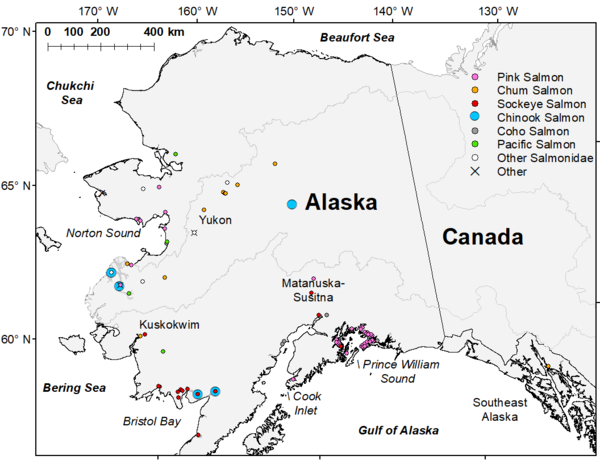
Map showing the premature mortality observations of Pacific salmon carcasses in Alaska
Map showing the premature mortality observations of Pacific salmon carcasses in AlaskaMap showing the premature mortality observations of Pacific salmon carcasses in Alaska during summer and fall of 2019. Symbol color and shape denote Pacific Salmon species or alternative taxonomic groupings specified in the legend.
Map showing the premature mortality observations of Pacific salmon carcasses in Alaska
Map showing the premature mortality observations of Pacific salmon carcasses in AlaskaMap showing the premature mortality observations of Pacific salmon carcasses in Alaska during summer and fall of 2019. Symbol color and shape denote Pacific Salmon species or alternative taxonomic groupings specified in the legend.
Comparison of the body area of walruses in human care in two positions (head up and flat) used for estimating body mass.
Overview illustration of Russia for use with the AK Science Center Bird checklists.