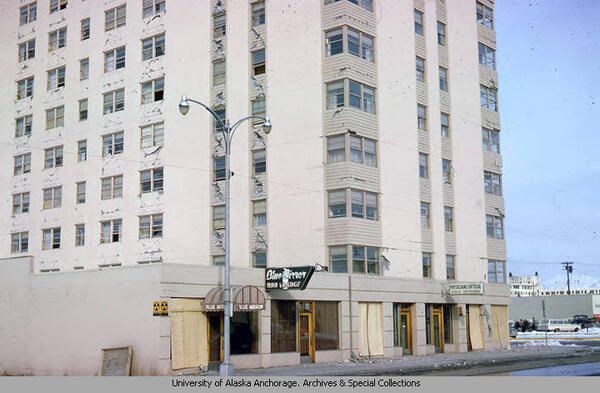
The control tower at Anchorage International Airport fell to the ground during the earthquake. It was a split-level structure that was seven stories high on one side and built of reinforced concrete.
Images
Browse images from a wide range of science topics covered by USGS. All items in this gallery are considered public domain unless otherwise noted.
The control tower at Anchorage International Airport fell to the ground during the earthquake. It was a split-level structure that was seven stories high on one side and built of reinforced concrete.
Annotated photo of ake00346. Album caption: A subsidence trough (or graben) formed at the head of the "L" Street landslide in Anchorage during the earthquake. The slide block, which is the virtually unbroken ground tot he left of graben, moved to the left. The subsidence trough sank 7 to 10 feet in response to 11 feet of horizontal movement of the slide block.
Arc-shaped bluff that many interpret to be evidence of landsliding during a pre-1964 earthquake of unknown age. The Frank and Maxine Reed Family Staircase at this stop was built to accommodate pedestrian traffic over a steep bluff along West Twelfth Avenue which is made discontinuous by the bluff. There was no sliding on this feature in 1964.
This map shows the extent of ground disrupted by the Fourth Avenue Slide and some of the measured displacements. Much of this area north of Third Avenue has since been re-graded and reinforced. The North-facing slope dropping into Ship Creek has been reinforced at its toe with a buried gravel buttress, giving the park its name.
Annotated Native Hospital landslide in Anchorage District, Cook Inlet Region, Alaska
Annotated Native Hospital landslide in Anchorage District, Cook Inlet Region, AlaskaNative Hospital landslide in Anchorage, showing graben and pressure ridge. The scar of an older landslide is transected by the slide of March 27. Photo lables the hospital and two areas of the main scarp on the 1964 landslide.
Annotated Native Hospital landslide in Anchorage District, Cook Inlet Region, Alaska
Annotated Native Hospital landslide in Anchorage District, Cook Inlet Region, AlaskaNative Hospital landslide in Anchorage, showing graben and pressure ridge. The scar of an older landslide is transected by the slide of March 27. Photo lables the hospital and two areas of the main scarp on the 1964 landslide.
annotated St. Mary's Residence - Old Providence Hospital
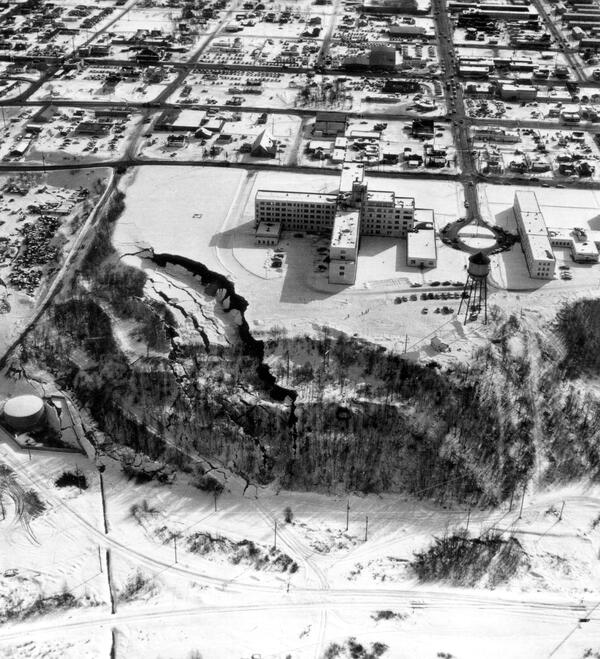
annotated St. Mary's Residence - Old Providence Hospital1964 aerial photograph of St. Mary's Residence and the nearby Four Seasons Apartment Building (#25 on map), Anchorage, Alaska. copyright: Air Photo Tech - NV5 Geospatial. Original photo was used to make annotated version.
annotated St. Mary's Residence - Old Providence Hospital
annotated St. Mary's Residence - Old Providence Hospital1964 aerial photograph of St. Mary's Residence and the nearby Four Seasons Apartment Building (#25 on map), Anchorage, Alaska. copyright: Air Photo Tech - NV5 Geospatial. Original photo was used to make annotated version.
Low-level oblique aerial view of Fairweather fault. Photo taken east of North Dome, looking northwest, August 26, 1958.
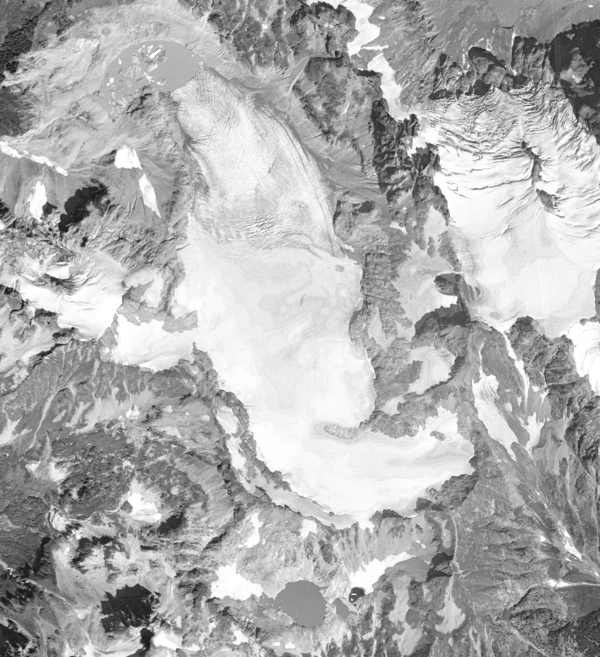
Aerial photograph of South Cascade Glacier, WA taken August 13th, 1958.
A raft of sea otters near Cohen Island in Kachemak Bay, Alaska. Sea otters rest together in groups called rafts. A raft can generally contain 10 to 100 sea otters. You will see either all male or all female with pups rafts.
Emily Reynolds watching sea otters through a spotting scope
Emily Reynolds watching sea otters through a spotting scopeEmily Reynolds, a graduate student, looks through a spotting scope. The student is watching sea otters in Kachemak Bay forage. USGS researchers spend hundreds of hours annually observing sea otter foraging behavior to document prey composition and energy recovery rates.
Emily Reynolds watching sea otters through a spotting scope
Emily Reynolds watching sea otters through a spotting scopeEmily Reynolds, a graduate student, looks through a spotting scope. The student is watching sea otters in Kachemak Bay forage. USGS researchers spend hundreds of hours annually observing sea otter foraging behavior to document prey composition and energy recovery rates.
Unlike their smiling cartoon brethren on television, since 2013, real-life sea stars have been suffering from a wasting disease epidemic in which they lose limbs and literally disintegrate in a matter of days.
Rainbow Over Yukon River, Eagle, Alaska, June 2002
Rainbow Over Yukon River, Eagle, Alaska, June 2002Eagle was our put-in point for our first synoptic cruise down the Yukon River.
Rainbow Over Yukon River, Eagle, Alaska, June 2002
Rainbow Over Yukon River, Eagle, Alaska, June 2002Eagle was our put-in point for our first synoptic cruise down the Yukon River.
Chevak youth help funnel Cackling Geese into holding pen for banding.
Old Chevak ancestral church reborn as research site in 1986 for 25 year cooperative banding program where Chevak youth worked with U.S. Geological Survey and U.S. Fish and Wildlife Service capturing and banding geese and swans along the Kashunuk River on Yukon-Kuskokwim Delta, Alaska.