U.S. flag

An official website of the United States government

Your wait is over, ASTER users.

For years, you have patiently ordered ASTER (Advanced Spaceborne Thermal Emission and Reflection Radiometer) granules or images and waited for them to be processed before you could use them in your projects.

How does getting them immediately sound instead? 

You can now access the full collection of consistently processed ASTER products in NASA’s Earthdata Cloud, thanks to a recently completed effort by staff at the U.S. Geological Survey (USGS) Earth Resources Observation and Science (EROS) Center for NASA’s Land Processes Distributed Active Archive Center (LP DAAC) project at EROS.

Media
Satellite
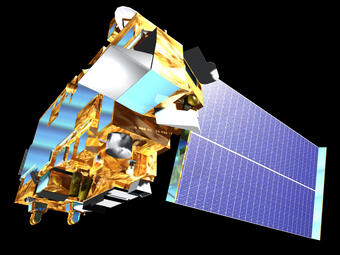
This is a NASA illustration of the Terra satellite, which contains the ASTER instrument.

It was not a small effort. During its 25 years in orbit (and counting) aboard NASA’s Terra satellite, the ASTER instrument has obtained more than 4.7 million images of the Earth’s surface. When multiplied by 11 different products that include ASTER’s thermal and elevation capabilities, the new collection totals more than 4 petabytes (PB) of data. That’s equivalent to more than 1.3 million 3GB HD movies.

Also impressive is the fact that rather than taking an expected 18 months to process all the data, the LP DAAC team has done it in less than a year, starting the effort in January 2025 and completing it in October.

“Almost always, when a data provider is set up to do a historical reprocessing campaign, it takes longer than they anticipate,” said LP DAAC Project Scientist Cole Krehbiel of the USGS. 

“I can’t think of a case where any production effort finished early. Humans tend to be optimistic about planning, so typically we set expectations that are a little too optimistic,” said USGS geographer Thomas Maiersperger, who served as the LP DAAC Project Scientist when discussions about the project began more than five years ago. 

Let’s explore what ASTER data have been used for, what this collection could mean for the future and how the LP DAAC accomplished this immense task.

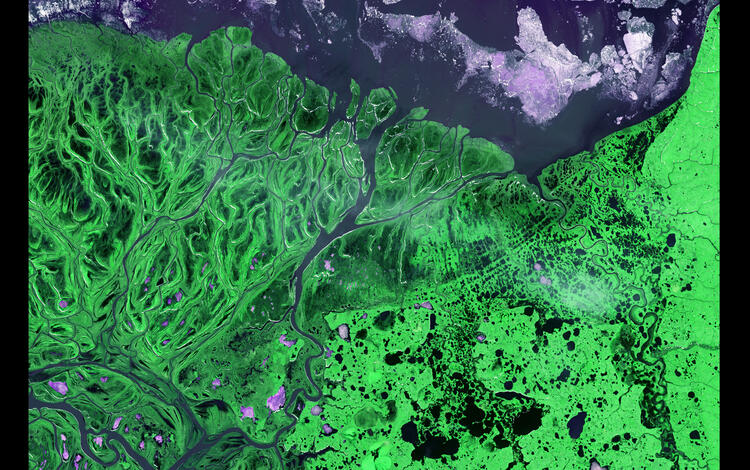
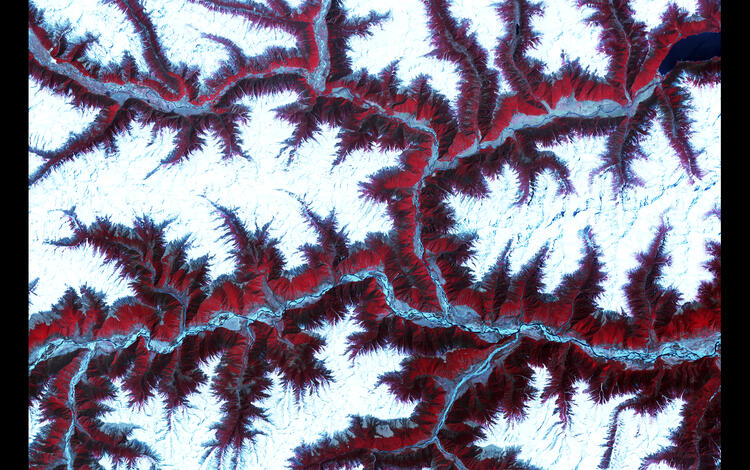
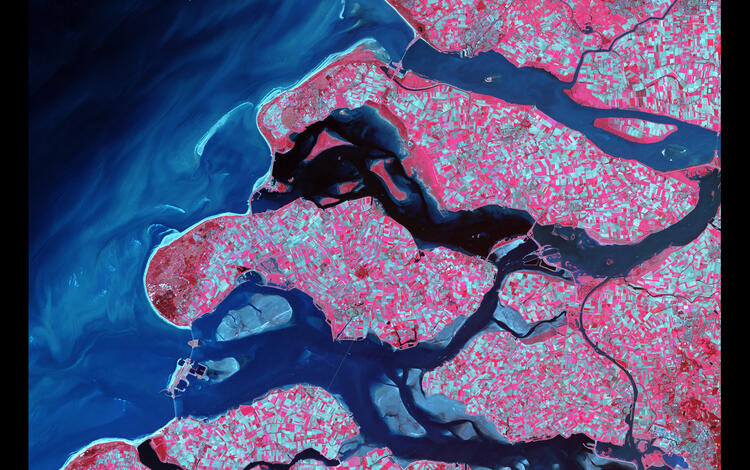
Below: ASTER images in the Earth As Art collection. Carousel above: ASTER image "Lake Disappointment" in the Earth As Art collection.

Earth As art image Yukon Delta
Yukon Delta
Earth As Art image Himalayas
Himalayas
Earth As Art image Delta Region, Netherlands
Delta Region, Netherlands

ASTER’s Capabilities and Limitations

The ASTER instrument was the result of a partnership between NASA and Japan’s Ministry of Economy, Trade and Industry, which built it. Technology has greatly changed since ASTER launched at the end of the last century—on December 18, 1999. At the time, just a few people had primitive smartphones, and most people who had internet connected via dial-up. 

Technical constraints limited the ability to record and downlink ASTER data, as well as processing capacity and storage capacity. As a result, ASTER still can collect data for only 8 minutes of every 99-minute orbit, which adds as many as 700 daytime and nighttime images per day to the archive. Image collection is selective, prioritizing significant land features that ASTER captures well such as volcanoes and glaciers, areas recently affected by natural disasters, special requests from data users, and then filling in with the rest of the Earth’s land surfaces. 

ASTER captures data in an area that’s 60 by 60 kilometers, with spatial resolutions ranging from 15 to 90 meters—much higher than other instruments on Terra, such as MODIS (Moderate Resolution Imaging Spectroradiometer), whose best resolution is 250 meters. 

Especially notable are ASTER’s capabilities of capturing thermal infrared imagery in five wavelengths on the electromagnetic spectrum, called bands, and capturing imagery from two directions to produce a 3D-like image that is used to generate digital elevation models (DEMs). Altogether, ASTER was designed with 14 visible and infrared bands. 

ASTER data have yielded a variety of uses, including glacier, volcano and hazard monitoring, vegetation and ecosystem dynamics, hydrology, geology and soils, and land surface and land cover change.    

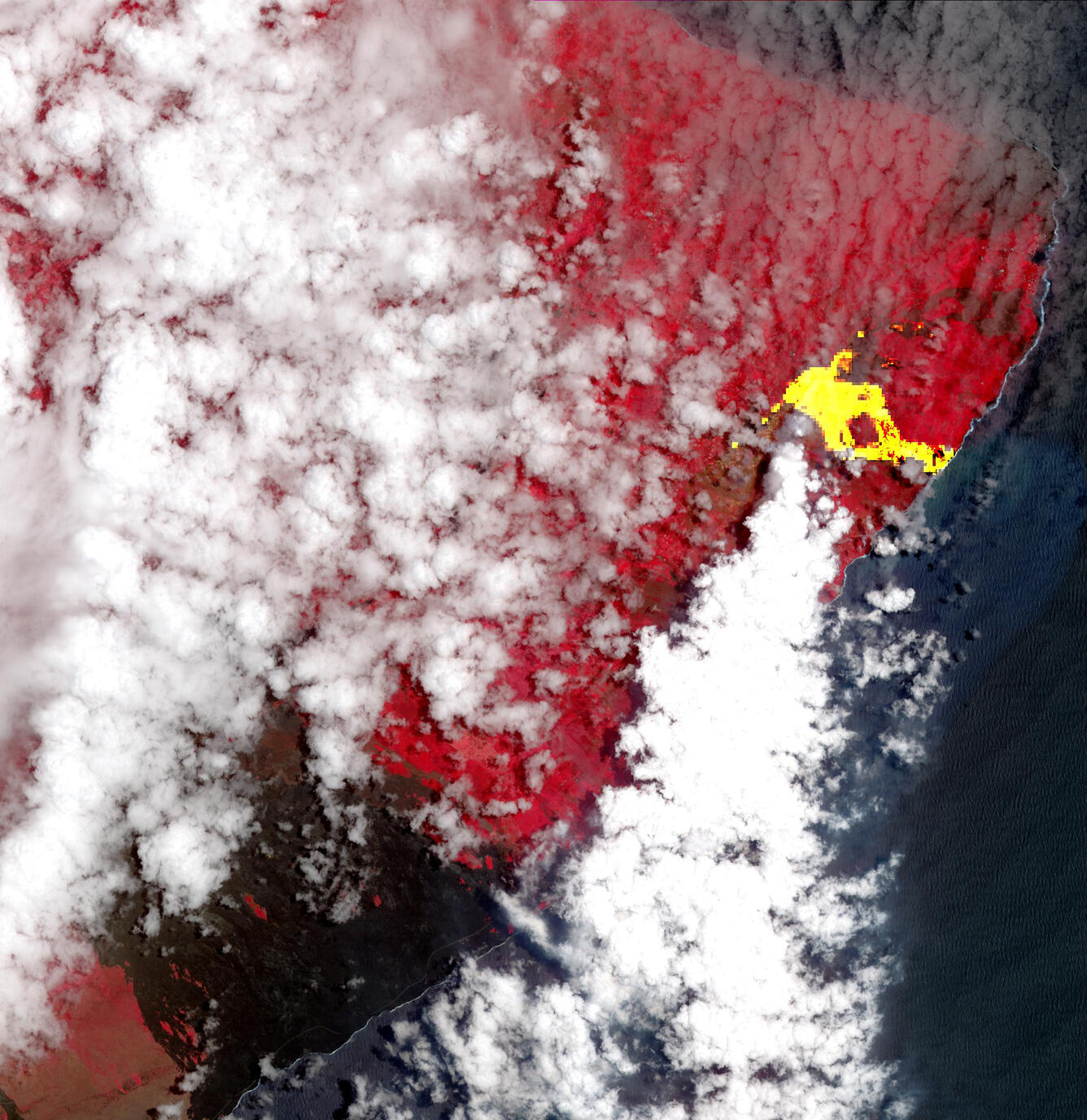
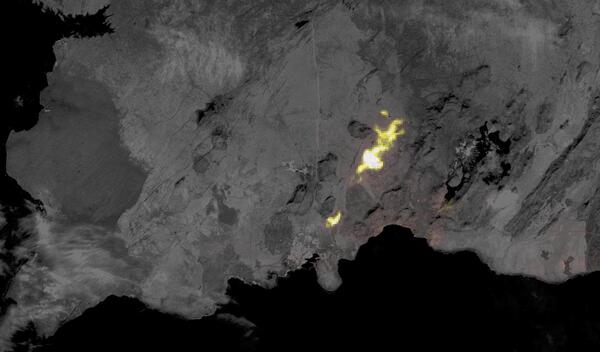
Background: This ASTER image from May 22, 2018, of an eruption at Kilauea in Hawaii displays vegetation in red, clouds in white and the hot lava flows, detected by ASTER's thermal infrared channels, overlaid in yellow. Lava flows from the eruption had reached the ocean, and the combination of molten lava and seawater produced clouds of noxious gases, such as hydrogen sulfide. Image courtesy of NASA.


ASTER image of an eruption at Kilauea

Unleashed Potential for Large-Scale Models

The new collection swings the door wide open for researchers to access large amounts of ASTER data in the cloud for projects that were too big for their systems to tackle or too tedious to access before. Prior to 2016, images were processed and made available only after users requested and paid for them. The processing-on-demand method implemented in 2016 provided imagery at no cost, but users still had to make the requests, wait for the processing and then download the results.

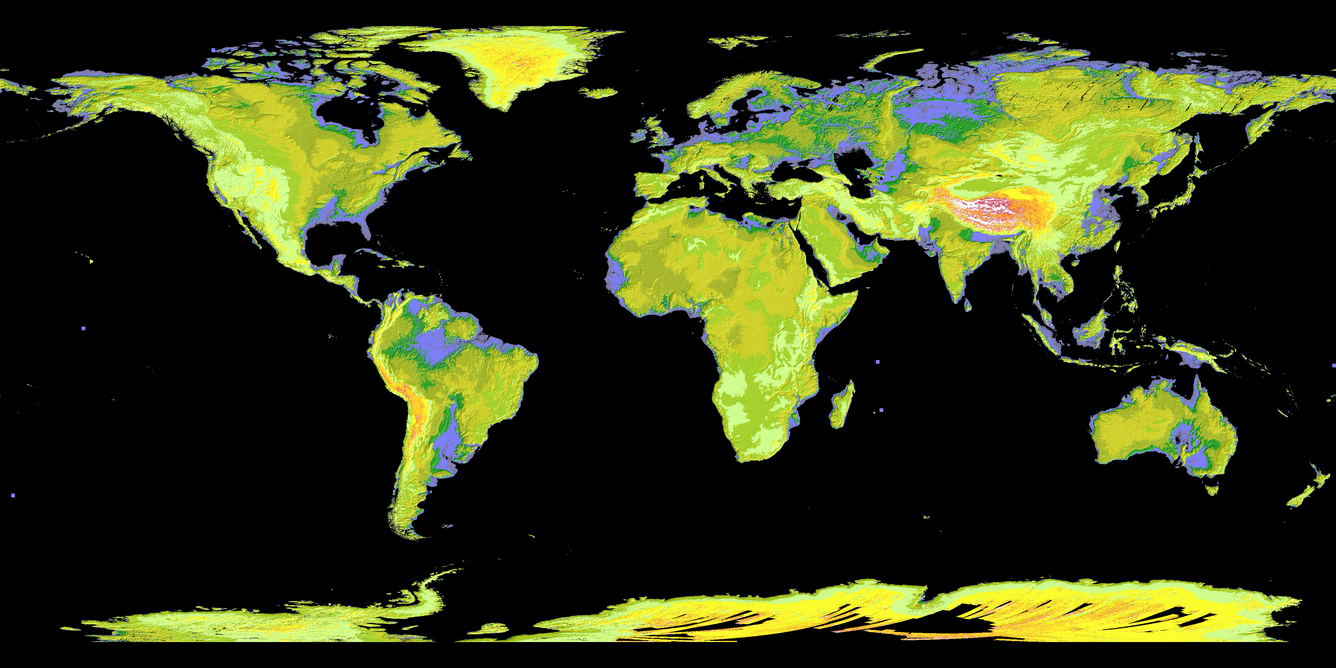
One massive project, the ASTER Global Digital Elevation Model (GDEM), required the NASA and Japan ASTER science teams to produce it. The first version, released in 2009, used 1.2 million stereo granules, while the 2019 release of the latest version—the third—used 1.8 million stereo granules and also included the ASTER Global Water Bodies Database. 

Media
Map of the world's land masses in various colors with North and South American on the left
In this colorized version of the ASTER Global Digital Elevation Model (GDEM), low elevations are purple, medium elevations are greens and yellows, and high elevations are orange, red and white. 

Stereo granules are pairs of images, one captured by a telescope looking straight down and the second captured very shortly afterward as the telescope looks back at the same spot. Nearly all of ASTER’s daytime images have stereo granules.

“ASTER GDEM is really a keystone in the archive,” Krehbiel said. “It's the second most used product in the LP DAAC archive in terms of unique users.” 

People who monitor glaciers have found ASTER’s DEM capabilities useful for showing change in glaciers. But keeping an eye on all 200,000 glaciers scattered around the world presents a challenge. As a solution, the ASTER Science Team created the Global Land Ice Measurements from Space (GLIMS) Glacier Database, which is a global inventory of land ice, including surface topography, that relies primarily on ASTER data.

The thermal infrared bands on ASTER help estimate surface temperature, which can be useful in monitoring not only glaciers but also volcanoes, fires and even Yellowstone National Park’s hydrothermal features with daytime and nighttime imagery acquisitions. 

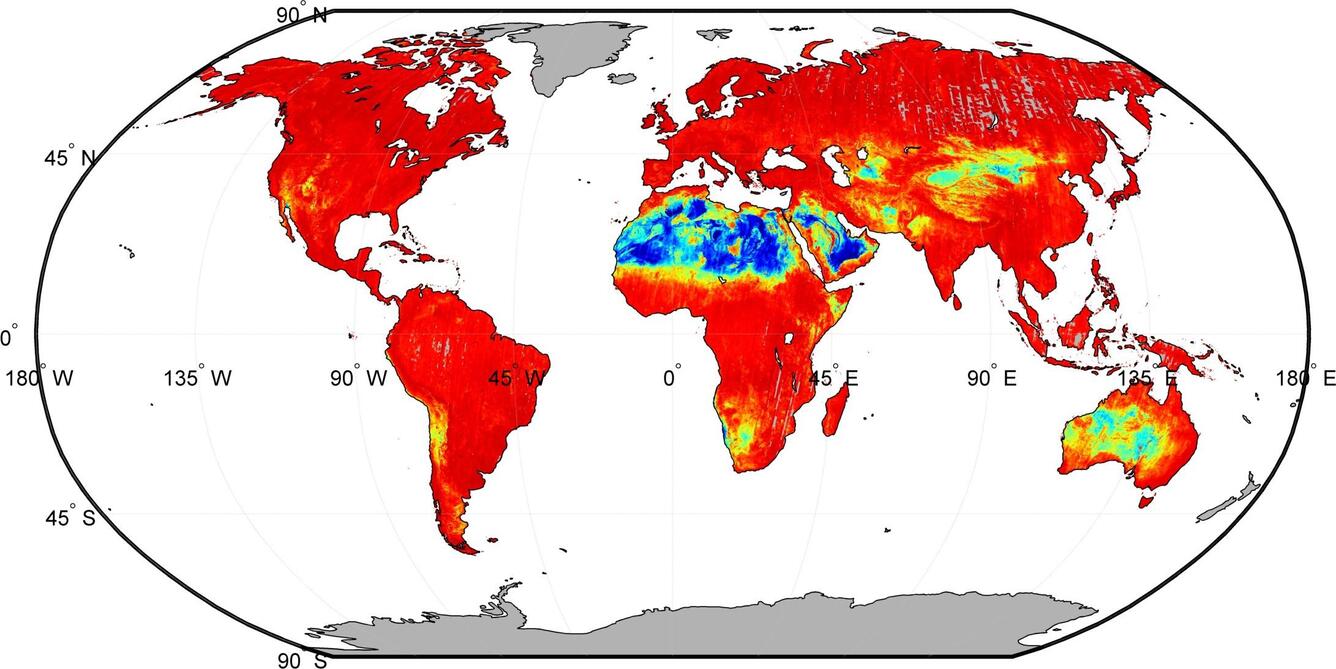
Related databases are the ASTER Volcano Archive, with images and information about 1,430 recently active volcanoes, and the ASTER Global Emissivity Dataset (GED), which is a measure of how efficiently heat energy is radiated from the Earth’s surface.

Media
Map of the world with key latitude and longitude labels and variety of colors over the countries, mostly red
The ASTER Global Emissivity Database (GED) was released in 2014 using the archive of ASTER scenes from 2000 to 2008. Here, lower emissivities are shown in blue and green in arid and semiarid regions, and higher emissivities are shown in orange and reds in areas of dense vegetation, water or ice/snow surfaces.

Scientist Valued ASTER Data from the Beginning

R. Greg Vaughan has used ASTER data since it first became available while he was a Ph.D. student working with rock and mineral mapping. He then worked on a postdoc with the ASTER Science Team at the NASA Jet Propulsion Laboratory, where he used ASTER data to study active volcanoes and geothermal systems. 

Now Vaughan is the remote sensing lead for the USGS Yellowstone Volcano Observatory and a research geologist based at the USGS Astrogeology Science Center. He began working at the USGS in 2008, studying Yellowstone’s thermal areas. 

“At the time, ASTER was the only moderate-resolution thermal infrared instrument available to get frequent nighttime imagery over Yellowstone,” Vaughan said. Nighttime images, especially in the winter, provide the best contrast between thermal areas and the colder background. 

“And the excellent radiometric quality of ASTER thermal infrared data allowed me to make quantitative estimates of the geothermal radiant heat output from Yellowstone’s thermal areas,” Vaughan added.

Now, with the ASTER collection spanning such a long time period, Krehbiel sees potential for data users who want to compare change over time for an area of any size, or who want to compile a large model or database.

“They’ve got the entire archive at their fingertips, so they could create their own digital elevation models, or maybe annual composite digital elevation model or annual emissivity database,” Krehbiel said. “The one that I get really excited about that hasn't happened yet is a global surface mineralogy product—a base map of the surface mineral composition of Earth.”

Another bonus of the new ASTER collection is increased compatibility with Landsat Earth observation satellite data, which has a 53-year record, for people who wish to use both together. ASTER L1T, a popular terrain-corrected ASTER product, includes updates to the input DEM sources and ground control points to match Landsat Collection 2. 

Background: The Abyss Pool at Yellowstone National Park. USGS photo.

Complex Task Yields Standardized Data

The idea to create a collection of ASTER data stemmed from the goal of moving all the LP DAAC’s archive into the cloud, which also includes data from MODIS, Visible Infrared Imaging Radiometer Suite (VIIRS) and Harmonized Landsat Sentinel-2 (HLS), among others.

Processing the raw ASTER data into a higher-level collection and eliminating the on-demand step just made sense, though it didn’t make the project less daunting. One advantage: The USGS Landsat team at EROS had some excess hardware that the LP DAAC could borrow to help speed up the process. But there were still challenges.

“There’s nothing elegant about doing all this image processing,” Maiersperger said. “It's complex, and it’s difficult, and there’s a lot of things that come up. You are constantly monitoring and firefighting on errors and anomalies and exceptions and edge cases.”

But it’s worth it. The new collection offers more standardized data, Maiersperger added. Users previously selected some options when they requested how their images were processed, which could yield slightly different results for the same image. Now, they can be confident that the data access in the cloud is consistent throughout the entire archive.

Of course, with the ASTER instrument still active, the LP DAAC is not finished processing data, as newly acquired imagery continues to be added to the cloud archive. However, in late 2026 or early 2027, the Terra satellite is expected to begin shutting down operations, and ASTER would finish collecting imagery by then.

Satellite image of a glacier with chunks of ice in the water around the end of it
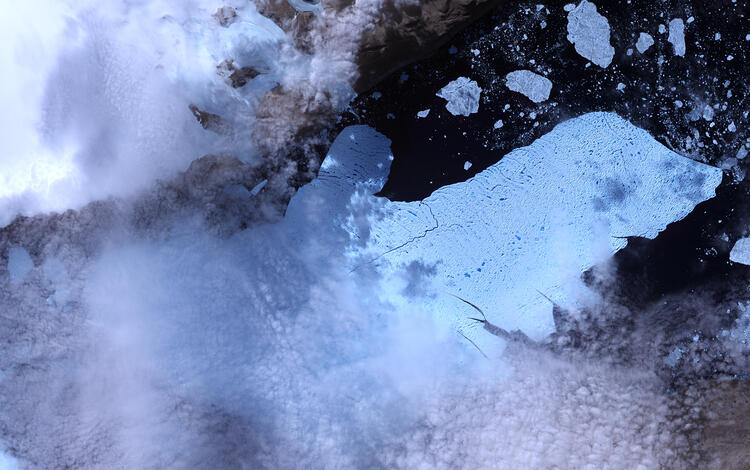
ASTER image of Petermann Glacier and an ice island
Satellite image of a volcano crater filled with a lake and green vegetation down much of the sides
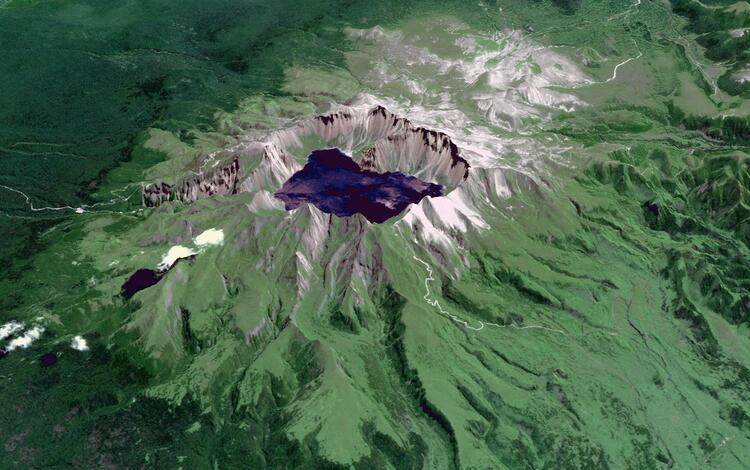
ASTER image of Baektu Mountain, an active volcano on the border between North Korea and China

Above: Two notable user communities of ASTER data are glacier and volcano scientists. The left image, acquired August 11, 2010, shows a massive ice island dominating the center of the image that had broken off the Petermann Glacier in northwestern Greenland on August 5, 2010. This false-color image of the ice island displays ice in light blue, water as nearly black, and clouds as nearly white. The right image from 2014 shows Baektu Mountain, an active volcano on the border between North Korea and China, with a crater lake at the summit called Heaven Lake.

In addition to contributing an extensive archive to the world of remote sensing, ASTER has also served as an inspiration. ASTER was an example of a successful international remote sensing collaboration, which NASA has continued to pursue. In 2025 alone, NASA launched the NASA-ISRO Synthetic Aperture Radar (NISAR) satellite in partnership with the Indian Space Research Organization, as well as Sentinel 6-B, a radar satellite whose partners include ESA (European Space Agency), EUMETSAT (European Organisation for the Exploitation of Meteorological Satellites), the European Commission and the French space agency CNES. 

ASTER also helped demonstrate the capabilities and usefulness of various types of data, including thermal, for future remote sensing missions to consider, such as NASA’s ECOSTRESS (ECOsystem Spaceborne Thermal Radiometer Experiment on Space Station) instrument.

“These science instruments and science missions fill a part of this continuum that actually boosts what comes after,” Maiersperger said.

Was this page helpful?