



GLSC Director Russ Strach presents the 2018 GLSC Moffett Award to lead author Yu-Chun Kao for his 2017 paper, Evaluating Stocking Efficacy in an Ecosystem Undergoing Oligotrophication, with GLSC coauthors Mark Rogers and David “Bo” Bunnell.
Images
Images captured by GLSC scientists while working in and around the Great Lakes.
Filter Total Items: 494

Moffett Award Presented to Yu-Chun Kao
GLSC Director Russ Strach presents the 2018 GLSC Moffett Award to lead author Yu-Chun Kao for his 2017 paper, Evaluating Stocking Efficacy in an Ecosystem Undergoing Oligotrophication, with GLSC coauthors Mark Rogers and David “Bo” Bunnell.

GLSC Greenhouse
GLSC’s Aaron DeVries and Mckenzie Smith, left, discuss innovative controls for invasive Phragmites australis in GLSC’s greenhouse facility.
GLSC’s Aaron DeVries and Mckenzie Smith, left, discuss innovative controls for invasive Phragmites australis in GLSC’s greenhouse facility.
A crayfish in our sample area
A diver points at a small crayfish near a pivot point used for circular transects in Lake Ontario.
A diver points at a small crayfish near a pivot point used for circular transects in Lake Ontario.

A Circular Transect in Lake Ontario
Two SCUBA divers, one at the center pivot (on the left), the other running an integrated camera and scooter (right) run a circular transect in Lake Ontario
Two SCUBA divers, one at the center pivot (on the left), the other running an integrated camera and scooter (right) run a circular transect in Lake Ontario

A center pivot is used for circular transects
A diver is holding onto a pole which is used as a pivot point. A line can be seen that a diver attachs to a camera for running circular transects. Image taken in Lake Michigan near South Manitou Island.
A diver is holding onto a pole which is used as a pivot point. A line can be seen that a diver attachs to a camera for running circular transects. Image taken in Lake Michigan near South Manitou Island.

Preparing to Collect Data in Lake Ontario
A camera integrated wth a dive scooter is lowered into the water in Lake Ontario
A camera integrated wth a dive scooter is lowered into the water in Lake Ontario

The Diver's Point of View
This is the view a SCUBA diver has using our integrated camera and scooter instrument in Lake Huron.
This is the view a SCUBA diver has using our integrated camera and scooter instrument in Lake Huron.

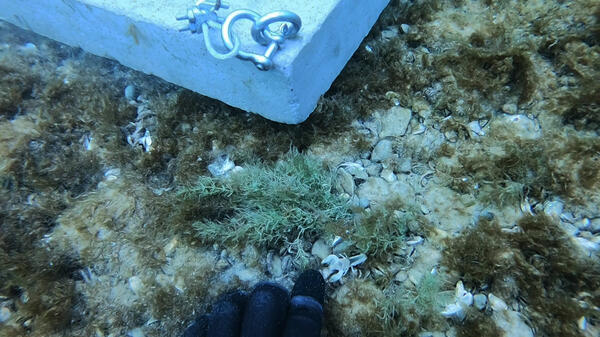
Lake Michigan lake bottom and the corner of a pivot point
Lake Michigan lake bottom and the corner of a pivot pointLake Michigan lake-bottom near South Manitou Island. Visible is part of a diver's hand and the corner of a anchor point used for circular transects.
Lake Michigan lake bottom and the corner of a pivot point
Lake Michigan lake bottom and the corner of a pivot pointLake Michigan lake-bottom near South Manitou Island. Visible is part of a diver's hand and the corner of a anchor point used for circular transects.

Deploying Underwater Camera in Lake Michigan
USGS personnel: Sam Pecoraro (left), Tanner Kenney (middle), and Scott Dwyer (right; in the water) deploying an underwater camera in Lake Michigan near South Manitou Island.
USGS personnel: Sam Pecoraro (left), Tanner Kenney (middle), and Scott Dwyer (right; in the water) deploying an underwater camera in Lake Michigan near South Manitou Island.

A Smallmouth Bass in Lake Ontario
A smallmouth bass swims near a diver in Lake Ontario.
A smallmouth bass swims near a diver in Lake Ontario.

US Congressman Dan Kildee with USGS personnel aboard the R/V Arcticus
US Congressman Dan Kildee with USGS personnel aboard the R/V ArcticusUS Congressman Dan Kildee (MI-05) and his Senior Legislative Assistant Jordan Dickinson experience Great Lakes fisheries research first hand aboard the USGS research vessel Arcticus.
US Congressman Dan Kildee with USGS personnel aboard the R/V Arcticus
US Congressman Dan Kildee with USGS personnel aboard the R/V ArcticusUS Congressman Dan Kildee (MI-05) and his Senior Legislative Assistant Jordan Dickinson experience Great Lakes fisheries research first hand aboard the USGS research vessel Arcticus.

US Congressman Dan Kildee with GLSC employees next to R/V Arcticus
US Congressman Dan Kildee with GLSC employees next to R/V ArcticusUS Congressman Dan Kildee (MI-05), third from left, and his Senior Legislative Assistant Jordan Dickinson, third from right, visit the science and vessel crew of the USGS research vessel Arcticus. Jill Wingifield of the Great Lakes Fishery Commission, second from right, also joined the two-hour cruise.
US Congressman Dan Kildee with GLSC employees next to R/V Arcticus
US Congressman Dan Kildee with GLSC employees next to R/V ArcticusUS Congressman Dan Kildee (MI-05), third from left, and his Senior Legislative Assistant Jordan Dickinson, third from right, visit the science and vessel crew of the USGS research vessel Arcticus. Jill Wingifield of the Great Lakes Fishery Commission, second from right, also joined the two-hour cruise.

Staff from NYSDEC and volunteers release 2,500 lake sturgeon into Cayu
Staff from NYSDEC and volunteers release 2,500 lake sturgeon into CayuStaff from NYSDEC and volunteers release 2,500 lake sturgeon into Cayuga Lake.
Staff from NYSDEC and volunteers release 2,500 lake sturgeon into Cayu
Staff from NYSDEC and volunteers release 2,500 lake sturgeon into CayuStaff from NYSDEC and volunteers release 2,500 lake sturgeon into Cayuga Lake.

Volunteers mark lake sturgeon at the NYSDEC Oneida Hatchery
Volunteers mark lake sturgeon at the NYSDEC Oneida HatcheryVolunteers mark lake sturgeon at the NYSDEC Oneida Hatchery
Volunteers mark lake sturgeon at the NYSDEC Oneida Hatchery
Volunteers mark lake sturgeon at the NYSDEC Oneida HatcheryVolunteers mark lake sturgeon at the NYSDEC Oneida Hatchery

Diver's view of underwater camera in Lake Michigan
Diver's view of underwater camera in Lake MichiganRobotic System

Maumee River Watershed
The Maumee River Watershed with Areas of Concern
The Maumee River Watershed with Areas of Concern

Phragmites Causing a Safety Hazard
Phragmites australis (ssp. australis) is commonly found along roadways. Credit: USGS Great Lakes Science Center.
Phragmites australis (ssp. australis) is commonly found along roadways. Credit: USGS Great Lakes Science Center.

Biologist Murulee Byappanahalli with students at the Chesterton lab
Biologist Murulee Byappanahalli with students at the Chesterton labMurulee Byappanahalli GLSC; Lake Michigan Ecological Research Station; LMERS; Chesterton, Indiana, IN; students from Indiana University Northwest visit to learn about microbiology science and applications; outreach;
Biologist Murulee Byappanahalli with students at the Chesterton lab
Biologist Murulee Byappanahalli with students at the Chesterton labMurulee Byappanahalli GLSC; Lake Michigan Ecological Research Station; LMERS; Chesterton, Indiana, IN; students from Indiana University Northwest visit to learn about microbiology science and applications; outreach;

Otolith from a Bloater Chub used for age analysis
An otolith, sometimes called “earstone,” of a bloater, a small prey fish in the Great Lakes. Fishery scientists interpret the age of bloater and other fishes by counting annual growth rings on their otoliths.
An otolith, sometimes called “earstone,” of a bloater, a small prey fish in the Great Lakes. Fishery scientists interpret the age of bloater and other fishes by counting annual growth rings on their otoliths.

Field of Phragmites
Field of Phragmites near Cedar Point, Ohio.
Field of Phragmites near Cedar Point, Ohio.
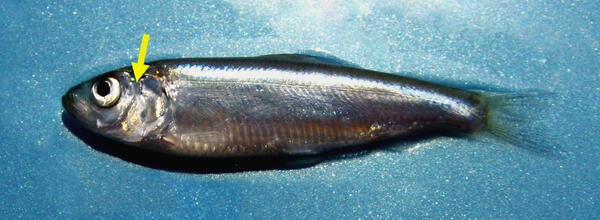
Location of Otolith Inside Alewife
Otoliths are located directly behind the brain of bony fishes. On the young alewife shown here, the approximate location of the otoliths is noted with a yellow arrow.
Otoliths are located directly behind the brain of bony fishes. On the young alewife shown here, the approximate location of the otoliths is noted with a yellow arrow.