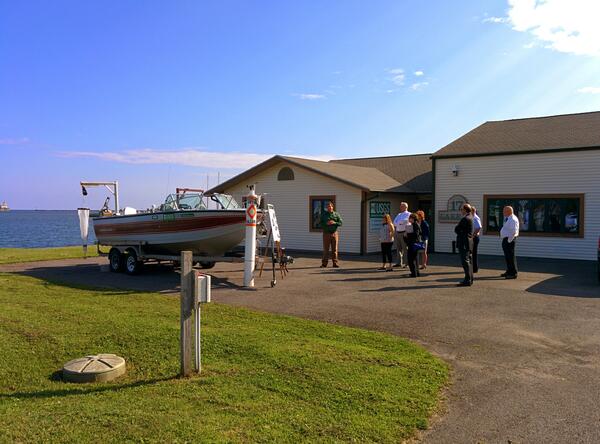
The new, large research vessel (R/V) Arcticus will enable USGS Great Lakes Science Center scientists to explore fish health and water quality in Lakes Michigan and Huron.
Images
Images captured by GLSC scientists while working in and around the Great Lakes.
The new, large research vessel (R/V) Arcticus will enable USGS Great Lakes Science Center scientists to explore fish health and water quality in Lakes Michigan and Huron.
The R/V Arcticus, based in Cheboygan, Michigan, was built in 2014 and currently operates on Lakes Huron and Michigan. The Arcticus is used primarily to carry out annual prey fish assessments, which have occurred since the 1970s.
The new, large research vessel (R/V) Arcticus will enable USGS Great Lakes Science Center scientists to explore fish health and water quality in Lakes Michigan and Huron.
Alexandra Sasha Bozimowski performing wetland sampling.
A bald eagle (Haliaeetus leucocephalus) is seen perched in a tree in the Ottawa National Wildlife Refuge. Image credit: Michael Eggleston, USGS.
USGS researchers process a fyke net sample from a restored wetland unit by identifying and enumerating the captured fish species. Photo Credit: USGS
R/V Sturgeon leaving dock at the Navy Pier in Chicago, IL
R/V Sturgeon leaving dock at the Navy Pier in Chicago, ILThe R/V Sturgeon setting sail from the Navy Pier in Chicago, IL on its fall survey of Lake Michigan. The Sturgeon is based in Cheboygan, MI at the Cheboygan Vessel Base.
R/V Sturgeon leaving dock at the Navy Pier in Chicago, IL
R/V Sturgeon leaving dock at the Navy Pier in Chicago, ILThe R/V Sturgeon setting sail from the Navy Pier in Chicago, IL on its fall survey of Lake Michigan. The Sturgeon is based in Cheboygan, MI at the Cheboygan Vessel Base.
The R/V Kaho in Lake Ontario. The Kaho is stationed at the Lake Ontario Biological Station in Oswego, NY.
GLSC Biologist Brian Weidel explains the importance of the small vessel program outside the Lake Ontario Biological Station in Oswego, New York.
Researcher holding Cladophora glomerata collected in Lake Michigan
A sea lamprey (Petromyzon marinus) in a tank at the Hammond Bay Biological Station, a field station of the Great Lakes Science Center. Photo Credit: Andrea Miehls, USGS
An iceberg floating in Lake Superior, June 2014. Photographed from the R/V Kiyi.
An experimental Sea Lamprey trap with pulsed direct current in Bridgeland Creek, Ontario. This experiment is conducted by the Hammond Bay Biological Station (GLSC) located in MIllersburg, MI.
Sea Lamprey at the Hammond Bay Biological Statioin in Millersburg, MI
Hammond Bay Biological Station researcher Nick Johnson pipettes a sea lamprey pheromone into a vial. Research on pheromones aims to develop tools to disrupt sea lamprey migration and reproduction as well as improve trapping efforts.
Field Overgrown with Phragmites
Chuck Madenjian placing his estimate for the days catch aboard the R/V Sturgeon on the Fall Lake Trout Survey on Lake Michigan.
Dr. Kurt Kowalski in a Tall Phragmites Stand. Crane Creek, USFWS Ottawa National Wildlife Refuge.
Wetland scientist Kurt Kowalski (GLSC) in a stand of Phragmites australis, or common reed, an invasive species in the Great Lakes. Crane Creek, Ottawa National Wildlife Refuge, OH.