An official website of the United States government
Here's how you know
Official websites use .gov
A .gov website belongs to an official government organization in the United States.
Secure .gov websites use HTTPS
A lock () or https:// means you’ve safely connected to the .gov website. Share sensitive information only on official, secure websites.
Part of the 2000 annual review of the industrial minerals sector. A general overview of the common clay and shale industry is provided. In 2000, U.S. production increased by 5 percent, while sales or use declined to 23.6 Mt. Despite the slowdown in the economy, no major changes are expected for the market.
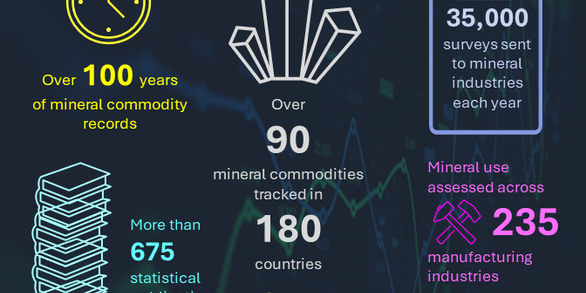
Published on an annual basis, this report is the earliest Government publication to furnish estimates covering nonfuel mineral industry data. Data sheets contain information on the domestic industry structure, Government programs, tariffs, and 5-year salient statistics for over 90 individual minerals and materials.
US ammonia production in 2000 declined by about 7% from 1999. The largest decline occurred in the second half of the year. High natural gas prices caused many plants to close or curtail production near the end of the year. By year-end, about one-third of the US ammonia production capacity was shut down.
A general overview of the fluorspar industry is provided. The U.S. had no reported mine production in 2000. Imports, sales from the U.S. National Defense Stockpile, and small amounts of synthetic fluorspar met domestic fluorspar needs. According to the U.S. Geographical Survey, 509 kt of fluorspar was consumed domestically.
Part of the 2000 annual review of the industrial minerals sector. A general overview of the kaolin industry is provided. In 2000, production of kaolin was estimated to be 8.87 Mt, which is less than the amount produced in 1999. Domestic sales of kaolin decreased in 2000, with sales of kaolin for paper filler applications continuing to drop.
Seawater and natural brines accounted for about 63% of US magnesium compounds production during 2000. Premier Services in Florida, Dow Chemical in Michigan, Martin Marietta Magnesia Specialties, and Rohm & Haas recovered dead-burned and caustic-calcined magnesias from seawater. And Premier Services' recoveries, in Nevada, were from magnasite.
Part of the 2000 annual review of the industrial minerals sector. A general overview of the gemstones industry is provided. Although no extensive commercial mining of gemstones takes place in the U.S., it is the world's leading gemstone market. Total U.S. gemstone trade exceeded $16.9 billion in 2000.
Part of an annual review of mines and mineral resources in the U.S. An overview of nonfuel-mineral exploration in 2000 is presented. Principal exploration target was gold exploration in Latin America, Australia, and the U.S. There was a decrease of 18 percent in the exploration budget for gold as compared with the budget for 1999. Statistical information on nonfuel-mineral exploration...
Part of the 2000 annual review of the industrial minerals sector. A general overview of the ball clay industry is provided. In 2000, sales of ball clay reached record levels, with sanitary ware and tile applications accounting for the largest sales. Ball clay production, consumption, prices, foreign trade, and industry news are summarized. The outlook for the ball clay industry is also...
An overview of the industrial diamond industry is provided. More than 90 percent of the industrial diamond consumed in the U.S. and the rest of the world is manufactured diamond. Ireland, Japan, Russia, and the U.S. produce 75 percent of the global industrial diamond output. In 2000, the U.S. was the largest market for industrial diamond. Industrial diamond applications, prices for...
The estimated production during 2000 of construction aggregates, crushed stone, and construction sand and gravel increased by about 2.6% to 2.7 Gt (3 billion st), compared with 1999. The expansion that started in 1992 continued with record production levels for the ninth consecutive year. By commodity, construction sand and gravel production increased by 4.5% to 1.16 Gt (1.28 billion st)...
Mexico is the leading producer of celestite, the most common strontium ore. Chemical Products is the only major US maker of strontium compounds. It produces all of its strontium carbonate from imported Mexican celestite. Mexico is also a large producer of strontium carbonate, as are China, Germany, Japan and the Republic of Korea. There has been no celestite production in the United...