U.S. flag

An official website of the United States government

Publications

The Center publishes analyses critical to national security on domestic and international mineral supply chains.

Filter Total Items: 605

China, the United States, and competition for resources that enable emerging technologies China, the United States, and competition for resources that enable emerging technologies

Historically, resource conflicts have often centered on fuel minerals (particularly oil). Future resource conflicts may, however, focus more on competition for nonfuel minerals that enable emerging technologies. Whether it is rhenium in jet engines, indium in flat panel displays, or gallium in smart phones, obscure elements empower smarter, smaller, and faster technologies, and nations...
Authors
Andrew Gulley, Nedal T. Nassar, Sean Xun

Draft critical mineral list—Summary of methodology and background information—U.S. Geological Survey technical input document in response to Secretarial Order No. 3359 Draft critical mineral list—Summary of methodology and background information—U.S. Geological Survey technical input document in response to Secretarial Order No. 3359

Pursuant to the Presidential Executive Order (EO) No. 13817, “A Federal Strategy to Ensure Secure and Reliable Supplies of Critical Minerals,” the Secretary of the Interior, in coordination with the Secretary of Defense, and in consultation with the heads of other relevant executive departments and agencies, was tasked with developing and submitting a draft list of minerals defined as...
Authors
Steven Fortier, Nedal T. Nassar, Graham Lederer, Jamie Brainard, Joseph Gambogi, Erin McCullough

Mineral commodity summaries 2018 Mineral commodity summaries 2018

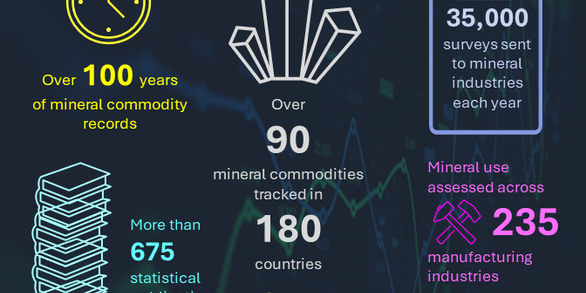
This report is the earliest Government publication to furnish estimates covering 2017 nonfuel mineral industry data. Data sheets contain information on the domestic industry structure, Government programs, tariffs, and 5-year salient statistics for more than 90 individual minerals and materials.
Authors
Joyce Ober

Globally sourced mineral commodities used in U.S. Navy SEAL gear—An illustration of U.S. net import reliance Globally sourced mineral commodities used in U.S. Navy SEAL gear—An illustration of U.S. net import reliance

A U.S. Navy SEAL (an acronym for sea, air, land) carries gear containing at least 23 nonfuel mineral commodities for which the United States is greater than 50 percent net import reliant. The graphics display the leading world producers of selected nonfuel mineral commodities used to manufacture U.S. Navy SEAL gear. SEALs are members of the U.S. Navy's special operations forces.
Authors
Jamie Brainard, Nedal T. Nassar, Joseph Gambogi, Michael S. Baker, Michael T. Jarvis

Recent trends in Cuba’s mining and petroleum industries Recent trends in Cuba’s mining and petroleum industries

In response to recent diplomatic developments between Cuba and the United States, the National Minerals Information Center compiled available information on the mineral industries of Cuba. This fact sheet highlights a new map and table that identify mines, mineral processing facilities, and petroleum facilities as well as information on location, operational status, and ownership. It...
Authors
Susan Wacaster, Michael S. Baker, Yadira Soto-Viruet, Steven Textoris

Critical mineral resources of the United States—Economic and environmental geology and prospects for future supply Critical mineral resources of the United States—Economic and environmental geology and prospects for future supply

SummaryMineral commodities are vital for economic growth, improving the quality of life, providing for national defense, and the overall functioning of modern society. Minerals are being used in larger quantities than ever before and in an increasingly diverse range of applications. With the increasing demand for a considerably more diverse suite of mineral commodities has come renewed...

Graphite Graphite

Graphite is a form of pure carbon that normally occurs as black crystal flakes and masses. It has important properties, such as chemical inertness, thermal stability, high electrical conductivity, and lubricity (slipperiness) that make it suitable for many industrial applications, including electronics, lubricants, metallurgy, and steelmaking. For some of these uses, no suitable...
Authors
Gilpin Robinson, Jane Hammarstrom, Donald Olson

Tellurium Tellurium

Tellurium (Te) is a very rare element that averages only 3 parts per billion in Earth’s upper crust. It shows a close association with gold and may be present in orebodies of most gold deposit types at levels of tens to hundreds of parts per million. In large-tonnage mineral deposits, such as porphyry copper and seafloor volcanogenic massive sulfide deposits, sulfide minerals may contain...
Authors
Richard Goldfarb, Byron Berger, Micheal George, Robert R. Seal,

Beryllium Beryllium

Beryllium is a mineral commodity that is used in a variety of industries to make products that are essential for the smooth functioning of a modern society. Two minerals, bertrandite (which is supplied domestically) and beryl (which is currently supplied solely by imports), are necessary to ensure a stable supply of high-purity beryllium metal, alloys, and metal-matrix composites and...
Authors
Nora Foley, Brian W. Jaskula, Nadine M. Piatak, Ruth Schulte

Gallium Gallium

Gallium is a soft, silvery metallic element with an atomic number of 31 and the chemical symbol Ga. Gallium is used in a wide variety of products that have microelectronic components containing either gallium arsenide (GaAs) or gallium nitride (GaN). GaAs is able to change electricity directly into laser light and is used in the manufacture of optoelectronic devices (laser diodes, light...
Authors
Nora Foley, Brian W. Jaskula, Bryn Kimball, Ruth Schulte

Manganese Manganese

Manganese is an essential element for modern industrial societies. Its principal use is in steelmaking, where it serves as a purifying agent in iron-ore refining and as an alloy that converts iron into steel. Although the amount of manganese consumed to make a ton of steel is small, ranging from 6 to 9 kilograms, it is an irreplaceable component in the production of this fundamental...
Authors
William Cannon, Bryn Kimball, Lisa Corathers

Rare-earth elements Rare-earth elements

The rare-earth elements (REEs) are 15 elements that range in atomic number from 57 (lanthanum) to 71 (lutetium); they are commonly referred to as the “lanthanides.” Yttrium (atomic number 39) is also commonly regarded as an REE because it shares chemical and physical similarities and has affinities with the lanthanides. Although REEs are not rare in terms of average crustal abundance...
Authors
Bradley Van Gosen, Philip Verplanck, Robert R. Seal,, Keith Long, Joseph Gambogi
Was this page helpful?