



Controls on habitat for native lamprey in the Siletz River Basin
Chinook Salmon and Pacific Lamprey are culturally significant fishes to the Tribal community along the Siletz River, Oregon. The USGS studied how streamflow and bedload conditions may influence mainstem spawning habitats.
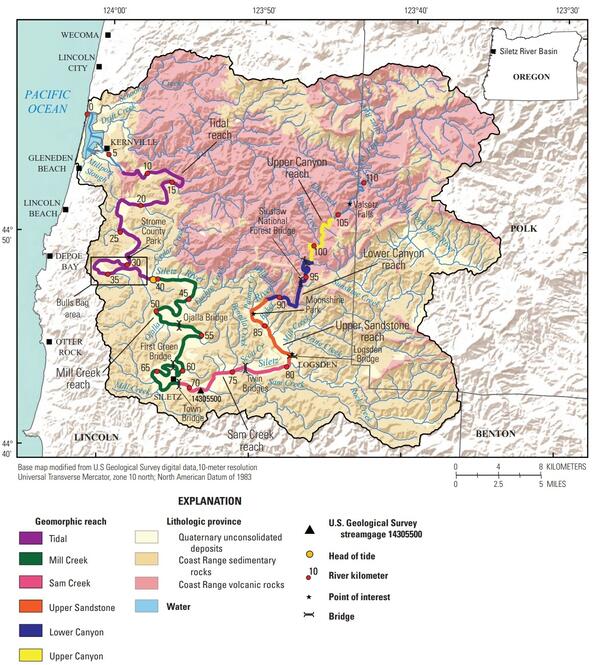
In cooperation with the Confederated Tribes of the Siletz Indians of Oregon (Tribe), the USGS completed a comprehensive assessment of present and future habitat conditions for Chinook salmon (Oncorhynchus tshawytscha) and Pacific lamprey (Entosphenus tridentatus) in the Siletz River Basin. The study integrated hydrology and geomorphology expertise of the USGS Oregon Water Science Center and fish biology expertise of the USGS Forest and Rangeland Ecosystem Science Center to examine:
- Channel changes over time.
- Patterns of riverbed sediment that make up fish habitats.
- Hydraulics and sediment transport.
- Potential burrowing habitat for lamprey larvae.
Results provide insights on the potential responsiveness of the Siletz River to projected increases in future streamflow.
(1) The study team examined how the location of the channel and area of gravel bars changed from 1939 to 2016 to characterize the relative responsiveness of the Siletz River to change over time. They found the location of the Siletz River channel and the size of its gravel bars was relatively stable along a 97-kilometer stretch. This overall stability of the Siletz River is because of the bedrock and terraces that act like natural walls confining the river. Only a few short sections had noticeable changes in channel location and gravel bar area. These sections, usually less than a kilometer long, were located at river bends and where the channel is wider.
(2) The study team characterized patterns in bed-material sediment particles -the building blocks of habitat for Chinook salmon and Pacific lamprey. The size of sediment particles on gravel bars generally declined downstream along a 54-kilometer stretch in the study area. Some changes in this pattern occurred where channel width and slope changed considerably and tributaries delivered sediment to the Siletz River.
(3) The study team assessed hydraulics and bedload sediment transport for a range of streamflows to understand how flow events transport and deposit bed-material sediment and influence habitat conditions for Chinook salmon and Pacific lamprey. Overall, the biggest increases in water velocity and the bedload sediment transport capacity occur during flow events that happen every 1 to 2 years. Smaller flow volumes generally stay within the riverbanks, while larger flows inundate nearby gravel bars and low floodplain areas. Several moderate floods in one year—like in water year 1996—can move just as much (or more) sediment than one large flood—like in water year 2000. For most of the Siletz River between Wildcat Creek and the City of Siletz, the river has more power to move sediment than there is sediment available. This is clear from the amount of exposed bedrock in the channel. Nonetheless, the river’s ability to transport sediment changes from year to year and along the river, depending on flow and local hydraulics.
(4) The study team assessed how much of the stream network may support potential burrowing habitat (PBH) for lamprey larvae. About 28 % of the Siletz River and its tributaries meet the conditions needed to support PBH for lamprey larvae —areas where sediment grain size and channel slope are apt to allow for fine sediment deposition. However, the large areas of exposed bedrock along the Siletz River and the river’s ability to move sediment likely limit how much of burrowing habitat exists.
Key implications:
- In the future, moderate increases in autumn-winter streamflows are not expected to result in substantial changes in coarse gravel bars along the Siletz River.
- Projected future increases in streamflow (assuming no large changes in bed-material sediment supply) may result in:
- Selective transport of gravel and smaller sediments that provide spawning habitats for Chinook salmon and Pacific lamprey and burrowing habitats for lamprey larvae.
- Frequent entrainment of lamprey larvae that are burrowed in coarse sand deposits.
- Suspension and downstream transport of salmon eggs incubating in gravels.
- Reductions in the areas of spawning gravels for Chinook salmon and Pacific lamprey.
- Exact implications of current and future streamflow conditions for these species along the Siletz River depend on many factors, including sediment supply, local hydraulics, and the timing of flood events relative to fish life stages.
Findings can be used by the Tribe and other partners as they develop management and habitat restoration strategies to protect and sustain these culturally important species now and into the future.

Below are other science projects associated with this project.

Controls on Habitat for Native Lampreys in the Umpqua River Basin
Chinook Salmon and Pacific Lamprey are culturally significant fishes to the Tribal community along the Siletz River, Oregon. The USGS studied how streamflow and bedload conditions may influence mainstem spawning habitats.
In cooperation with the Confederated Tribes of the Siletz Indians of Oregon (Tribe), the USGS completed a comprehensive assessment of present and future habitat conditions for Chinook salmon (Oncorhynchus tshawytscha) and Pacific lamprey (Entosphenus tridentatus) in the Siletz River Basin. The study integrated hydrology and geomorphology expertise of the USGS Oregon Water Science Center and fish biology expertise of the USGS Forest and Rangeland Ecosystem Science Center to examine:
- Channel changes over time.
- Patterns of riverbed sediment that make up fish habitats.
- Hydraulics and sediment transport.
- Potential burrowing habitat for lamprey larvae.
Results provide insights on the potential responsiveness of the Siletz River to projected increases in future streamflow.
(1) The study team examined how the location of the channel and area of gravel bars changed from 1939 to 2016 to characterize the relative responsiveness of the Siletz River to change over time. They found the location of the Siletz River channel and the size of its gravel bars was relatively stable along a 97-kilometer stretch. This overall stability of the Siletz River is because of the bedrock and terraces that act like natural walls confining the river. Only a few short sections had noticeable changes in channel location and gravel bar area. These sections, usually less than a kilometer long, were located at river bends and where the channel is wider.
(2) The study team characterized patterns in bed-material sediment particles -the building blocks of habitat for Chinook salmon and Pacific lamprey. The size of sediment particles on gravel bars generally declined downstream along a 54-kilometer stretch in the study area. Some changes in this pattern occurred where channel width and slope changed considerably and tributaries delivered sediment to the Siletz River.
(3) The study team assessed hydraulics and bedload sediment transport for a range of streamflows to understand how flow events transport and deposit bed-material sediment and influence habitat conditions for Chinook salmon and Pacific lamprey. Overall, the biggest increases in water velocity and the bedload sediment transport capacity occur during flow events that happen every 1 to 2 years. Smaller flow volumes generally stay within the riverbanks, while larger flows inundate nearby gravel bars and low floodplain areas. Several moderate floods in one year—like in water year 1996—can move just as much (or more) sediment than one large flood—like in water year 2000. For most of the Siletz River between Wildcat Creek and the City of Siletz, the river has more power to move sediment than there is sediment available. This is clear from the amount of exposed bedrock in the channel. Nonetheless, the river’s ability to transport sediment changes from year to year and along the river, depending on flow and local hydraulics.
(4) The study team assessed how much of the stream network may support potential burrowing habitat (PBH) for lamprey larvae. About 28 % of the Siletz River and its tributaries meet the conditions needed to support PBH for lamprey larvae —areas where sediment grain size and channel slope are apt to allow for fine sediment deposition. However, the large areas of exposed bedrock along the Siletz River and the river’s ability to move sediment likely limit how much of burrowing habitat exists.
Key implications:
- In the future, moderate increases in autumn-winter streamflows are not expected to result in substantial changes in coarse gravel bars along the Siletz River.
- Projected future increases in streamflow (assuming no large changes in bed-material sediment supply) may result in:
- Selective transport of gravel and smaller sediments that provide spawning habitats for Chinook salmon and Pacific lamprey and burrowing habitats for lamprey larvae.
- Frequent entrainment of lamprey larvae that are burrowed in coarse sand deposits.
- Suspension and downstream transport of salmon eggs incubating in gravels.
- Reductions in the areas of spawning gravels for Chinook salmon and Pacific lamprey.
- Exact implications of current and future streamflow conditions for these species along the Siletz River depend on many factors, including sediment supply, local hydraulics, and the timing of flood events relative to fish life stages.
Findings can be used by the Tribe and other partners as they develop management and habitat restoration strategies to protect and sustain these culturally important species now and into the future.
Below are other science projects associated with this project.