
Krista Jones
Krista Jones is a hydrologist at the USGS Oregon Water Science Center.
Krista Jones is a Hydrologist with the Geomorphology Team at the U.S. Geological Survey Oregon Water Science Center in Portland, OR. Over her 15+ years with USGS, Krista’s research integrates hydrology, geomorphology, and stream ecology first to characterize water resources and habitats for riparian and aquatic species and then to assess implications of river and floodplain management and habitat restoration on water resources and habitats.
Education and Certifications
B.S. in Ecology and B.A. in English from the University of Georgia, 2001
M.S. in Ecology from the University of Georgia, 2004
Science and Products
Controls on habitat for native lamprey in the Siletz River Basin
Chinook Salmon and Pacific Lamprey are culturally significant fishes to the Tribal community along the Siletz River, Oregon. The USGS studied how streamflow and bedload conditions may influence mainstem spawning habitats.
Modeling distributions of native Western Pearlshell and Western Ridged Mussels in the Willamette River Basin, western Oregon
The U.S. Geological Survey is working with Tribal, federal, state, and non-profit partners to understand and predict where native Western Pearlshell and Western Ridged mussels are found in the Willamette River Basin. Freshwater mussels provide critical ecosystem services to people but are imperiled world-wide. Findings will support freshwater mussel management and conservation in the Willamette...
City Beavers: Tualatin River Basin Beaver Study
Beavers and their dams are common sights along creeks in the Tualatin River basin. Beaver help create diverse habitats for many other animals, including birds, fish, and amphibians. The USGS studying the affect beaver activity has on the amount and quality of water in local streams, so that agencies in the basin can make strategic management and habitat restoration decisions based on science.
Integrated Water Science Basins: Willamette River
The Willamette River Basin reflects the conflicting water demands between humans and ecosystems—particularly salmon— and the challenge resource managers face throughout the Pacific Northwest.
Synthesizing the State of Science of Coldwater Refuges in the Willamette River Basin
Many regulatory, management, and conservation organizations are interested in protecting and increasing coldwater refuges and thermal diversity for Chinook salmon, steelhead, and other natives fishes in the Willamette River basin. This study synthesizes current and emerging science related to coldwater refuges and thermal diversity. It is also develops conceptual frameworks for understanding the...
Controls on Habitat for Native Lampreys in the Umpqua River Basin
Native lampreys are culturally significant fishes for tribal communities in Oregon. As such, the USGS has begun working with the Cow Creek Band of Umpqua Tribe of Indians to study changes that may be affecting habitat for native Pacific and western brook lampreys in the Umpqua River basin.
Computed and estimated streamflow in Bronson and Fanno Creeks, OR, 2016-2017 Computed and estimated streamflow in Bronson and Fanno Creeks, OR, 2016-2017
The USGS computed streamflow during 2016 and 2017 at two sites – one on Bronson Creek (USGS station 453250122494501) and one on Fanno Creek (USGS station 452738122474100), which are tributaries to the Tualatin River in northwestern Oregon. The computed streamflows from the two aforementioned sites were then used to estimate the corresponding streamflow at two other sites- USGS station...
Modeled bedload-transport capacity for the Siletz River, Oregon Modeled bedload-transport capacity for the Siletz River, Oregon
Bedload-transport capacity models of the Siletz River, Oregon, were developed using standard sediment transport equations (Parker, 1990a,b; Wilcock and Crowe, 2003; Recking, 2013) for the reach from Moonshine Park to the town of Siletz, Oregon (river kilometers 87.2 to 68.5) to evaluate bedload transport capacity over a broad range of streamflows. Models were used to assess longitudinal...
Fish passage classification of the stream network in the Willamette River Basin, 1990-2020 Fish passage classification of the stream network in the Willamette River Basin, 1990-2020
The U.S. Geological Survey (USGS) Oregon Water Science and Forest and Rangeland Ecosystem Science Centers have developed a spatial database of the stream network in the Willamette River Basin classified by degree of obstruction to fish passage. This effort was funded by the USGS Ecological Flows program in cooperation with the Integrated Water Availability Assessments in the Willamette...
One- and two-dimensional hydraulic models for the Siletz River, Oregon One- and two-dimensional hydraulic models for the Siletz River, Oregon
Hydraulic models of the Siletz River, Oregon, were developed using the U.S. Army Corps of Engineers Hydraulic Engineering Center River Analysis System (HEC-RAS; version 6.5). A one-dimensional (1D) steady-flow model was developed from Moonshine Park to the City of Siletz, Oregon (river kilometer [Rkm] 87.2 to 68.5). Results from the 1D model provided insights into longitudinal patterns...
Particle count data to support modeling of native freshwater mussel habitat in the Willamette River Basin, Oregon, 2024 Particle count data to support modeling of native freshwater mussel habitat in the Willamette River Basin, Oregon, 2024
The Willamette River Basin encompasses 31,000 square kilometers of western Oregon and consists of twelve major subbasins, each with hundreds of individual streams and unique hydrogeomorphic regimes and river corridor conditions. In conjunction with environmental DNA (eDNA) sample collection to support occupancy modeling of native freshwater mussels across the Willamette River Basin, bed...
Elevation data to support estimations of stored sediment depths and volume in a beaver pond along Fanno Creek, western Oregon, 2016 Elevation data to support estimations of stored sediment depths and volume in a beaver pond along Fanno Creek, western Oregon, 2016
Elevation-at-refusal (EAR) data were collected in May and September 2016 in conjunction with a comprehensive bed-elevation survey (White, 2025; methods described in White and others, 2025) to estimate the depth and total volume of sediment stored in a beaver pond along Fanno Creek, western Oregon. The EAR.csv file consists of points with xy coordinate and z elevation data. A stadia rod...
Water Surface Elevation Data from the Siletz River, 2017-18 Water Surface Elevation Data from the Siletz River, 2017-18
Water-surface elevations were recorded by 12 submerged pressure transducers deployed from fall 2017 to summer 2018 along an approximately 25-km reach of the Siletz River, Oregon. All pressure transducers were deployed in the main channel of the Siletz River. The water-surface elevations were surveyed by using a real-time kinematic global positioning system (RTK-GPS) at each pressure...
Native and Non-Native Fish Species in the Willamette River Basin, Oregon Native and Non-Native Fish Species in the Willamette River Basin, Oregon
The Willamette River Basin, Oregon, supports native fish species and non-native fish species introduced for sport fisheries or accidentally from aquarium releases and other sources. Based on fish surveys completed from 1998 to 2018 by Oregon State University and records from the Oregon State University Ichthyology Collection, the Willamette River Basin has 34 native fish species found...
Surficial and subsurface grain-size data for the Siletz River, Oregon, 2017-18 Surficial and subsurface grain-size data for the Siletz River, Oregon, 2017-18
The Siletz River Basin encompasses 970 square kilometers of western Oregon and drains to the Pacific Ocean. In cooperation with the Confederated Tribes of the Siletz Indians of Oregon (CTSI), the U.S. Geological Survey is evaluating how streamflow and bedload sediment conditions may influence mainstem spawning habitats for spring Chinook Salmon (Oncorhynchus tshawytschya) and Pacific...
Active channel mapping for the Siletz River, Oregon, 1939 to 2016 Active channel mapping for the Siletz River, Oregon, 1939 to 2016
The Siletz River Basin encompasses 970 square kilometers of western Oregon and drains to the Pacific Ocean. In cooperation with the Confederated Tribes of the Siletz Indians of Oregon (CTSI), the U.S. Geological Survey is evaluating how streamflow and bedload sediment conditions may influence mainstem spawning habitats for spring Chinook Salmon (Oncorhynchus tshawytschya) and Pacific...
Geomorphic and larval lamprey surveys in tributaries of the Umpqua River, Oregon Geomorphic and larval lamprey surveys in tributaries of the Umpqua River, Oregon
Interactions between geomorphic processes at multiple scales shape the distributions of habitats, species, and life stages that a river can support. Understanding these hierarchical processes may be helpful for proactive monitoring and restoration of native Western Brook Lamprey (Lampetra richardsoni) and Pacific Lamprey (Entosphenus tridentatus) in Pacific Northwest rivers. The...
Filter Total Items: 28
Beavers in the Tualatin River Basin, northwestern Oregon Beavers in the Tualatin River Basin, northwestern Oregon
Growing interest in beaver-assisted restoration in the Tualatin River Basin of northwestern Oregon motivated a series of studies by the U.S. Geological Survey to assess the capacity of the stream network to support beaver dams and to evaluate the effects of beaver dams and ponds on urban streams. This multichapter volume describes the data collection from 2016–17 and the findings of...
Stream network capacity to support beaver dams in the Tualatin River Basin, northwestern Oregon Stream network capacity to support beaver dams in the Tualatin River Basin, northwestern Oregon
Significant Findings Beaver dams can help streams connect to their floodplains. These floodplain connections can expand the range of available aquatic habitats and aid in the restoration of stream and floodplain function and processes. American beavers (Castor canadensis) occupy a wide variety of aquatic habitats; however, their ability to build dams, the agent of stream and floodplain...
Authors
James White, Cassandra Smith, Krista Jones, Stewart Rounds
Effects of beaver dams and ponds on hydrologic and hydraulic responses of storm flows in urban streams of the Tualatin River Basin, northwestern Oregon Effects of beaver dams and ponds on hydrologic and hydraulic responses of storm flows in urban streams of the Tualatin River Basin, northwestern Oregon
Significant Findings American beaver (Castor canadensis) dams fundamentally alter stream hydraulics and hydrology by temporarily impounding water in stream channels. Water managers are interested in how this impoundment translates to changes in hydrograph dynamics, particularly regarding the magnitude and duration of high flows, the temporary storage of storm water, and the range and...
Authors
James White, Krista Jones, Stewart Rounds
Effects of beaver dams and ponds on the transport and deposition of suspended sediment in urban streams of the Tualatin River Basin, northwestern Oregon Effects of beaver dams and ponds on the transport and deposition of suspended sediment in urban streams of the Tualatin River Basin, northwestern Oregon
Significant Findings This study investigated the effects of natural beaver dams and ponds on sediment transport and deposition in two urban beaver-affected reaches in the Tualatin River Basin, northwestern Oregon. Data were collected during 2016–17 from Fanno Creek at Greenway Park (between SW Hall Boulevard and SW Pearson Court) and Bronson Creek (between NW Laidlaw Road and NW Kaiser...
Authors
Micelis Doyle, Cassandra Smith, Krista Jones, Alexandria Costello
Effects of beaver dams and ponds on water quality in urban streams of the Tualatin River Basin, northwestern Oregon Effects of beaver dams and ponds on water quality in urban streams of the Tualatin River Basin, northwestern Oregon
Significant Findings American beavers (Castor canadensis) are native to the Pacific Northwest, and their populations have increased in many locations after being nearly removed by historical trapping. Beaver dams have well-documented effects on water quality in forested streams, but their effects on water quality in urban streams have not been well characterized. The study documented the...
Authors
Cassandra Smith, Erin Leahy, Krista Jones, Stewart Rounds
Beaver dams and their effects on urban streams in the Tualatin River Basin, northwestern Oregon Beaver dams and their effects on urban streams in the Tualatin River Basin, northwestern Oregon
Introduction In response to growing interest in beaver-assisted restoration in the Tualatin River Basin of northwestern Oregon, the U.S. Geological Survey (USGS), in partnership with Clean Water Services, collected data from 2016–17 and completed a series of studies to: (1) inventory known locations of beaver dams and activity in the Tualatin River Basin, (2) estimate the number of...
Authors
Krista Jones, Cassandra Smith, James White, Stewart Rounds, Micelis Doyle, Erin Leahy
Assessment of channel morphology, hydraulics, and bedload transport along the Siletz River, western Oregon Assessment of channel morphology, hydraulics, and bedload transport along the Siletz River, western Oregon
Significant FindingsChinook salmon (Oncorhynchus tshawytscha) and Pacific lamprey (Entosphenus tridentatus) are native, anadromous fish species in the Siletz River Basin, western Oregon, that face many threats to their survival in freshwater and the ocean. The Confederated Tribes of Siletz Indians of Oregon seek to mitigate freshwater threats to Chinook salmon and Pacific lamprey, where...
Authors
Krista Jones, Mackenzie Keith, Tessa Harden, James White, Stan van de Wetering, Jason Dunham
Restoring Pacific Lamprey in the Umpqua River Basin of Oregon: A workshop summary Restoring Pacific Lamprey in the Umpqua River Basin of Oregon: A workshop summary
The Umpqua River Basin in southwestern Oregon (Figure 1) is part of the lands inhabited by the Cow Creek Band of Umpqua Tribe of Indians and an area of active co-management authority. This Basin supports a unique fish fauna, including important populations of Pacific salmon (Oncorhynchus spp.) and steelhead (O. mykiss), and other native fishes that are endemic to the region (Mims et al...
Authors
Jason B. Dunham, Krista Jones, Kelly Coates, Travis Mackie
Science to support conservation action in a large river system: The Willamette River, Oregon, USA Science to support conservation action in a large river system: The Willamette River, Oregon, USA
Management and conservation efforts that support the recovery and protection of large rivers are daunting, reflecting the complexity of the challenge and extent of effort (in terms of policy, economic investment, and spatial extent) needed to afford measurable change. These large systems have generally experienced intensive development and regulation, compromising their capacity to...
Authors
Rebecca Flitcroft, Luke Whitman, James White, J. Rose Wallick, Laurel Stratton Garvin, Cassandra Smith, Robert Plotnikoff, Michael Mulvey, Tobias Kock, Krista Jones, Peter Gruendike, Carolyn Gombert, Guillermo Giannico, Andrew Dutterer, Daniel Brown, Hannah Barrett, Robert Hughes
Monitoring framework to evaluate effectiveness of aquatic and floodplain habitat restoration activities for native fish along the Willamette River, northwestern Oregon Monitoring framework to evaluate effectiveness of aquatic and floodplain habitat restoration activities for native fish along the Willamette River, northwestern Oregon
Since 2008, large-scale restoration programs have been implemented along the Willamette River, Oregon, to address historical losses of floodplain habitats caused by dam construction, bank protection, large wood removal, land conversion, and other anthropogenic influences. The Willamette Focused Investment Partnership (WFIP) restoration initiative brings together more than 16...
Authors
Mackenzie Keith, J. Rose Wallick, Rebecca Flitcroft, Tobias Kock, Laura Brown, Rich Miller, Joan Hagar, Kathleen Guillozet, Krista Jones
Historical changes in bed elevation and water depth within the Nehalem Bay, Oregon, 1891–2019 Historical changes in bed elevation and water depth within the Nehalem Bay, Oregon, 1891–2019
Estuaries, at the nexus of rivers and the ocean, are depositional areas that respond to changes in streamflow, tides, sea level, and inputs of sediment from marine and watershed sources. Understanding changes in bed elevations, deposited and eroded sediment, and water depth throughout estuaries is relevant for understanding their present-day status and long-term evolution, identifying...
Authors
Mackenzie Keith, Krista Jones, Gabriel W. Gordon
River network and reach‐scale controls on habitat for lamprey larvae in the Umpqua River Basin, Oregon River network and reach‐scale controls on habitat for lamprey larvae in the Umpqua River Basin, Oregon
This study developed a spatially explicit framework to support the conservation of Western Brook Lamprey Lampetra richardsoni and Pacific Lamprey Entosphenus tridentatus in the Umpqua River basin, Oregon. This framework identified locations within the river network likely to support “potential burrowing habitat” for lamprey larvae based on geomorphic conditions and evaluated the overlap...
Authors
Krista Jones, Jason Dunham, Jim E. O'Connor, Mackenzie Keith, Joseph Mangano, Kelly Coates, Travis Mackie
Science and Products
Controls on habitat for native lamprey in the Siletz River Basin
Chinook Salmon and Pacific Lamprey are culturally significant fishes to the Tribal community along the Siletz River, Oregon. The USGS studied how streamflow and bedload conditions may influence mainstem spawning habitats.
Modeling distributions of native Western Pearlshell and Western Ridged Mussels in the Willamette River Basin, western Oregon
The U.S. Geological Survey is working with Tribal, federal, state, and non-profit partners to understand and predict where native Western Pearlshell and Western Ridged mussels are found in the Willamette River Basin. Freshwater mussels provide critical ecosystem services to people but are imperiled world-wide. Findings will support freshwater mussel management and conservation in the Willamette...
City Beavers: Tualatin River Basin Beaver Study
Beavers and their dams are common sights along creeks in the Tualatin River basin. Beaver help create diverse habitats for many other animals, including birds, fish, and amphibians. The USGS studying the affect beaver activity has on the amount and quality of water in local streams, so that agencies in the basin can make strategic management and habitat restoration decisions based on science.
Integrated Water Science Basins: Willamette River
The Willamette River Basin reflects the conflicting water demands between humans and ecosystems—particularly salmon— and the challenge resource managers face throughout the Pacific Northwest.
Synthesizing the State of Science of Coldwater Refuges in the Willamette River Basin
Many regulatory, management, and conservation organizations are interested in protecting and increasing coldwater refuges and thermal diversity for Chinook salmon, steelhead, and other natives fishes in the Willamette River basin. This study synthesizes current and emerging science related to coldwater refuges and thermal diversity. It is also develops conceptual frameworks for understanding the...
Controls on Habitat for Native Lampreys in the Umpqua River Basin
Native lampreys are culturally significant fishes for tribal communities in Oregon. As such, the USGS has begun working with the Cow Creek Band of Umpqua Tribe of Indians to study changes that may be affecting habitat for native Pacific and western brook lampreys in the Umpqua River basin.
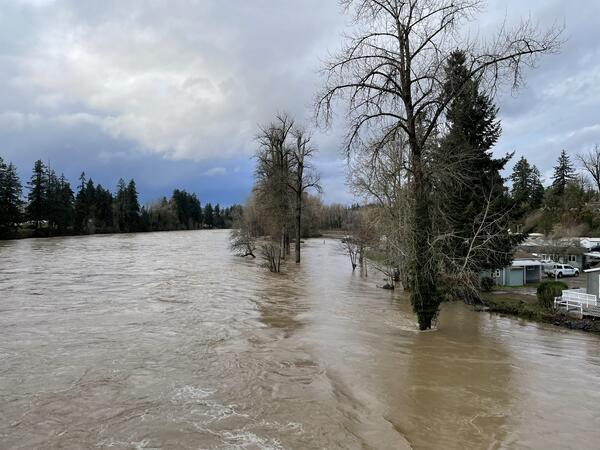
Computed and estimated streamflow in Bronson and Fanno Creeks, OR, 2016-2017 Computed and estimated streamflow in Bronson and Fanno Creeks, OR, 2016-2017
The USGS computed streamflow during 2016 and 2017 at two sites – one on Bronson Creek (USGS station 453250122494501) and one on Fanno Creek (USGS station 452738122474100), which are tributaries to the Tualatin River in northwestern Oregon. The computed streamflows from the two aforementioned sites were then used to estimate the corresponding streamflow at two other sites- USGS station...
Modeled bedload-transport capacity for the Siletz River, Oregon Modeled bedload-transport capacity for the Siletz River, Oregon
Bedload-transport capacity models of the Siletz River, Oregon, were developed using standard sediment transport equations (Parker, 1990a,b; Wilcock and Crowe, 2003; Recking, 2013) for the reach from Moonshine Park to the town of Siletz, Oregon (river kilometers 87.2 to 68.5) to evaluate bedload transport capacity over a broad range of streamflows. Models were used to assess longitudinal...
Fish passage classification of the stream network in the Willamette River Basin, 1990-2020 Fish passage classification of the stream network in the Willamette River Basin, 1990-2020
The U.S. Geological Survey (USGS) Oregon Water Science and Forest and Rangeland Ecosystem Science Centers have developed a spatial database of the stream network in the Willamette River Basin classified by degree of obstruction to fish passage. This effort was funded by the USGS Ecological Flows program in cooperation with the Integrated Water Availability Assessments in the Willamette...
One- and two-dimensional hydraulic models for the Siletz River, Oregon One- and two-dimensional hydraulic models for the Siletz River, Oregon
Hydraulic models of the Siletz River, Oregon, were developed using the U.S. Army Corps of Engineers Hydraulic Engineering Center River Analysis System (HEC-RAS; version 6.5). A one-dimensional (1D) steady-flow model was developed from Moonshine Park to the City of Siletz, Oregon (river kilometer [Rkm] 87.2 to 68.5). Results from the 1D model provided insights into longitudinal patterns...
Particle count data to support modeling of native freshwater mussel habitat in the Willamette River Basin, Oregon, 2024 Particle count data to support modeling of native freshwater mussel habitat in the Willamette River Basin, Oregon, 2024
The Willamette River Basin encompasses 31,000 square kilometers of western Oregon and consists of twelve major subbasins, each with hundreds of individual streams and unique hydrogeomorphic regimes and river corridor conditions. In conjunction with environmental DNA (eDNA) sample collection to support occupancy modeling of native freshwater mussels across the Willamette River Basin, bed...
Elevation data to support estimations of stored sediment depths and volume in a beaver pond along Fanno Creek, western Oregon, 2016 Elevation data to support estimations of stored sediment depths and volume in a beaver pond along Fanno Creek, western Oregon, 2016
Elevation-at-refusal (EAR) data were collected in May and September 2016 in conjunction with a comprehensive bed-elevation survey (White, 2025; methods described in White and others, 2025) to estimate the depth and total volume of sediment stored in a beaver pond along Fanno Creek, western Oregon. The EAR.csv file consists of points with xy coordinate and z elevation data. A stadia rod...
Water Surface Elevation Data from the Siletz River, 2017-18 Water Surface Elevation Data from the Siletz River, 2017-18
Water-surface elevations were recorded by 12 submerged pressure transducers deployed from fall 2017 to summer 2018 along an approximately 25-km reach of the Siletz River, Oregon. All pressure transducers were deployed in the main channel of the Siletz River. The water-surface elevations were surveyed by using a real-time kinematic global positioning system (RTK-GPS) at each pressure...
Native and Non-Native Fish Species in the Willamette River Basin, Oregon Native and Non-Native Fish Species in the Willamette River Basin, Oregon
The Willamette River Basin, Oregon, supports native fish species and non-native fish species introduced for sport fisheries or accidentally from aquarium releases and other sources. Based on fish surveys completed from 1998 to 2018 by Oregon State University and records from the Oregon State University Ichthyology Collection, the Willamette River Basin has 34 native fish species found...
Surficial and subsurface grain-size data for the Siletz River, Oregon, 2017-18 Surficial and subsurface grain-size data for the Siletz River, Oregon, 2017-18
The Siletz River Basin encompasses 970 square kilometers of western Oregon and drains to the Pacific Ocean. In cooperation with the Confederated Tribes of the Siletz Indians of Oregon (CTSI), the U.S. Geological Survey is evaluating how streamflow and bedload sediment conditions may influence mainstem spawning habitats for spring Chinook Salmon (Oncorhynchus tshawytschya) and Pacific...
Active channel mapping for the Siletz River, Oregon, 1939 to 2016 Active channel mapping for the Siletz River, Oregon, 1939 to 2016
The Siletz River Basin encompasses 970 square kilometers of western Oregon and drains to the Pacific Ocean. In cooperation with the Confederated Tribes of the Siletz Indians of Oregon (CTSI), the U.S. Geological Survey is evaluating how streamflow and bedload sediment conditions may influence mainstem spawning habitats for spring Chinook Salmon (Oncorhynchus tshawytschya) and Pacific...
Geomorphic and larval lamprey surveys in tributaries of the Umpqua River, Oregon Geomorphic and larval lamprey surveys in tributaries of the Umpqua River, Oregon
Interactions between geomorphic processes at multiple scales shape the distributions of habitats, species, and life stages that a river can support. Understanding these hierarchical processes may be helpful for proactive monitoring and restoration of native Western Brook Lamprey (Lampetra richardsoni) and Pacific Lamprey (Entosphenus tridentatus) in Pacific Northwest rivers. The...
Filter Total Items: 28
Beavers in the Tualatin River Basin, northwestern Oregon Beavers in the Tualatin River Basin, northwestern Oregon
Growing interest in beaver-assisted restoration in the Tualatin River Basin of northwestern Oregon motivated a series of studies by the U.S. Geological Survey to assess the capacity of the stream network to support beaver dams and to evaluate the effects of beaver dams and ponds on urban streams. This multichapter volume describes the data collection from 2016–17 and the findings of...
Stream network capacity to support beaver dams in the Tualatin River Basin, northwestern Oregon Stream network capacity to support beaver dams in the Tualatin River Basin, northwestern Oregon
Significant Findings Beaver dams can help streams connect to their floodplains. These floodplain connections can expand the range of available aquatic habitats and aid in the restoration of stream and floodplain function and processes. American beavers (Castor canadensis) occupy a wide variety of aquatic habitats; however, their ability to build dams, the agent of stream and floodplain...
Authors
James White, Cassandra Smith, Krista Jones, Stewart Rounds
Effects of beaver dams and ponds on hydrologic and hydraulic responses of storm flows in urban streams of the Tualatin River Basin, northwestern Oregon Effects of beaver dams and ponds on hydrologic and hydraulic responses of storm flows in urban streams of the Tualatin River Basin, northwestern Oregon
Significant Findings American beaver (Castor canadensis) dams fundamentally alter stream hydraulics and hydrology by temporarily impounding water in stream channels. Water managers are interested in how this impoundment translates to changes in hydrograph dynamics, particularly regarding the magnitude and duration of high flows, the temporary storage of storm water, and the range and...
Authors
James White, Krista Jones, Stewart Rounds
Effects of beaver dams and ponds on the transport and deposition of suspended sediment in urban streams of the Tualatin River Basin, northwestern Oregon Effects of beaver dams and ponds on the transport and deposition of suspended sediment in urban streams of the Tualatin River Basin, northwestern Oregon
Significant Findings This study investigated the effects of natural beaver dams and ponds on sediment transport and deposition in two urban beaver-affected reaches in the Tualatin River Basin, northwestern Oregon. Data were collected during 2016–17 from Fanno Creek at Greenway Park (between SW Hall Boulevard and SW Pearson Court) and Bronson Creek (between NW Laidlaw Road and NW Kaiser...
Authors
Micelis Doyle, Cassandra Smith, Krista Jones, Alexandria Costello
Effects of beaver dams and ponds on water quality in urban streams of the Tualatin River Basin, northwestern Oregon Effects of beaver dams and ponds on water quality in urban streams of the Tualatin River Basin, northwestern Oregon
Significant Findings American beavers (Castor canadensis) are native to the Pacific Northwest, and their populations have increased in many locations after being nearly removed by historical trapping. Beaver dams have well-documented effects on water quality in forested streams, but their effects on water quality in urban streams have not been well characterized. The study documented the...
Authors
Cassandra Smith, Erin Leahy, Krista Jones, Stewart Rounds
Beaver dams and their effects on urban streams in the Tualatin River Basin, northwestern Oregon Beaver dams and their effects on urban streams in the Tualatin River Basin, northwestern Oregon
Introduction In response to growing interest in beaver-assisted restoration in the Tualatin River Basin of northwestern Oregon, the U.S. Geological Survey (USGS), in partnership with Clean Water Services, collected data from 2016–17 and completed a series of studies to: (1) inventory known locations of beaver dams and activity in the Tualatin River Basin, (2) estimate the number of...
Authors
Krista Jones, Cassandra Smith, James White, Stewart Rounds, Micelis Doyle, Erin Leahy
Assessment of channel morphology, hydraulics, and bedload transport along the Siletz River, western Oregon Assessment of channel morphology, hydraulics, and bedload transport along the Siletz River, western Oregon
Significant FindingsChinook salmon (Oncorhynchus tshawytscha) and Pacific lamprey (Entosphenus tridentatus) are native, anadromous fish species in the Siletz River Basin, western Oregon, that face many threats to their survival in freshwater and the ocean. The Confederated Tribes of Siletz Indians of Oregon seek to mitigate freshwater threats to Chinook salmon and Pacific lamprey, where...
Authors
Krista Jones, Mackenzie Keith, Tessa Harden, James White, Stan van de Wetering, Jason Dunham
Restoring Pacific Lamprey in the Umpqua River Basin of Oregon: A workshop summary Restoring Pacific Lamprey in the Umpqua River Basin of Oregon: A workshop summary
The Umpqua River Basin in southwestern Oregon (Figure 1) is part of the lands inhabited by the Cow Creek Band of Umpqua Tribe of Indians and an area of active co-management authority. This Basin supports a unique fish fauna, including important populations of Pacific salmon (Oncorhynchus spp.) and steelhead (O. mykiss), and other native fishes that are endemic to the region (Mims et al...
Authors
Jason B. Dunham, Krista Jones, Kelly Coates, Travis Mackie
Science to support conservation action in a large river system: The Willamette River, Oregon, USA Science to support conservation action in a large river system: The Willamette River, Oregon, USA
Management and conservation efforts that support the recovery and protection of large rivers are daunting, reflecting the complexity of the challenge and extent of effort (in terms of policy, economic investment, and spatial extent) needed to afford measurable change. These large systems have generally experienced intensive development and regulation, compromising their capacity to...
Authors
Rebecca Flitcroft, Luke Whitman, James White, J. Rose Wallick, Laurel Stratton Garvin, Cassandra Smith, Robert Plotnikoff, Michael Mulvey, Tobias Kock, Krista Jones, Peter Gruendike, Carolyn Gombert, Guillermo Giannico, Andrew Dutterer, Daniel Brown, Hannah Barrett, Robert Hughes
Monitoring framework to evaluate effectiveness of aquatic and floodplain habitat restoration activities for native fish along the Willamette River, northwestern Oregon Monitoring framework to evaluate effectiveness of aquatic and floodplain habitat restoration activities for native fish along the Willamette River, northwestern Oregon
Since 2008, large-scale restoration programs have been implemented along the Willamette River, Oregon, to address historical losses of floodplain habitats caused by dam construction, bank protection, large wood removal, land conversion, and other anthropogenic influences. The Willamette Focused Investment Partnership (WFIP) restoration initiative brings together more than 16...
Authors
Mackenzie Keith, J. Rose Wallick, Rebecca Flitcroft, Tobias Kock, Laura Brown, Rich Miller, Joan Hagar, Kathleen Guillozet, Krista Jones
Historical changes in bed elevation and water depth within the Nehalem Bay, Oregon, 1891–2019 Historical changes in bed elevation and water depth within the Nehalem Bay, Oregon, 1891–2019
Estuaries, at the nexus of rivers and the ocean, are depositional areas that respond to changes in streamflow, tides, sea level, and inputs of sediment from marine and watershed sources. Understanding changes in bed elevations, deposited and eroded sediment, and water depth throughout estuaries is relevant for understanding their present-day status and long-term evolution, identifying...
Authors
Mackenzie Keith, Krista Jones, Gabriel W. Gordon
River network and reach‐scale controls on habitat for lamprey larvae in the Umpqua River Basin, Oregon River network and reach‐scale controls on habitat for lamprey larvae in the Umpqua River Basin, Oregon
This study developed a spatially explicit framework to support the conservation of Western Brook Lamprey Lampetra richardsoni and Pacific Lamprey Entosphenus tridentatus in the Umpqua River basin, Oregon. This framework identified locations within the river network likely to support “potential burrowing habitat” for lamprey larvae based on geomorphic conditions and evaluated the overlap...
Authors
Krista Jones, Jason Dunham, Jim E. O'Connor, Mackenzie Keith, Joseph Mangano, Kelly Coates, Travis Mackie