



Morphodynamics of dune-based coastal flood mitigation under sea-level rise
Natural and engineered sand dunes serve as barriers to protect against storms. Engineered sand dunes, called "Nature-based Solutions", are increasingly being used for coastal protection, yet their effectiveness remains understudied. New research finds that dunes' flood protection benefits depend not only on the size of the storm, but also on how the dunes themselves change during the event.
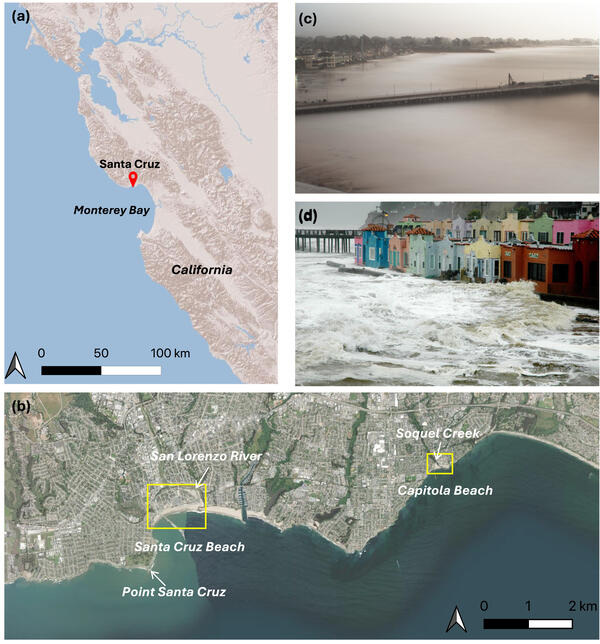
Using a modeling framework incorporating both hydrodynamic and morphodynamic feedbacks, scientists evaluated how dunes at two beaches in Santa Cruz County respond to rising sea levels and increasingly powerful storms. The study found that storm-driven erosion can dramatically reduce the flood protection dunes provide, highlighting the importance of accounting for changing coastal landscapes when planning for climate resilience.
Looking Beyond Static Coastlines
Many coastal flood assessments assume beaches and dunes remain unchanged during storms. But powerful waves can rapidly erode dunes, reshape beaches, and move large volumes of sand offshore over the course of a storm event.
To capture these dynamic processes, the study authors developed a process-based modeling framework that simulated both flooding and changes in beach and dune morphology.
The team examined three future time periods—2025, 2055, and 2085—and modeled storms with return periods of 5, 20, 50, and 100 years at two contrasting locations: Santa Cruz Beach and Capitola Beach.
Natural Sand Movement Can Reduce Flooding
At Santa Cruz Beach, the models demonstrated that beaches naturally adjust during storms in ways that can reduce flooding.
As waves reshape the shoreline, sand is redistributed and nearshore sandbars can form, absorbing wave energy before it reaches the beach.
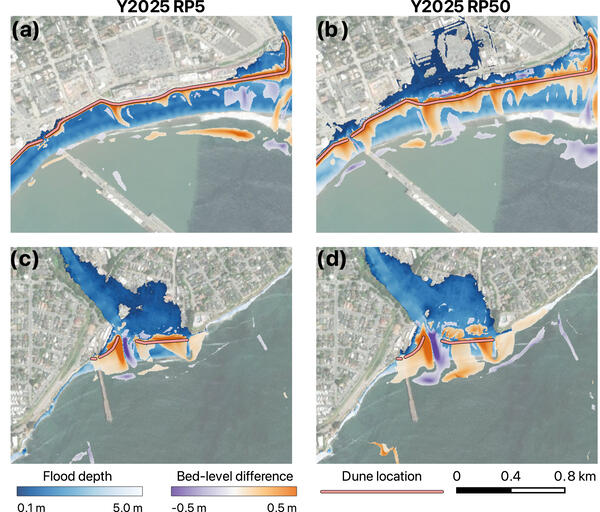
These storm-driven adjustments reduced predicted flood extent by as much as 32.4 percent compared with simulations that did not account for these morphodynamic processes.
The findings suggest that allowing beaches to evolve naturally during storms can, in some cases, enhance coastal resilience.
Dunes Work—Until They Don't
The study found that dunes can substantially reduce flooding during moderate storm conditions.
When waves collide with dunes but do not overtop them—a condition known as the collision regime—the dunes reduced flooding by up to 60 percent.
However, as sea levels rise and storms become more intense, those benefits decline rapidly.
Once waves begin overtopping dunes, entering overwash and eventually inundation regimes, erosion accelerates and the dunes lose much of their protective capacity.
At Capitola Beach, limited space for the beach and dunes to migrate left little opportunity for natural adjustment. Models indicate that the site is already close to its flooding threshold under present-day conditions. Across nearly every future scenario, dunes experienced near-complete collapse and provided little additional flood protection.
These findings demonstrate that the success of dune-based adaptation depends heavily on local coastal setting.
Why Dynamic Modeling Matters
Perhaps one of the study's most important conclusions is that treating dunes as static features can produce misleading flood estimates.
Comparisons between models using fixed dunes and those allowing dunes to erode produced differences in predicted flooding of up to 54.3 percent, depending on storm intensity and future sea-level conditions.
In some cases, static models underestimated flooding; in others, they overestimated it.
The results suggest that realistic assessments of coastal hazards require models that account for the constantly changing nature of beaches and dunes during storms.
Nature-based solutions such as dune restoration remain valuable tools for reducing coastal flood risk, but the study emphasizes that their performance cannot be assumed to remain constant as climate conditions evolve. Coastal managers are urged to incorporate site-specific analyses, process-based modeling, and adaptive management into future planning efforts.
Read the study, Morphodynamic controls on the performance of dune-based coastal flood mitigation under sea-level rise, in Coastal Engineering.
Related

Remote Sensing Coastal Change
Related