



Genetics and eDNA
Genetics and eDNA
Filter Total Items: 4
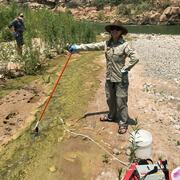
Early detection of aquatic threats: eDNA research in the Colorado River ecosystem & Lake Powell
The USGS and partners are conducting environmental DNA (eDNA) research in the Colorado River downstream from Glen Canyon Dam and in Lake Powell to detect invasive fish species and other aquatic threats before they become established. eDNA is a cutting-edge technology that makes it possible to identify invasive species before they are visible, even in vast or hard-to-survey environments like rivers...

Monitoring the Rare Island Night Lizard on San Nicolas Island
The Island Night Lizard ( Xantusia riversiana) was removed from the Federal list of Threatened species in May 2014. This rare and unique species represents an ancient lineage whose members are now sparsely distributed across parts of the Southwest North America, south through Mexico to the New World Tropics. The information on population size and habitat helps to inform and guide conservation and...

SBSC: Providing Unbiased Actionable Science & Information to Support Natural Resource Management Needs of the U.S. & Department of the Interior Priorities
The U.S. Geological Survey Southwest Biological Science Center (SBSC) is uniquely positioned in the Colorado River Basin to provide sound information, specialized expertise, and innovative tools to support the management and sustained use of natural resources on public and Tribal lands in the Southwest U.S.

Genomic Research Supporting Western Conservation
In the western United States (U.S.), there are many regionally restricted, rare species resulting from complex demographic and ecological processes through time. In addition to the inherent risks associated with being rare (i.e., having few individuals spread over a limited area that could be disproportionately affected by chance events), anthropogenic disturbances are increasing in magnitude...