An official website of the United States government
Here's how you know
Official websites use .gov
A .gov website belongs to an official government organization in the United States.
Secure .gov websites use HTTPS
A lock () or https:// means you’ve safely connected to the .gov website. Share sensitive information only on official, secure websites.
Coastal marshes are important habitats that serve as buffer zones between the land and the sea. However, many are at severe risk from increasing urbanization, climate change, sea-level rise, and storms. A team at USGS has been studying changes at Grand Bay along the northern Gulf of America coast for almost a decade to help predict the future of this valuable ecosystem.
Along the coast of the northern Gulf of America lies the estuary of Grand Bay, trimmed with an expanse of marsh spanning across the Mississippi-Alabama border. Here, the Grand Bay National Estuarine Research Reserve overlaps with the Grand Bay National Wildlife Refuge, providing well-known benefits such as habitat for commercially and ecologically important species and serving as popular destinations for recreational activities like hunting, fishing, and hiking. In addition, these vast coastal marshes offer protection for the surrounding upland habitats, communities, and infrastructure by buffering waves and flooding, and sequestering carbon from the atmosphere.
Despite the apparent vastness of these public lands, the marsh has been shrinking for over a century. A team from the USGS St. Petersburg Coastal and Marine Science Center has been visiting Grand Bay multiple times a year a year since 2013 to figure out why. Their research aims to discover what drives change to the marsh landscape through time, track how the shoreline position is moving as a result, and predict the future of this vulnerable ecosystem. Kathryn Smith, one of the Principal Investigators on the Estuarine and Marsh Geology (EMrG) project conducting this research, stated,
We study sediments—the foundation of coastal marshes—to see how they move between the marsh platform and the estuary. Where is the sediment going? Where is it coming from? The answers to these questions can help us better understand how the ecosystem changes and what its future holds.
Shoreline change rates help identify locations that are at risk of erosion due to sea level rise, climate change, or storms. Negative values indicate that the shoreline is eroding, or moving inland and losing land. Within our study area, very few locations are accreting, while the majority of the marsh has been eroding since 1848. For more information on shoreline change rates and how they are mapped, take a look at this Geonarrative by Terrano and Smith (2022) or this paper bySmith and others (2021).
The EMrG team uses a variety of methods to study sediments, such as net sedimentation tiles (NSTs) – handy little tools you could make at home. They include a tile (like what you might have in your bathroom or kitchen) on top of a piece of PVC piping, stuck into the mud and even with the top of the sediment platform. After a few months, they revisit and remove the tiles to measure how much sediment has accumulated on the NST – a sign of how much marsh accretion is occurring over time.
In some areas, the marshes in Grand Bay are eroding well over 2 meters (~6 feet) per year. That’s a major concern for our federal and state partners who manage these areas, so we’re working here to try to better understand why.
The team also collects sediment cores to study the long-term history of marsh sedimentation.
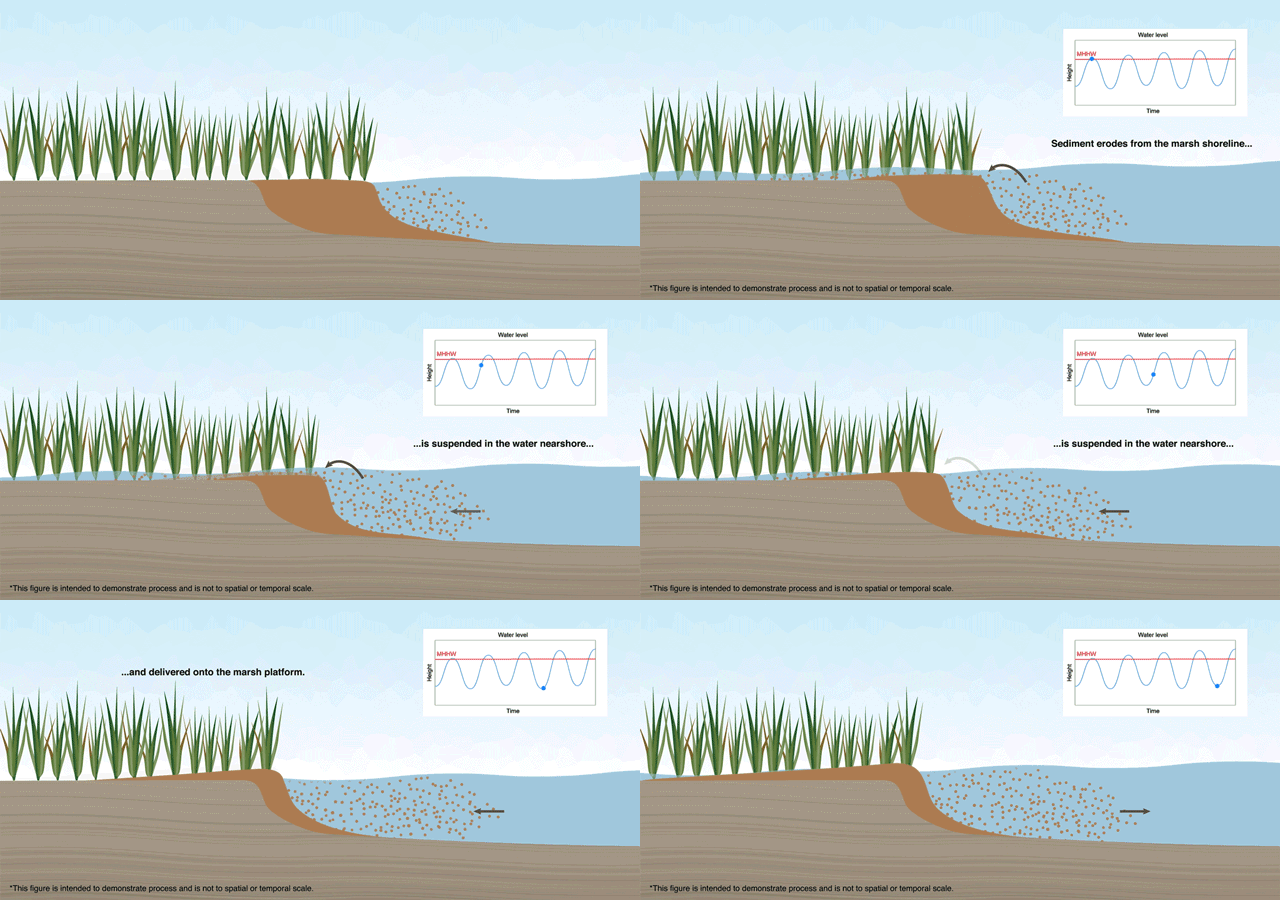
The team also uses a combination of historical maps, aerial imagery, and satellite data to track how the position of the marsh shoreline has changed through time. They also use a GPS to mark shoreline positions during their field work. While the team has seen high rates of sediment delivery into the marsh near the shoreline, the gradual retreat of the marsh shoreline appears to be the source of much of this sediment—essentially, the sediment is taken away from the edges and deposited on top.
As sea levels rise, water from the estuary can add sediment to the top of the marsh platform and allow the marsh to grow vertically—and therefore keep pace with increasing sea-level. Even if the shoreline is retreating, the marsh can adapt to the impacts of climate change by moving inland and converting the upland dry habitats to marsh. However, it can only retreat so far before it runs out of space or erosion out-paces upland transgression.
Scientists at the USGS St. Petersburg Coastal and Marine Science Center use models to project marsh response to sea-level rise. In Grand Bay, the model predicts that marshes will lose productivity under a high sea-level rise scenario, and attempt to migrate upland or convert to open water. The graphic (Alizad and others, 2018) shows predicted model output of marsh productivity in Grand Bay under a high sea-level rise scenario between the year 2000 and 2100.
Models developed by Karim Alizad, a member of the EMrG team, show that over the next few decades, the productivity of the marshes in Grand Bay will decline substantially, and the shoreline will continue to retreat until the marsh runs out of space due to coastal infrastructure, agricultural lands, and urbanized areas. Ultimately, once sea level rises high enough, the marshes could disappear and put coastal communities at risk. However, the team is working to refine and improve these model predictions with additional sediment parameters, a critical component of marsh development.
Understanding marsh shoreline change is increasingly important due the diverse estuarine habitats at risk from habitat loss and expanding coastal communities under increasing threat from sea level rise and storms. This information can also be used for making decisions regarding living shoreline projects, habitat management for protected species, land-use planning, and coastal restoration.
The hope is that we can use our data to refine models so we can provide better predictions about the future of these valuable ecosystems.
Researchers with the U.S. Geological Survey (USGS) St. Petersburg Coastal and Marine Science Center (SPCMSC) have been working within the Grand Bay National Estuarine Research Reserve and Grand Bay National Wildlife Refuge to track how marsh shorelines are changing over time, study how sediment moves between the marsh and the estuary, and predict how the marsh is responding to sea-level rise. Coastal marshes and estuaries like those at Grand Bay are very important as they provide habitat for fish and wildlife, cleanse polluted waters and recharging groundwater aquifers, store carbon from the atmosphere, and help mitigate the effects of sea-level rise and storm impacts. Learn more about Estuarine and Marsh Geology research.
The goal of the estuarine shoreline change project is to define shoreline positions for historical and modern wetland shorelines and calculate rates of change along the U.S. East and Gulf coasts.
The goal of the estuarine shoreline change project is to define shoreline positions for historical and modern wetland shorelines and calculate rates of change along the U.S. East and Gulf coasts.
The goal of the Estuarine and MaRsh Geology (EMRG) Research Project is to study how and where short- and long-term marsh and estuarine coastal processes interact, how they influence coastal accretion or erosion, and how they pre-condition a marsh’s resiliency to storms, sea-level change, and human alterations along the northern Gulf of America (Grand Bay and Point aux Chenes, Mississippi and St...
The goal of the Estuarine and MaRsh Geology (EMRG) Research Project is to study how and where short- and long-term marsh and estuarine coastal processes interact, how they influence coastal accretion or erosion, and how they pre-condition a marsh’s resiliency to storms, sea-level change, and human alterations along the northern Gulf of America (Grand Bay and Point aux Chenes, Mississippi and St...
Land and seafloor slopes are generally low along the coasts in the Mid-Atlantic and Gulf Coast states, making wetlands and estuaries vulnerable to sea level change, subsidence, and extreme events (e.g., hurricanes and tropical storms). Land-use change and land loss have been mapped extensively and with increasing frequency, but the link between land loss and the processes responsible for landscape...
Land and seafloor slopes are generally low along the coasts in the Mid-Atlantic and Gulf Coast states, making wetlands and estuaries vulnerable to sea level change, subsidence, and extreme events (e.g., hurricanes and tropical storms). Land-use change and land loss have been mapped extensively and with increasing frequency, but the link between land loss and the processes responsible for landscape...
This project assesses the physical controls of sediment and material exchange between wetlands and estuarine environments along the northern Gulf of America (Grand Bay Alabama/Mississippi and Vermilion Bay, Louisiana) and the Atlantic coast (Chincoteague Bay, Virginia/Maryland).
Sea-level and Storm Impacts on Estuarine Environments and Shorelines (SSIEES)
This project assesses the physical controls of sediment and material exchange between wetlands and estuarine environments along the northern Gulf of America (Grand Bay Alabama/Mississippi and Vermilion Bay, Louisiana) and the Atlantic coast (Chincoteague Bay, Virginia/Maryland).
Researchers with the [U.S. Geological Survey (USGS) St. Petersburg Coastal and Marine Science Center (SPCMSC) have been working within the Grand Bay National Estuarine Research Reserve and Grand Bay National Wildlife Refuge to track how marsh shorelines are changing over time, study how sediment moves between the marsh and the estuary, and predict how the marsh is responding to sea-level rise...
Marsh lateral shoreline erosion and shore-proximal sediment deposition
Salt marshes provide important economic and ecologic services but are vulnerable to habitat loss, particularly due to shoreline erosion from storms and sea level rise. Sediments eroded at the marsh edge are either delivered onto the marsh platform or into the estuary, the latter resulting in a net loss to the marsh sediment budget and released soil carbon.
Salt marshes provide important economic and ecologic services but are vulnerable to habitat loss, particularly due to shoreline erosion from storms and sea level rise. Sediments eroded at the marsh edge are either delivered onto the marsh platform or into the estuary, the latter resulting in a net loss to the marsh sediment budget and released soil carbon.
Mapped shoreline position from 1848 to 2014 overlaid on 2020 U.S. Department of Agriculture (USDA) National Aerial Imagery Program (NAIP) natural-color aerial imagery provide evidence of coastal wetland change over time
Mapped shoreline position from 1848 to 2014 overlaid on 2020 U.S. Department of Agriculture (USDA) National Aerial Imagery Program (NAIP) natural-color aerial imagery provide evidence of coastal wetland change over time
Coastal wetland shoreline position is mapped from historic and modern data sources, such as topographic sheets, aerial imagery, and satellite imagery. From these data, the shoreline change rate is determined from the date of the data source and the distance between each shoreline.
Coastal wetland shoreline position is mapped from historic and modern data sources, such as topographic sheets, aerial imagery, and satellite imagery. From these data, the shoreline change rate is determined from the date of the data source and the distance between each shoreline.
Rapid salt-marsh erosion in Grand Bay, Mississippi
This time-lapse video shows lateral erosion of a salt marsh in the Grand Bay National Estuarine Research Reserve, part of an embayment near the city of Pascagoula, Mississippi, on the US Gulf coast. Wave action over the course of 6.5 months led to about 1.5 meters of erosion.
This time-lapse video shows lateral erosion of a salt marsh in the Grand Bay National Estuarine Research Reserve, part of an embayment near the city of Pascagoula, Mississippi, on the US Gulf coast. Wave action over the course of 6.5 months led to about 1.5 meters of erosion.
The Grand Bay National Estuarine Research Reserve (NERR) in southern Mississippi was established to provide recreational and educational opportunities along with facilitating science-based coastal management; therefore, Grand Bay is the subject of numerous short and long-term environmental studies. The reserve is an important location for research and conservation.
The goal of the estuarine shoreline change project is to define shoreline positions for historical and modern wetland shorelines and calculate rates of change along the U.S. East and Gulf coasts.
The goal of the estuarine shoreline change project is to define shoreline positions for historical and modern wetland shorelines and calculate rates of change along the U.S. East and Gulf coasts.
The goal of the Estuarine and MaRsh Geology (EMRG) Research Project is to study how and where short- and long-term marsh and estuarine coastal processes interact, how they influence coastal accretion or erosion, and how they pre-condition a marsh’s resiliency to storms, sea-level change, and human alterations along the northern Gulf of America (Grand Bay and Point aux Chenes, Mississippi and St...
The goal of the Estuarine and MaRsh Geology (EMRG) Research Project is to study how and where short- and long-term marsh and estuarine coastal processes interact, how they influence coastal accretion or erosion, and how they pre-condition a marsh’s resiliency to storms, sea-level change, and human alterations along the northern Gulf of America (Grand Bay and Point aux Chenes, Mississippi and St...
Land and seafloor slopes are generally low along the coasts in the Mid-Atlantic and Gulf Coast states, making wetlands and estuaries vulnerable to sea level change, subsidence, and extreme events (e.g., hurricanes and tropical storms). Land-use change and land loss have been mapped extensively and with increasing frequency, but the link between land loss and the processes responsible for landscape...
Land and seafloor slopes are generally low along the coasts in the Mid-Atlantic and Gulf Coast states, making wetlands and estuaries vulnerable to sea level change, subsidence, and extreme events (e.g., hurricanes and tropical storms). Land-use change and land loss have been mapped extensively and with increasing frequency, but the link between land loss and the processes responsible for landscape...
This project assesses the physical controls of sediment and material exchange between wetlands and estuarine environments along the northern Gulf of America (Grand Bay Alabama/Mississippi and Vermilion Bay, Louisiana) and the Atlantic coast (Chincoteague Bay, Virginia/Maryland).
Sea-level and Storm Impacts on Estuarine Environments and Shorelines (SSIEES)
This project assesses the physical controls of sediment and material exchange between wetlands and estuarine environments along the northern Gulf of America (Grand Bay Alabama/Mississippi and Vermilion Bay, Louisiana) and the Atlantic coast (Chincoteague Bay, Virginia/Maryland).
Researchers with the [U.S. Geological Survey (USGS) St. Petersburg Coastal and Marine Science Center (SPCMSC) have been working within the Grand Bay National Estuarine Research Reserve and Grand Bay National Wildlife Refuge to track how marsh shorelines are changing over time, study how sediment moves between the marsh and the estuary, and predict how the marsh is responding to sea-level rise...
Marsh lateral shoreline erosion and shore-proximal sediment deposition
Salt marshes provide important economic and ecologic services but are vulnerable to habitat loss, particularly due to shoreline erosion from storms and sea level rise. Sediments eroded at the marsh edge are either delivered onto the marsh platform or into the estuary, the latter resulting in a net loss to the marsh sediment budget and released soil carbon.
Salt marshes provide important economic and ecologic services but are vulnerable to habitat loss, particularly due to shoreline erosion from storms and sea level rise. Sediments eroded at the marsh edge are either delivered onto the marsh platform or into the estuary, the latter resulting in a net loss to the marsh sediment budget and released soil carbon.
Mapped shoreline position from 1848 to 2014 overlaid on 2020 U.S. Department of Agriculture (USDA) National Aerial Imagery Program (NAIP) natural-color aerial imagery provide evidence of coastal wetland change over time
Mapped shoreline position from 1848 to 2014 overlaid on 2020 U.S. Department of Agriculture (USDA) National Aerial Imagery Program (NAIP) natural-color aerial imagery provide evidence of coastal wetland change over time
Coastal wetland shoreline position is mapped from historic and modern data sources, such as topographic sheets, aerial imagery, and satellite imagery. From these data, the shoreline change rate is determined from the date of the data source and the distance between each shoreline.
Coastal wetland shoreline position is mapped from historic and modern data sources, such as topographic sheets, aerial imagery, and satellite imagery. From these data, the shoreline change rate is determined from the date of the data source and the distance between each shoreline.
Rapid salt-marsh erosion in Grand Bay, Mississippi
This time-lapse video shows lateral erosion of a salt marsh in the Grand Bay National Estuarine Research Reserve, part of an embayment near the city of Pascagoula, Mississippi, on the US Gulf coast. Wave action over the course of 6.5 months led to about 1.5 meters of erosion.
This time-lapse video shows lateral erosion of a salt marsh in the Grand Bay National Estuarine Research Reserve, part of an embayment near the city of Pascagoula, Mississippi, on the US Gulf coast. Wave action over the course of 6.5 months led to about 1.5 meters of erosion.
The Grand Bay National Estuarine Research Reserve (NERR) in southern Mississippi was established to provide recreational and educational opportunities along with facilitating science-based coastal management; therefore, Grand Bay is the subject of numerous short and long-term environmental studies. The reserve is an important location for research and conservation.