



Investigating Links between Chloride and Harmful Algal Blooms in the Great Lakes
The USGS is investigating links between chloride concentrations in Great Lakes tributaries as a catalyst for Harmful Algal Blooms (HABs).
Background
The seasonal application of road salt in northern climates as well as other anthropogenic sources surrounding urban landscapes provides a recurring source of chloride that can be transported in stormwater runoff and groundwater to Great Lakes tributaries. As a result, chloride concentrations in the Great Lakes have been rising over the last century (Chapra et al., 2009; Dugan et al., 2021). Elevated chloride levels can be toxic to freshwater organisms, particularly during sensitive life stages; chronic exposure has been shown to impair reproduction, growth, and survival in aquatic invertebrates and fish (Corsi et al., 2010; Findlay and Kelly, 2011). McClymont et al. (2022) found that elevated chloride concentrations have negative effects on zooplankton, a primary consumer of phytoplankton. They also detected a shift in phytoplankton from green algae to cyanobacteria as chloride concentration increased. The compounding effects of reduced competition for nutrients from less salt tolerant phytoplankton as well as fewer predatory zooplankton creates an environment conducive for cyanobacteria to flourish. By benefitting cyanobacteria and cryptophytes, high chloride concentrations could potentially increase HAB occurrence and frequency.
In addition to direct toxicity, increasing chloride concentrations can potentially alter the physical structure of lakes by enhancing density stratification. Chloride-enriched runoff often sinks and forms dense bottom layers that inhibit vertical mixing, which can lead to hypolimnetic oxygen depletion (Foley and Steinman, 2023). Prolonged anoxic conditions at the sediment-water interface can trigger internal phosphorus loading, as iron-bound phosphorus in sediments is released into the overlying water, potentially fueling eutrophication and harmful algal blooms (Orihel et al., 2017; Szklarek et al. 2022).
Study Objectives
This study will help environmental managers begin to understand the complex interactions between nutrients, chloride, and algal dynamics as they develop effective science-based HAB management strategies in the Great Lakes. Specifically, this study will:
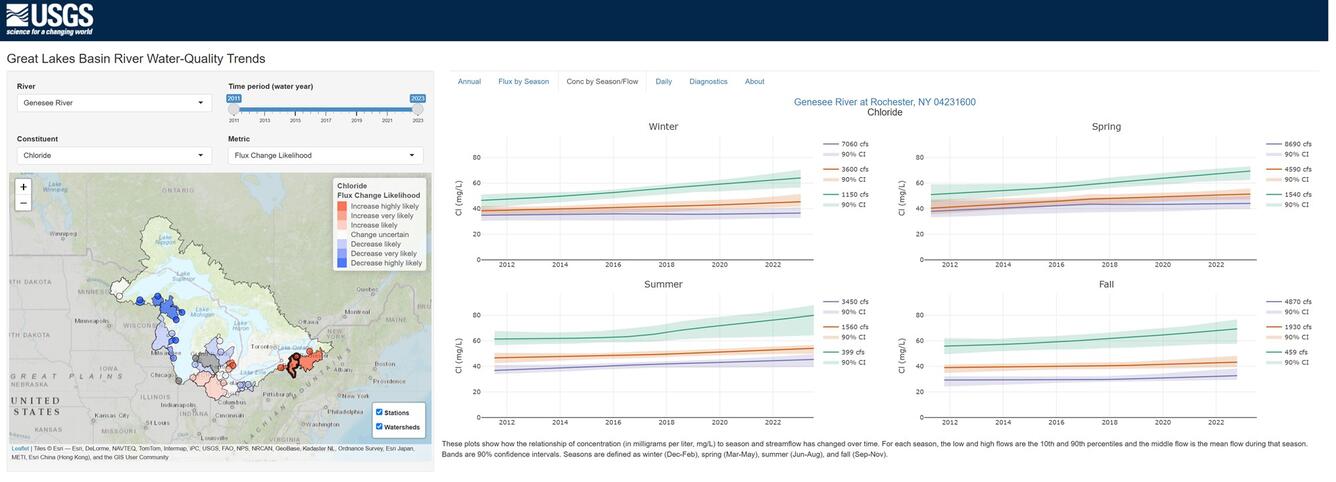
Characterize long-term chloride and phosphorus trends in 24 Great Lakes tributaries.
- Estimate daily chloride concentrations and fluxes using the Weighted Regressions on Time, Discharge, and Season statistical package at the 24 Great Lakes tributary sites from water year 2011 to 2023.
- Explore the spatial, seasonal, and multi-year trends and variability of chloride and phosphorus loading using flow-normalized estimates from the Weighted Regressions on Time, Discharge, and Season statistical package.
- Inventory drainage area characteristics (e.g., population, urban growth, percent imperviousness, road density, and winter management practices) for the 24 Great Lakes tributary monitoring network watersheds. Investigate statistical relations between drainage area characteristics and chloride/phosphorus loading patterns.
Assess effects of chloride on harmful algal bloom development.
- Measure effects of chloride on sediment nutrient flux rates (i.e., internal phosphorus loading).
- Internal nutrient loading in streams, river mouths and nearshore zones often support late-summer and fall blooms. Road salts are believed to influence the release of these nutrients by altering the chemistry of the sediment-water interface (Jin et al., 2013). Sediment core incubations will be used to measure internal nutrient loading across a gradient of chloride concentrations. This builds on earlier studies that measured river mouth and nearshore fluxes of nutrients from sediments into the water column.
- Measure effects of chloride on sediment nutrient flux rates (i.e., internal phosphorus loading).
Benefits
This project will not only provide a scientific foundation for assessing chloride contamination levels in major tributaries across the Great Lakes but is intended to also reveal trends that may be a cause for future concern. This project will also provide critical information needed to link chloride to potential nutrient flux from sediment. Together, results from this project are intended to be used to better understand if chloride is an immediate or future concern for the health of the Great Lakes and how it may influence HABs.
Significance
With no viable alternative to road salt deicing agents in the winter, few management options are available outside of source reduction. However, few states have developed the regulatory framework to delist impaired waterbodies for chloride. Results from this study can be used to not only support development of chloride reduction goals but also provide a foundation for evaluating the success of various management strategies in the future. Information learned from this study, when coupled with sediment nutrient flux rates, can be used to better identify areas where chloride may eventually become a parameter of concern for future riverine and nearshore HABs.
References
Chapra, S. C., A. Dove, and D. C. Rockwell, 2009. Great Lakes chloride trends: Long-term mass balance and loading analysis. Journal of Great Lakes Research, 35, pp. 272–284. doi:10.1016/j.jglr.2008.11.013
Corsi, S. R., De Cicco, L. A., Lutz, M. A., & Hirsch, R. M., 2015. River chloride trends in snow-affected urban watersheds: Increasing concentrations outpace urban growth rate and are common among all seasons. Science of the Total Environment, 508, pp. 488–497, doi.org/10.1016/j.scitotenv.2014.12.012
Dugan, H.A., Rock, L.A., Kendall, A.D., and Mooney, R.J., 2021. Tributary chloride loading into Lake Michigan, Limnology and Oceanography Letters, 8, pp. 83 – 92, doi: 10.1002/lol2.10228.
Findlay, S.E.G., Kelly, V.R., 2011. Emerging indirect and long-term road salt effects on ecosystems. Annals NY Acad. Sci. 1223 (1), 58–68. doi.org/10.1111/j.1749- 6632.2010.05942.x
Foley, C.J., J.M. Milanovich, K.M. TePas, and P.D. Collingsworth, 2023. Cooperative Science & Monitoring Initiative. Lake Michigan CSMI 2025 Kickoff Workshop Summary Report. Proceedings of a Workshop held in Milwaukee, WI, July 20−21, 2023. Prepared for the Science Advisory Board of the International Joint Commission by Illinois-Indiana Sea Grant. 37 p.
Jin X, He Y, Zhang B, Hassan Y, George K., 2013. Impact of sulfate and chloride on sediment phosphorus release in the Yangtze Estuary Reservoir, China. Water Sci Technol. 2013;67(8):1748-56. doi: 10.2166/wst.2013.042. PMID: 23579829.
McClymont, A., Arnott, S.E. and Rusak, J.A. (2023), Interactive effects of increasing chloride concentration and warming on freshwater plankton communities. Limnol. Oceanogr. Lett, 8: 56-64. doi.org/10.1002/lol2.10278
Orihel, D. M., Schindler, D. W., Ballard, N. C., Graham, M. D., O’Connell, D. W., Wilson, L. R., & Vinebrooke, R. D., 2017. The “nutrient pump:” Iron-poor sediments fuel low nitrogen-to-phosphorus ratios and cyanobacterial blooms in polymictic lakes. Limnology and Oceanography, 62(2), 855–871. doi.org/10.1002/lno.10076
Szklarek S, Górecka A, Wojtal-Frankiewicz A., 2022. The effects of road salt on freshwater ecosystems and solutions for mitigating chloride pollution - A review. Sci Total Environ 805, doi.org/10.1016/j.scitotenv.2021.150289

GLRI Urban Stormwater Monitoring
The USGS is investigating links between chloride concentrations in Great Lakes tributaries as a catalyst for Harmful Algal Blooms (HABs).
Background
The seasonal application of road salt in northern climates as well as other anthropogenic sources surrounding urban landscapes provides a recurring source of chloride that can be transported in stormwater runoff and groundwater to Great Lakes tributaries. As a result, chloride concentrations in the Great Lakes have been rising over the last century (Chapra et al., 2009; Dugan et al., 2021). Elevated chloride levels can be toxic to freshwater organisms, particularly during sensitive life stages; chronic exposure has been shown to impair reproduction, growth, and survival in aquatic invertebrates and fish (Corsi et al., 2010; Findlay and Kelly, 2011). McClymont et al. (2022) found that elevated chloride concentrations have negative effects on zooplankton, a primary consumer of phytoplankton. They also detected a shift in phytoplankton from green algae to cyanobacteria as chloride concentration increased. The compounding effects of reduced competition for nutrients from less salt tolerant phytoplankton as well as fewer predatory zooplankton creates an environment conducive for cyanobacteria to flourish. By benefitting cyanobacteria and cryptophytes, high chloride concentrations could potentially increase HAB occurrence and frequency.
In addition to direct toxicity, increasing chloride concentrations can potentially alter the physical structure of lakes by enhancing density stratification. Chloride-enriched runoff often sinks and forms dense bottom layers that inhibit vertical mixing, which can lead to hypolimnetic oxygen depletion (Foley and Steinman, 2023). Prolonged anoxic conditions at the sediment-water interface can trigger internal phosphorus loading, as iron-bound phosphorus in sediments is released into the overlying water, potentially fueling eutrophication and harmful algal blooms (Orihel et al., 2017; Szklarek et al. 2022).
Study Objectives
This study will help environmental managers begin to understand the complex interactions between nutrients, chloride, and algal dynamics as they develop effective science-based HAB management strategies in the Great Lakes. Specifically, this study will:
Characterize long-term chloride and phosphorus trends in 24 Great Lakes tributaries.
- Estimate daily chloride concentrations and fluxes using the Weighted Regressions on Time, Discharge, and Season statistical package at the 24 Great Lakes tributary sites from water year 2011 to 2023.
- Explore the spatial, seasonal, and multi-year trends and variability of chloride and phosphorus loading using flow-normalized estimates from the Weighted Regressions on Time, Discharge, and Season statistical package.
- Inventory drainage area characteristics (e.g., population, urban growth, percent imperviousness, road density, and winter management practices) for the 24 Great Lakes tributary monitoring network watersheds. Investigate statistical relations between drainage area characteristics and chloride/phosphorus loading patterns.
Assess effects of chloride on harmful algal bloom development.
- Measure effects of chloride on sediment nutrient flux rates (i.e., internal phosphorus loading).
- Internal nutrient loading in streams, river mouths and nearshore zones often support late-summer and fall blooms. Road salts are believed to influence the release of these nutrients by altering the chemistry of the sediment-water interface (Jin et al., 2013). Sediment core incubations will be used to measure internal nutrient loading across a gradient of chloride concentrations. This builds on earlier studies that measured river mouth and nearshore fluxes of nutrients from sediments into the water column.
- Measure effects of chloride on sediment nutrient flux rates (i.e., internal phosphorus loading).
Benefits
This project will not only provide a scientific foundation for assessing chloride contamination levels in major tributaries across the Great Lakes but is intended to also reveal trends that may be a cause for future concern. This project will also provide critical information needed to link chloride to potential nutrient flux from sediment. Together, results from this project are intended to be used to better understand if chloride is an immediate or future concern for the health of the Great Lakes and how it may influence HABs.
Significance
With no viable alternative to road salt deicing agents in the winter, few management options are available outside of source reduction. However, few states have developed the regulatory framework to delist impaired waterbodies for chloride. Results from this study can be used to not only support development of chloride reduction goals but also provide a foundation for evaluating the success of various management strategies in the future. Information learned from this study, when coupled with sediment nutrient flux rates, can be used to better identify areas where chloride may eventually become a parameter of concern for future riverine and nearshore HABs.
References
Chapra, S. C., A. Dove, and D. C. Rockwell, 2009. Great Lakes chloride trends: Long-term mass balance and loading analysis. Journal of Great Lakes Research, 35, pp. 272–284. doi:10.1016/j.jglr.2008.11.013
Corsi, S. R., De Cicco, L. A., Lutz, M. A., & Hirsch, R. M., 2015. River chloride trends in snow-affected urban watersheds: Increasing concentrations outpace urban growth rate and are common among all seasons. Science of the Total Environment, 508, pp. 488–497, doi.org/10.1016/j.scitotenv.2014.12.012
Dugan, H.A., Rock, L.A., Kendall, A.D., and Mooney, R.J., 2021. Tributary chloride loading into Lake Michigan, Limnology and Oceanography Letters, 8, pp. 83 – 92, doi: 10.1002/lol2.10228.
Findlay, S.E.G., Kelly, V.R., 2011. Emerging indirect and long-term road salt effects on ecosystems. Annals NY Acad. Sci. 1223 (1), 58–68. doi.org/10.1111/j.1749- 6632.2010.05942.x
Foley, C.J., J.M. Milanovich, K.M. TePas, and P.D. Collingsworth, 2023. Cooperative Science & Monitoring Initiative. Lake Michigan CSMI 2025 Kickoff Workshop Summary Report. Proceedings of a Workshop held in Milwaukee, WI, July 20−21, 2023. Prepared for the Science Advisory Board of the International Joint Commission by Illinois-Indiana Sea Grant. 37 p.
Jin X, He Y, Zhang B, Hassan Y, George K., 2013. Impact of sulfate and chloride on sediment phosphorus release in the Yangtze Estuary Reservoir, China. Water Sci Technol. 2013;67(8):1748-56. doi: 10.2166/wst.2013.042. PMID: 23579829.
McClymont, A., Arnott, S.E. and Rusak, J.A. (2023), Interactive effects of increasing chloride concentration and warming on freshwater plankton communities. Limnol. Oceanogr. Lett, 8: 56-64. doi.org/10.1002/lol2.10278
Orihel, D. M., Schindler, D. W., Ballard, N. C., Graham, M. D., O’Connell, D. W., Wilson, L. R., & Vinebrooke, R. D., 2017. The “nutrient pump:” Iron-poor sediments fuel low nitrogen-to-phosphorus ratios and cyanobacterial blooms in polymictic lakes. Limnology and Oceanography, 62(2), 855–871. doi.org/10.1002/lno.10076
Szklarek S, Górecka A, Wojtal-Frankiewicz A., 2022. The effects of road salt on freshwater ecosystems and solutions for mitigating chloride pollution - A review. Sci Total Environ 805, doi.org/10.1016/j.scitotenv.2021.150289