



Our planet is composed of hierarchical and interconnected ecosystems. The biogeochemical cycling of carbon, nitrogen, water, and other elements are fundamental ecosystem functions that support life. Natural and human‑driven factors—such as climate variability, wildfires, and land use and land cover change (LUCC)—can alter these cycles. Therefore, monitoring, analyzing, and predicting ecosystem biogeochemical changes is essential.
Modern technology allows us to monitor ecosystems through remote sensing and simulate ecosystem processes with computer models. Ecosystem model development is challenging. In this research, we employ a Dynamic Global Vegetation Model (DGVM), the parallel Integrated Biosphere Simulator (pIBIS), to simulate terrestrial ecosystem productivity and biomass across the conterminous United States (CONUS) at 1‑km resolution for the period 1985–2020.
Methods
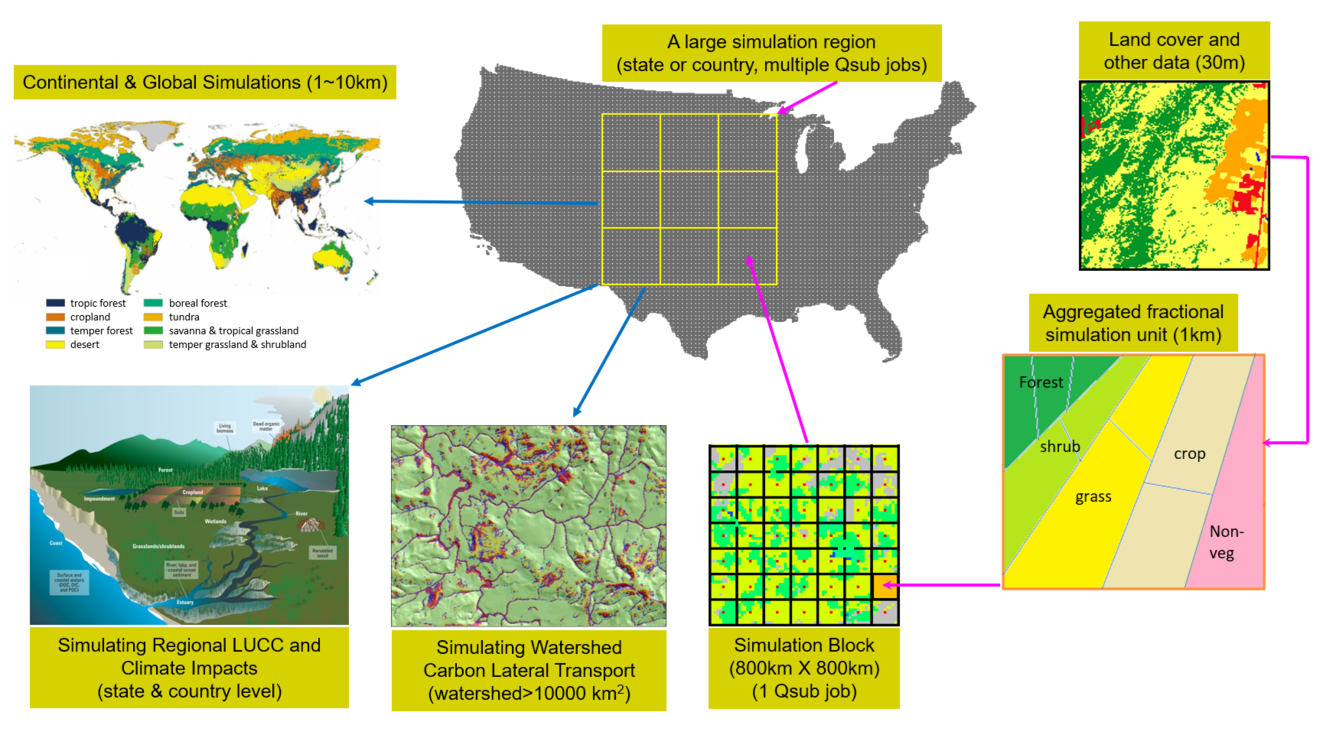
We developed a cross‑scale, cross‑landscape, and cross‑system modeling approach with pIBIS to simulate CONUS biogeochemical cycles. Key modeling features are:
- cross‑scale – fine‑resolution land‑cover data (30‑m) are applied across large regions, and multiple fractional land‑cover changes are processed on each aggregated coarser‑resolution (1‑km) land pixel;
- cross‑landscape – a fine‑resolution soil‑erosion model is linked with the coarse‑resolution pIBIS model, representing soil lateral transport across landscapes;
- cross‑system – a non‑spatial inland‑water carbon‑accounting model is developed to link land and water systems;
- model calibration using county‑scale observed data.
*Our modeling work used High-Performance Computing (HPC) resources from the Department of Energy (DOE) and U.S. Geological Survey (USGS).
Results
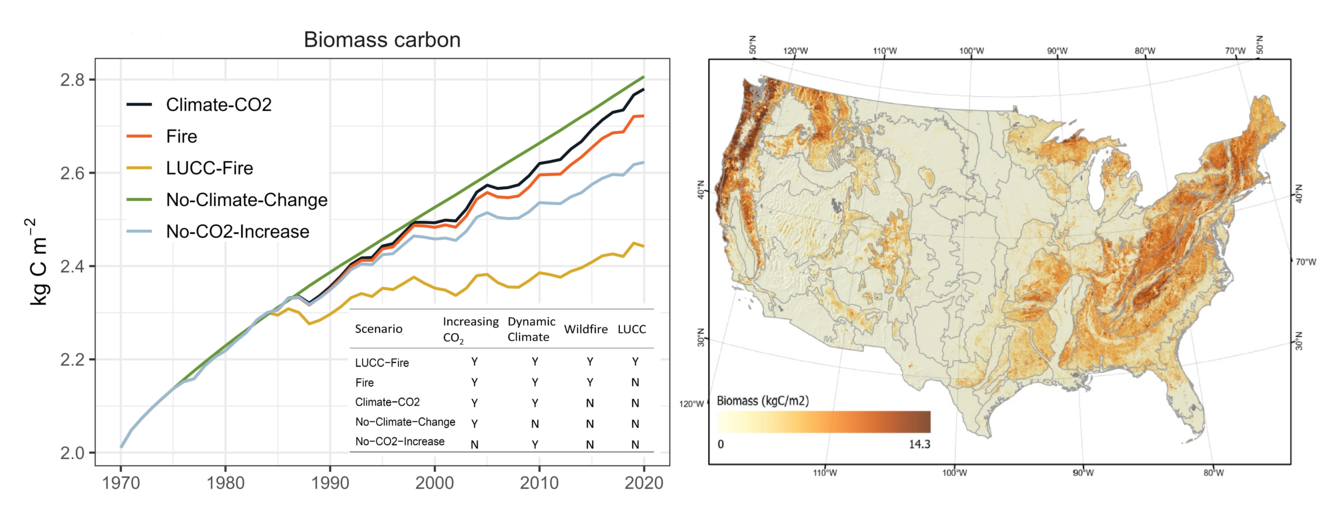
Temporal trends and spatial patterns of biomass stock were assessed in relation to multiple environmental drivers. Biomass stocks increased under all scenarios from 1985 to 2020, with the LUCC‑Fire scenario produced the lowest estimate (18000 ± 1600 Tg C; 1 Tg C = one million metric tones) because ecosystem carbon losses from LUCC and wildfire are accounted for.
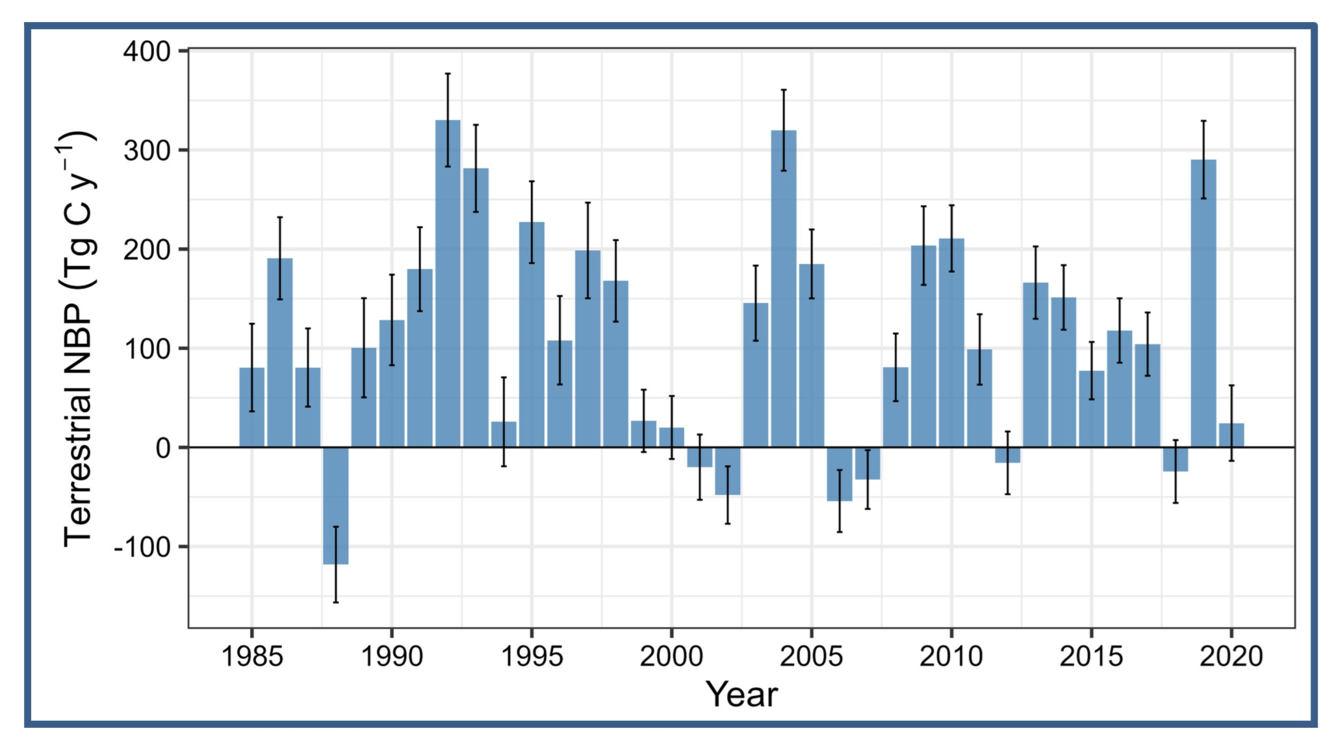
Net biome productivity (NBP), representing the terrestrial carbon sink (i.e, the net gain and loss of carbon stock in the terrestrial ecosystem), averaged +110 ± 37 Tg C yr⁻¹ across the study period. The terrestrial carbon sink showed no consistent long‑term trend, peaking in the 1990s and exhibiting more years as a carbon source since 2000, highlighting a potentially weakening land sink in recent years. This potential shift is important because a weakening land sink reduces its natural capacity to offset anthropogenic CO₂ emissions.
For terrestrial ecosystems, land change had the largest negative impact on NBP strength (–70±5.5 Tg C y-1), exceeding impacts of climate (–33±48 Tg C yr-1), wildfire (–7.7±2.4 Tg C yr-1), and erosion transport loss (–1.9±0.13 Tg C yr-1). The positive CO₂ fertilization effect (+69±12 Tg C y-1) was insufficient to maintain the NBP strength. CO₂ fertilization is a physiological and biophysical process in which higher atmospheric CO₂ enhances plant growth by increasing photosynthesis and boosting biomass production.
Below are data release associated with this project.
Data
USGS ScienceBase repository:
https://doi.org/10.5066/P1WDJOMS
Zenodo (external link):
https://zenodo.org/records/17135663
External Partners/Colaborator
University of Maryland Center for Environmental Science (UMCES), Mark Cochrane.
Hohai University, Qiuan Zhu
USDA Forest Service, Grant Domke
Oak Ridge National Laboratory, Bin Wang
Science Systems and Applications, Inc (SSAI), Qiang Zhou
Our planet is composed of hierarchical and interconnected ecosystems. The biogeochemical cycling of carbon, nitrogen, water, and other elements are fundamental ecosystem functions that support life. Natural and human‑driven factors—such as climate variability, wildfires, and land use and land cover change (LUCC)—can alter these cycles. Therefore, monitoring, analyzing, and predicting ecosystem biogeochemical changes is essential.
Modern technology allows us to monitor ecosystems through remote sensing and simulate ecosystem processes with computer models. Ecosystem model development is challenging. In this research, we employ a Dynamic Global Vegetation Model (DGVM), the parallel Integrated Biosphere Simulator (pIBIS), to simulate terrestrial ecosystem productivity and biomass across the conterminous United States (CONUS) at 1‑km resolution for the period 1985–2020.
Methods
We developed a cross‑scale, cross‑landscape, and cross‑system modeling approach with pIBIS to simulate CONUS biogeochemical cycles. Key modeling features are:
- cross‑scale – fine‑resolution land‑cover data (30‑m) are applied across large regions, and multiple fractional land‑cover changes are processed on each aggregated coarser‑resolution (1‑km) land pixel;
- cross‑landscape – a fine‑resolution soil‑erosion model is linked with the coarse‑resolution pIBIS model, representing soil lateral transport across landscapes;
- cross‑system – a non‑spatial inland‑water carbon‑accounting model is developed to link land and water systems;
- model calibration using county‑scale observed data.
*Our modeling work used High-Performance Computing (HPC) resources from the Department of Energy (DOE) and U.S. Geological Survey (USGS).
Results
Temporal trends and spatial patterns of biomass stock were assessed in relation to multiple environmental drivers. Biomass stocks increased under all scenarios from 1985 to 2020, with the LUCC‑Fire scenario produced the lowest estimate (18000 ± 1600 Tg C; 1 Tg C = one million metric tones) because ecosystem carbon losses from LUCC and wildfire are accounted for.
Net biome productivity (NBP), representing the terrestrial carbon sink (i.e, the net gain and loss of carbon stock in the terrestrial ecosystem), averaged +110 ± 37 Tg C yr⁻¹ across the study period. The terrestrial carbon sink showed no consistent long‑term trend, peaking in the 1990s and exhibiting more years as a carbon source since 2000, highlighting a potentially weakening land sink in recent years. This potential shift is important because a weakening land sink reduces its natural capacity to offset anthropogenic CO₂ emissions.
For terrestrial ecosystems, land change had the largest negative impact on NBP strength (–70±5.5 Tg C y-1), exceeding impacts of climate (–33±48 Tg C yr-1), wildfire (–7.7±2.4 Tg C yr-1), and erosion transport loss (–1.9±0.13 Tg C yr-1). The positive CO₂ fertilization effect (+69±12 Tg C y-1) was insufficient to maintain the NBP strength. CO₂ fertilization is a physiological and biophysical process in which higher atmospheric CO₂ enhances plant growth by increasing photosynthesis and boosting biomass production.
Below are data release associated with this project.
Data
USGS ScienceBase repository:
https://doi.org/10.5066/P1WDJOMS
Zenodo (external link):
https://zenodo.org/records/17135663
External Partners/Colaborator
University of Maryland Center for Environmental Science (UMCES), Mark Cochrane.
Hohai University, Qiuan Zhu
USDA Forest Service, Grant Domke
Oak Ridge National Laboratory, Bin Wang
Science Systems and Applications, Inc (SSAI), Qiang Zhou