



Combining Novel Technologies for Fast, Field-Ready eDNA Detection of Brown Treesnakes to Enhance Biosecurity Across International Borders
The USGS is working with the Department of the Navy to develop a new, field-ready tool to help detect Brown Treesnake environmental DNA to help prevent the spread and establishment of the invasive species into new areas.
The Science Issue and Relevance
The accidental introduction of Brown Treesnakes (BTS) to Guam has caused severe ecological and operational damage, including the collapse of native bird species and frequent power outages, as well as increased risks to human safety. Because Guam functions as a major transportation and military hub in the Western Pacific, the potential spread of BTS to locations such as Hawaii and the Commonwealth of the Northern Mariana Islands (CNMI) poses substantial threats to regional biodiversity and to the operations of the Department of the Interior and the Department of the Navy (DON). Preventing the establishment of BTS in new areas requires rapid, reliable early detection of this injurious species.

Environmental DNA (eDNA) methods are valuable for detecting invasive species, but traditional laboratory workflows for detection can take days to weeks, delaying critical response actions. The USGS has created eDNA approaches and a quantitative polymerase chain reaction (PCR) assay to detect BTS genetic material in terrestrial environments; however, the primary limitation for producing actionable results remains the length of time between sample collection and assay processing.
To close this gap, USGS scientists are collaborating with the DON, specifically, Joint Region Marianas (JRM), to develop an advanced, point-of-use (POU) eDNA assay capable of providing results within minutes and requiring no specialized equipment or training. Both Loop-mediated Isothermal Amplification (LAMP) and CRISPR-Cas technologies are being evaluated for this field-ready BTS detection tool. This effort aims to integrate these approaches into a single, highly sensitive and specific "one-step" reaction suitable for rapid screening of BTS at critical border inspection sites and other applications where immediate detection is required.
Methodology for Addressing the Issue
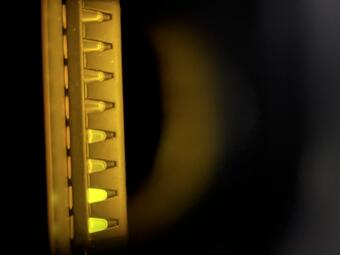
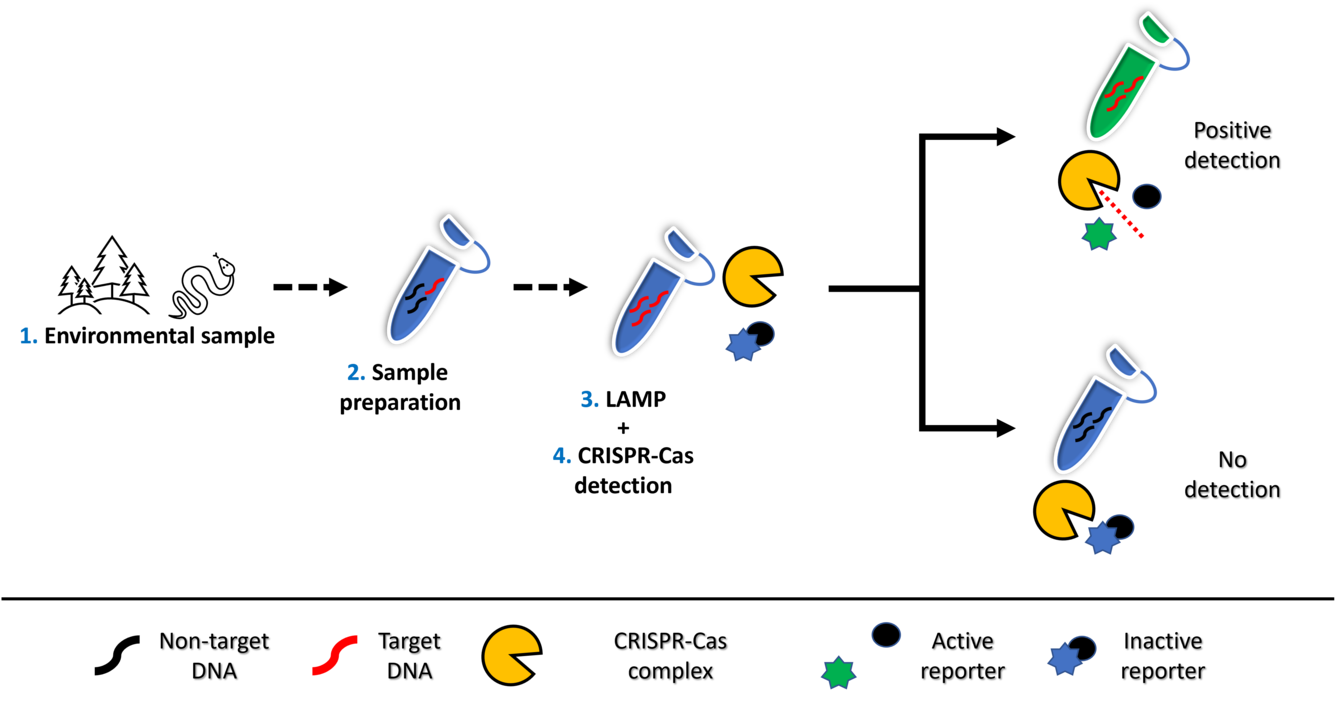
USGS scientists in collaboration with Benjamín Durán Vinet and Robert Fagerlund from the University of Otago (Dunedin, New Zealand) are working to develop a user-friendly BTS eDNA detection tool that merges LAMP and CRISPR-Cas technologies to produce a simple-to-deploy, "one-step" assay for on-demand detection of BTS. This streamlined approach is enabled by an enhanced CRISPR-Cas enzyme, eBrCas12b, which functionally matches the elevated temperatures required for LAMP, thus permitting complementary actions of amplification and detection to operate simultaneously in a single reaction. Being able to simultaneously run these tests, which are normally done separately, drastically reduces the amount of time needed to produce results and reduces risks of sample contamination, allowing for much more efficient detection of BTS eDNA.
To design this system, computer-based analyses were firstly conducted to identify mitochondrial DNA targets suitable for LAMP amplification. These candidate regions were then assessed for compatibility with eBrCas12b recognition sites to ensure that both components detect the same DNA sequence. The highest-performing (based both on speed and sensitivity) LAMP and eBrCas12b assays will be selected to form the basis of the integrated POU assay. The selected assay will then be freeze-dried to ensure it remains stable in the field, while other optimization protocols will be implemented to ensure specificity and sensitivity is maintained. Complementary to the assay development, the rapid extraction protocols will be tested with BTS eDNA samples from terrestrial environments to validate the entire protocol. End users will be able to use this POU assay to quickly determine whether BTS are present in an environment.
Future Steps
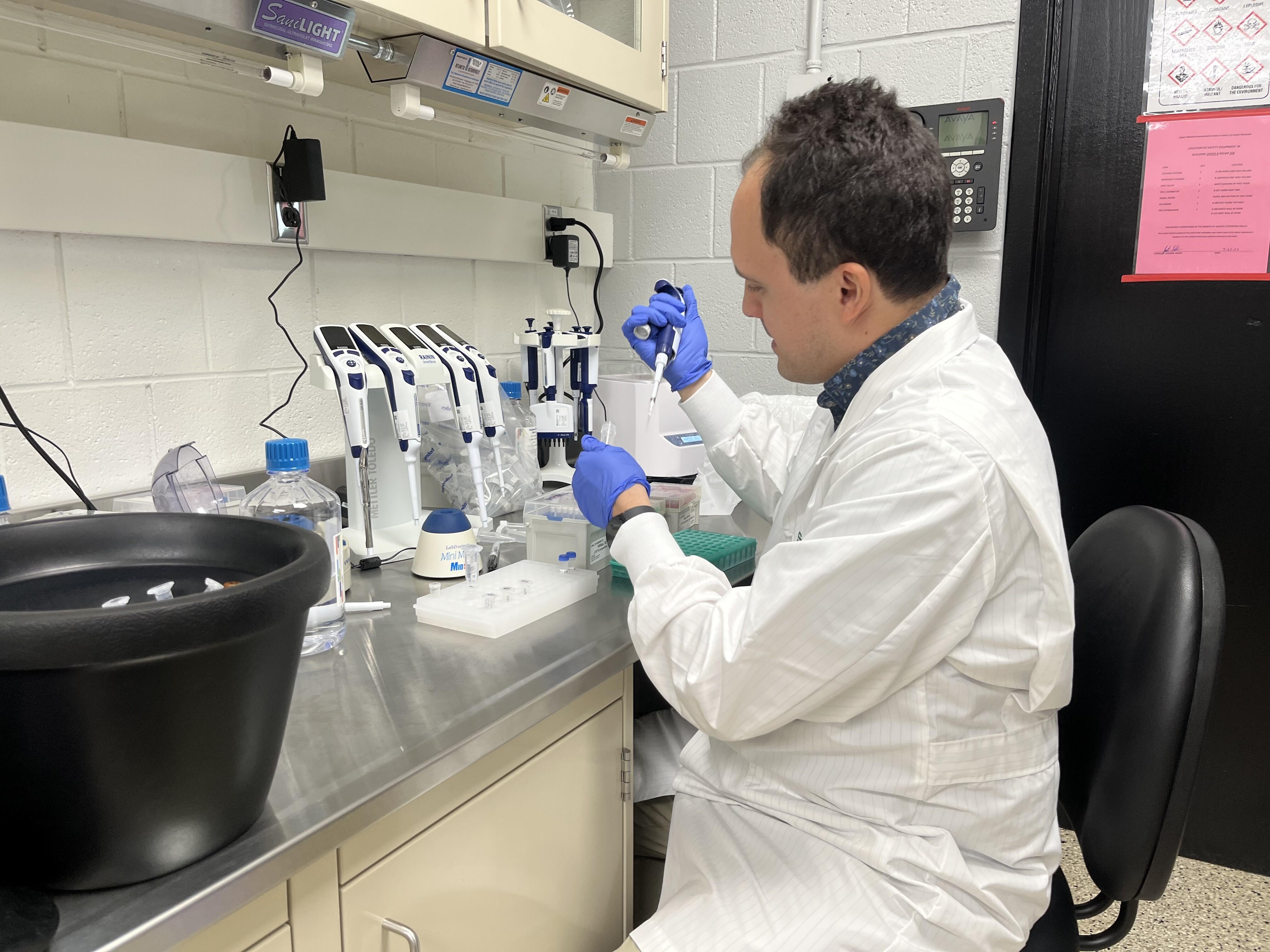
Assay field-validation, enacted in collaboration with biosecurity partners (e.g., U.S. Fish and Wildlife Service), provides a critical follow-up step to confirm the assay’s effectiveness and operational quality. Components of the field validation work would include testing rapid DNA extraction methods on a variety of sample types, confirming test efficacy in areas with confirmed BTS and areas where BTS is absent, and estimating detection probability to inform final protocols. Beyond technical validation, understanding how end users, particularly those responsible for BTS interdiction and monitoring, could integrate terrestrial eDNA tools into their existing workflows is critical to supporting rapid detection, improving confidence in management decisions, and ultimately reducing the risk of BTS spreading beyond Guam. Clear guidance is essential to ensure that tools are used effectively and that their combined capabilities and potential limitations are fully realized. USGS plans to address that need by engaging end users, identifying knowledge gaps, and developing a scientifically grounded decision framework to guide responsible agencies to evaluate when and how laboratory-based and POU terrestrial eDNA assays should be applied, either alone or in combination.
This tool has significant potential to enhance the DON’s BTS detection capabilities, helping to ensure that the CNMI and the State of Hawaii remain free of BTS as commerce and personnel move across islands and international borders. USGS is looking to streamline the validated POU assay as an on-demand kit accessible to various agencies (e.g., U.S. Fish and Wildlife Service and Customs and Border Protection). This POU assay kit could be deployed directly in the field by the Hawaii Department of Agriculture or the DON to swab shipping containers and military equipment during regional maneuvers, providing rapid onsite screening that strengthens biosecurity and reduces the risk of accidental introductions. Additional potential partners, such as U.S. Fish and Wildlife Service, the National Park Service, and Guam’s Division of Aquatic and Wildlife Resources, could apply the assay to verify snake removal following suppression or localized eradication efforts.
Funding
This project was funded by the USGS Ecosystems Mission Area and Department of Navy Joint Region of the Marianas because the work directly aligns with the critical biosecurity and rapid response requirements of regional plans.

Developing and evaluating a point-of-use environmental DNA test for rapid field detection of highly invasive brown treesnakes
The USGS is working with the Department of the Navy to develop a new, field-ready tool to help detect Brown Treesnake environmental DNA to help prevent the spread and establishment of the invasive species into new areas.
The Science Issue and Relevance
The accidental introduction of Brown Treesnakes (BTS) to Guam has caused severe ecological and operational damage, including the collapse of native bird species and frequent power outages, as well as increased risks to human safety. Because Guam functions as a major transportation and military hub in the Western Pacific, the potential spread of BTS to locations such as Hawaii and the Commonwealth of the Northern Mariana Islands (CNMI) poses substantial threats to regional biodiversity and to the operations of the Department of the Interior and the Department of the Navy (DON). Preventing the establishment of BTS in new areas requires rapid, reliable early detection of this injurious species.
Environmental DNA (eDNA) methods are valuable for detecting invasive species, but traditional laboratory workflows for detection can take days to weeks, delaying critical response actions. The USGS has created eDNA approaches and a quantitative polymerase chain reaction (PCR) assay to detect BTS genetic material in terrestrial environments; however, the primary limitation for producing actionable results remains the length of time between sample collection and assay processing.
To close this gap, USGS scientists are collaborating with the DON, specifically, Joint Region Marianas (JRM), to develop an advanced, point-of-use (POU) eDNA assay capable of providing results within minutes and requiring no specialized equipment or training. Both Loop-mediated Isothermal Amplification (LAMP) and CRISPR-Cas technologies are being evaluated for this field-ready BTS detection tool. This effort aims to integrate these approaches into a single, highly sensitive and specific "one-step" reaction suitable for rapid screening of BTS at critical border inspection sites and other applications where immediate detection is required.
Methodology for Addressing the Issue
USGS scientists in collaboration with Benjamín Durán Vinet and Robert Fagerlund from the University of Otago (Dunedin, New Zealand) are working to develop a user-friendly BTS eDNA detection tool that merges LAMP and CRISPR-Cas technologies to produce a simple-to-deploy, "one-step" assay for on-demand detection of BTS. This streamlined approach is enabled by an enhanced CRISPR-Cas enzyme, eBrCas12b, which functionally matches the elevated temperatures required for LAMP, thus permitting complementary actions of amplification and detection to operate simultaneously in a single reaction. Being able to simultaneously run these tests, which are normally done separately, drastically reduces the amount of time needed to produce results and reduces risks of sample contamination, allowing for much more efficient detection of BTS eDNA.
To design this system, computer-based analyses were firstly conducted to identify mitochondrial DNA targets suitable for LAMP amplification. These candidate regions were then assessed for compatibility with eBrCas12b recognition sites to ensure that both components detect the same DNA sequence. The highest-performing (based both on speed and sensitivity) LAMP and eBrCas12b assays will be selected to form the basis of the integrated POU assay. The selected assay will then be freeze-dried to ensure it remains stable in the field, while other optimization protocols will be implemented to ensure specificity and sensitivity is maintained. Complementary to the assay development, the rapid extraction protocols will be tested with BTS eDNA samples from terrestrial environments to validate the entire protocol. End users will be able to use this POU assay to quickly determine whether BTS are present in an environment.
Future Steps
Assay field-validation, enacted in collaboration with biosecurity partners (e.g., U.S. Fish and Wildlife Service), provides a critical follow-up step to confirm the assay’s effectiveness and operational quality. Components of the field validation work would include testing rapid DNA extraction methods on a variety of sample types, confirming test efficacy in areas with confirmed BTS and areas where BTS is absent, and estimating detection probability to inform final protocols. Beyond technical validation, understanding how end users, particularly those responsible for BTS interdiction and monitoring, could integrate terrestrial eDNA tools into their existing workflows is critical to supporting rapid detection, improving confidence in management decisions, and ultimately reducing the risk of BTS spreading beyond Guam. Clear guidance is essential to ensure that tools are used effectively and that their combined capabilities and potential limitations are fully realized. USGS plans to address that need by engaging end users, identifying knowledge gaps, and developing a scientifically grounded decision framework to guide responsible agencies to evaluate when and how laboratory-based and POU terrestrial eDNA assays should be applied, either alone or in combination.
This tool has significant potential to enhance the DON’s BTS detection capabilities, helping to ensure that the CNMI and the State of Hawaii remain free of BTS as commerce and personnel move across islands and international borders. USGS is looking to streamline the validated POU assay as an on-demand kit accessible to various agencies (e.g., U.S. Fish and Wildlife Service and Customs and Border Protection). This POU assay kit could be deployed directly in the field by the Hawaii Department of Agriculture or the DON to swab shipping containers and military equipment during regional maneuvers, providing rapid onsite screening that strengthens biosecurity and reduces the risk of accidental introductions. Additional potential partners, such as U.S. Fish and Wildlife Service, the National Park Service, and Guam’s Division of Aquatic and Wildlife Resources, could apply the assay to verify snake removal following suppression or localized eradication efforts.
Funding
This project was funded by the USGS Ecosystems Mission Area and Department of Navy Joint Region of the Marianas because the work directly aligns with the critical biosecurity and rapid response requirements of regional plans.