This video was created as part of the Climate Change Science and Management Webinar Series hosted by the U.S. Geological Survey's National Climate Change and Wildlife Science Center and the U.S. Fish and Wildlife Service's National Conservation Training Center.
Videos
Videos
This video was created as part of the Climate Change Science and Management Webinar Series hosted by the U.S. Geological Survey's National Climate Change and Wildlife Science Center and the U.S. Fish and Wildlife Service's National Conservation Training Center.
The USGS Hydrography Webinar Series shares success stories from users, provides information on The National Hydrography Dataset (NHD) and other related products, and provides a forum for users to learn more about Hydrography-related topics.
PubTalk 9/2015 — Coral Reefs, Climate Change, and Atoll Sustainability
PubTalk 9/2015 — Coral Reefs, Climate Change, and Atoll SustainabilityWill Micronesians become the U.S.'s first climate change refugees?
by Curt Storlazzi, USGS Research Geologist and Oceanographer
PubTalk 9/2015 — Coral Reefs, Climate Change, and Atoll Sustainability
PubTalk 9/2015 — Coral Reefs, Climate Change, and Atoll SustainabilityWill Micronesians become the U.S.'s first climate change refugees?
by Curt Storlazzi, USGS Research Geologist and Oceanographer
Field Office Chief Craig Painter on UAVs for Better Discharge Data
Field Office Chief Craig Painter on UAVs for Better Discharge DataUSGS field office chief Craig Painter shares his thoughts about the What's the Big Idea? innovation event at Kansas Water Science Center on Sept 2., 2015.
Field Office Chief Craig Painter on UAVs for Better Discharge Data
Field Office Chief Craig Painter on UAVs for Better Discharge DataUSGS field office chief Craig Painter shares his thoughts about the What's the Big Idea? innovation event at Kansas Water Science Center on Sept 2., 2015.
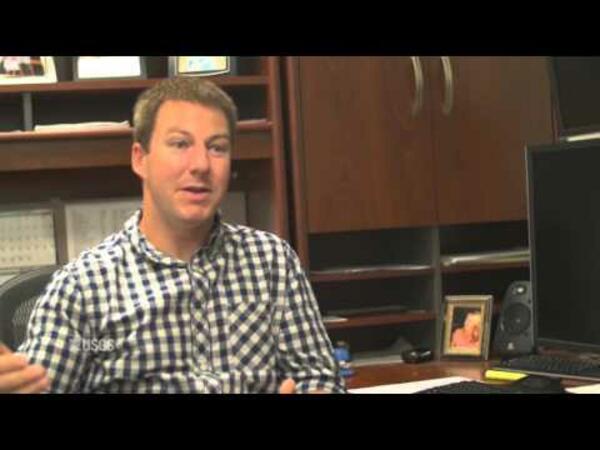
Hydrologist Arin Peters on Real-time Streamgage Cameras
Hydrologist Arin Peters on Real-time Streamgage CamerasUSGS hydrologist Arin Peters shares his thoughts about the What's the Big Idea? innovation event at Kansas Water Science Center on Sept 2., 2015.
Hydrologist Arin Peters on Real-time Streamgage Cameras
Hydrologist Arin Peters on Real-time Streamgage CamerasUSGS hydrologist Arin Peters shares his thoughts about the What's the Big Idea? innovation event at Kansas Water Science Center on Sept 2., 2015.
Chemist Rachael Lane on Developing-Scientist Gatherings
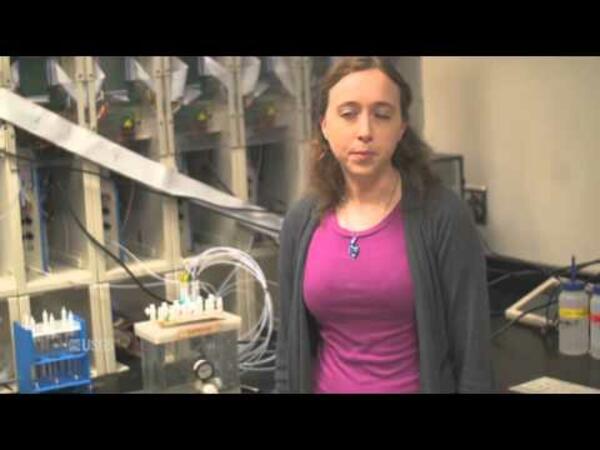
Chemist Rachael Lane on Developing-Scientist GatheringsUSGS chemist Rachael Lane shares her thoughts about the What's the Big Idea? innovation event at Kansas Water Science Center on Sept 2., 2015.
Chemist Rachael Lane on Developing-Scientist Gatherings
Chemist Rachael Lane on Developing-Scientist GatheringsUSGS chemist Rachael Lane shares her thoughts about the What's the Big Idea? innovation event at Kansas Water Science Center on Sept 2., 2015.
Barter Island sits at the top of the Arctic National Wildlife Refuge in Alaska, and with the Arctic facing quickly rising temperatures, USGS wants to investigate what’s causing the North Slope bluffs to erode so quickly.
PubTalk 8/2015 — Yes, Humans Really Are Causing Earthquakes
PubTalk 8/2015 — Yes, Humans Really Are Causing Earthquakesby Justin Rubinstein, USGS Research Geophysicist
PubTalk 8/2015 — Yes, Humans Really Are Causing Earthquakes
PubTalk 8/2015 — Yes, Humans Really Are Causing Earthquakesby Justin Rubinstein, USGS Research Geophysicist
Permanent Site: K1 West Transect; Depth: 6.0 Meters (19.8 Feet); Distance from river mouth: 4.5 Kilometers (2.8 Miles) east; Pre/Post Dam Removal: 4 years post-dam removal; Lat/Long: 48.13592923,-123.51082988; Site Description: This is a shallow site. Sediment is a gravel/sand mixture.
The Northwest Climate Science Center (NW CSC) is a Department of the Interior (DOI) initiative, sponsored by the USGS and jointly hosted by Oregon State University, the University of Idaho, and the University of Washington.
Permanent Site: A2 East Transect; Depth: 12.4 Meters (Feet 40.8); Distance from river mouth: Kilometers 1.8 (1.1 Miles); Pre/Post Dam Removal: 4 years post-dam removal; Lat/Long: 48.14130295, -123.58766124; Site Description: One of our deeper sites at over 40 feet. Sediment is primarily sand/sandy mud.
Permanent Site: A2 West Transect; Depth: 12.9 Meters (Feet 42.3); Distance from river mouth: Kilometers 1.8 (1.1 Miles); Pre/Post Dam Removal: 4 years post-dam removal; Lat/Long: 48.14130295, -123.5883331; Site Description: One of our deeper sites at over 40 feet. Sediment is primarily sand/sandy mud with a few scattered boulders.
Permanent Site: F2 West Transect; Depth: 11.2 Meters (36.9 Feet); Distance from river mouth: 1.5 Kilometers (0.9 Miles) east; Pre/Post Dam Removal: 4 years post-dam removal; Lat/Long: 48.15672004,-123.55036603; Site Description: Visibility is poor on video due to a large amount of surge on the day of the dive.
Permanent Site: 4SP1 - West Transect; Depth: 6.1 Meters (19.9 Feet); Distance from river mouth: 0.8 Kilometers (0.5 Miles) East; Pre/Post Dam Removal: 3 years post-dam removal; Lat/Long: 48.15257, -123.557376; Site Description: The site has converted from gravel/cobble substrate to all sand. Seaweed is completely absent.
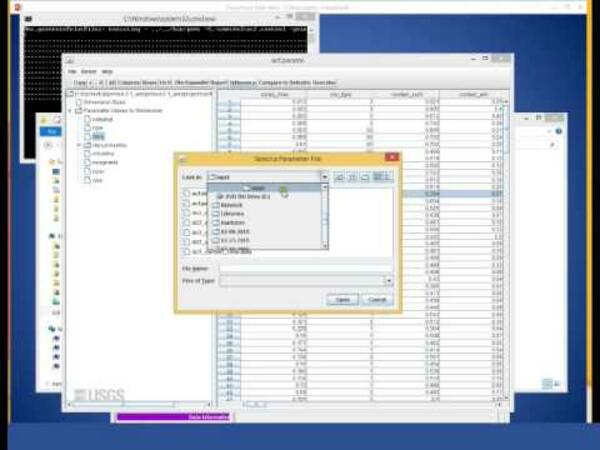
Demonstration of how to run USGS Precipitation Runoff Modeling System (PRMS) with the graphical user interface.
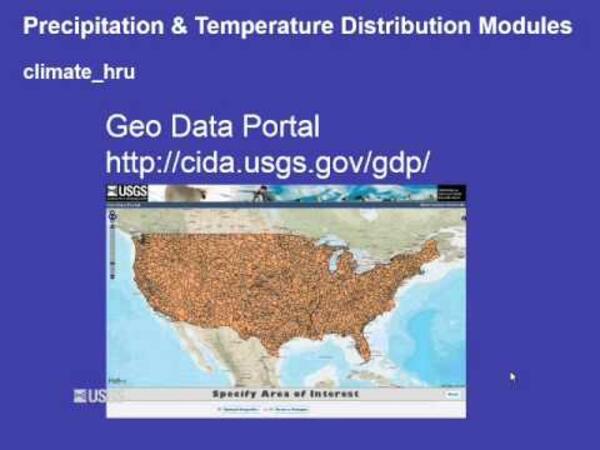
Presents the USGS Precipitation Runoff Modeling System (PRMS) climate distribution modules.
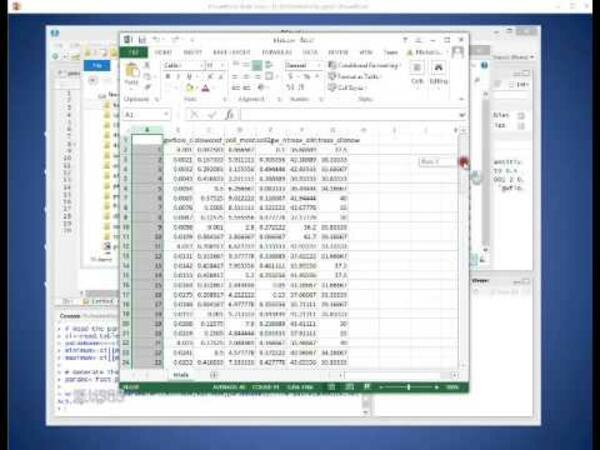
Parameter sensitivity analysis of USGS Precipitation Runoff Modeling System (PRMS) using the Fourier Amplitude Sensitivity Test algorithm.
Permanent Site: L1 West Transect; Depth: 11.4 Meters (37.3 Feet); Distance from river mouth: 2.3 Kilometers (1.4 Miles) west; Pre/Post Dam Removal: 4 years post-dam removal; Lat/Long: 48.13957527,-123.59427175; Site Description: This transect is medium depth. The first 20 meters contains scattered boulders (0:18 seconds).
Permanent Site: L1 East Transect; Depth: 11.6 Meters (38.0 Feet); Distance from river mouth: 2.3 Kilometers (1.4 Miles) west; Pre/Post Dam Removal: 4 years post-dam removal; Lat/Long: 48.13957527,-123.59359993; Site Description: This transect is medium depth. Substrate is mainly fine sediment/sand/mud with a few scattered boulders (1:15 seconds).
Permanent Site: A1 East Transect; Depth: 8.3 Meters (27.1 Feet); Distance from river mouth: 1.8 Kilometers (1.1 Miles) West; Pre/Post Dam Removal: 4 years post-dam removal; Lat/Long: 48.13870775, -123.5855312; Site Description: Transect is in eastern part of Freshwater Bay. Sediment is primarily sand/sandy mud. Previous small boulders appear to be buried.
Permanent Site: A1 West Transect; Depth: 8.7 Meters (28.5 Feet); Distance from river mouth: 1.9 Kilometers (1.2 Miles) West; Pre/Post Dam Removal: 4 years post-dam removal; Lat/Long: 48.13870775, -123.586203; Site Description: Transect is in eastern part of Freshwater Bay. Sediment is primarily sand/sandy mud with patches of boulders. Seaweeds have returned.