
Early Life History of Bighead, Silver, Black, and Grass Carps
Grass, bighead, black, and silver carps spawn in turbulent rivers, their eggs develop and hatch while drifting downriver. The larvae have a short period of development in the drift, and then they must swim from the mainstem of the river and find appropriate low- or no-flow nursery areas. Rivers which are not long enough, turbulent enough, or without nursery areas in the correct locations are not likely to support survival of these fishes. If we can cause these problematic fishes to spawn in locations that will not support survival, or if we can locate spawning and nursery areas to harvest fish or prevent their survival, these would be useful control methods.
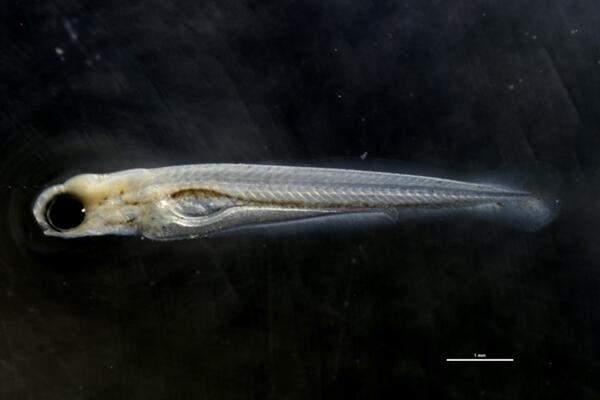
CERC scientists are studying the temperature-based development of eggs and larvae of these four invasive carp species as well as the behavior of larvae and eggs of these fishes in a flume. This will generate data to enhance drift models for early life history stages. These models aid in assessing the suitability of a river for spawning, the survival of young, the locations where captured eggs and larvae were spawned. As well as determining the portion of the river where the larvae are most likely to attempt to laterally disperse from the spawning river into nursery habitats and therefore where larvae might be susceptible to control methods.
The Issue: The early life stages (eggs, larvae, and juveniles) represent a critical period in the lives of fish, one characterized by high mortality rates. Survival of these stages commonly determines year-class strength and overall population size. These life stages are not captured using standard fishing gear meant for adults, thus there is a lack of knowledge about survival rates, habitat requirements, recruitment and dispersal potentials. Understanding the factors during early development is needed for risk analysis of establishment, prediction of transport distances and available nursery habitats, as well as, determination of spawning location, and development of controls which reduce early life stage survival and year-class strength.
Addressing the Issue: By combining early life biological data with physical and hydraulic data, models such as FluEgg have been developed to predict transport within a specific river system. CERC scientists have learned:
- Temperature-dependent developmental rates of grass carp, bighead carp, and silver carp eggs and larvae.
- Survival rates of grass carp eggs that settle to the bottom.
- Physical characteristics of grass carp, bighead carp, and silver carp eggs useful for identification and transport potential.
- Swimming behaviors and capabilities of grass carp, bighead carp, and silver carp larvae.
- Neurosensory development in grass carp larvae to determine potential environmental cues for dispersal.
- Physiological tolerances of larval invasive carp, such as salinity and hypoxia.
- Effects of turbulence on the survival of grass carp eggs and larvae.
In addition, CERC scientists are currently working on projects to:
- Determine early life history characteristics of black carp, including developmental rates, stages, physical characteristics of eggs, and swimming behavior.
- Assist with the development of control mechanisms aimed at early life stages, such as the Oblique Bubble Screen.
- Train and assist other agencies in the identification of captured larvae.
Return to Invasive Species Ecology
Return to Fisheries and Invasive Species
Below are data or web applications associated with this project.
Effects of hypoxic exposure on survival of larval grass carp (Ctenopharyngodon idella) Effects of hypoxic exposure on survival of larval grass carp (Ctenopharyngodon idella)
Behavioral responses to different sensory stimuli in larval Grass Carp Ctenopharyngodon idella Behavioral responses to different sensory stimuli in larval Grass Carp Ctenopharyngodon idella
Salinity tolerance of grass carp and silver carp during egg and early larval stages Salinity tolerance of grass carp and silver carp during egg and early larval stages
Light trap and larval trawl collection of bigheaded carp in the Missouri River Basin, 2016 Light trap and larval trawl collection of bigheaded carp in the Missouri River Basin, 2016
Swimming speeds of grass carp in response to turbulence Swimming speeds of grass carp in response to turbulence
Asian carp eDNA and egg morphology data collected from Truman Reservoir tributaries, Missouri, USA, 2014 Asian carp eDNA and egg morphology data collected from Truman Reservoir tributaries, Missouri, USA, 2014
Survival and hydrodynamic behavior of grass carp eggs and larvae in relation to turbulence and in-stream obstructions Survival and hydrodynamic behavior of grass carp eggs and larvae in relation to turbulence and in-stream obstructions
Survival and drifting patterns of grass carp eggs and larvae in response to interactions with flow and sediment in a laboratory flume Survival and drifting patterns of grass carp eggs and larvae in response to interactions with flow and sediment in a laboratory flume
Ontogenetic changes in swimming speed of silver carp, bighead carp, and grass carp larvae-Data Ontogenetic changes in swimming speed of silver carp, bighead carp, and grass carp larvae-Data
Data for Comparison of Size, Terminal Fall Velocity, and Density of Bighead, Silver, and Grass Carp Eggs for use in Drift Modeling Data for Comparison of Size, Terminal Fall Velocity, and Density of Bighead, Silver, and Grass Carp Eggs for use in Drift Modeling
Below are publications associated with this project.
Limiting downstream dispersal of invasive carp egg surrogates using a laboratory-scale oblique bubble screen Limiting downstream dispersal of invasive carp egg surrogates using a laboratory-scale oblique bubble screen
Assessing the efficacy of oblique bubble screens for control of aquatic invasive species Assessing the efficacy of oblique bubble screens for control of aquatic invasive species
Identifying turbulence features hindering swimming capabilities of grass carp larvae (Ctenopharyngodon idella) through submerged vegetation Identifying turbulence features hindering swimming capabilities of grass carp larvae (Ctenopharyngodon idella) through submerged vegetation
Using turbulence to identify preferential areas for grass carp (Ctenopharyngodon idella) larvae in streams: A laboratory study Using turbulence to identify preferential areas for grass carp (Ctenopharyngodon idella) larvae in streams: A laboratory study
Use of environmental DNA to detect grass carp spawning events Use of environmental DNA to detect grass carp spawning events
Developmental ecomorphology of the epibranchial organ of the silver carp, Hypophthalmichthys molitrix Developmental ecomorphology of the epibranchial organ of the silver carp, Hypophthalmichthys molitrix
Influence of turbulence and in-stream structures on the transport and survival of grass carp eggs and larvae at various developmental stages Influence of turbulence and in-stream structures on the transport and survival of grass carp eggs and larvae at various developmental stages
Survival and drifting patterns of grass carp eggs and larvae in response to interactions with flow and sediment in a laboratory flume Survival and drifting patterns of grass carp eggs and larvae in response to interactions with flow and sediment in a laboratory flume
Ontogenetic changes in swimming speed of silver carp, bighead carp, and grass carp larvae: implications for larval dispersal Ontogenetic changes in swimming speed of silver carp, bighead carp, and grass carp larvae: implications for larval dispersal
Evidence of Asian carp spawning upstream of a key choke point in the Mississippi River Evidence of Asian carp spawning upstream of a key choke point in the Mississippi River
Comparison of size, terminal fall velocity, and density of bighead carp, silver carp, and grass carp eggs for use in drift modeling Comparison of size, terminal fall velocity, and density of bighead carp, silver carp, and grass carp eggs for use in drift modeling
Genetic analysis shows that morphology alone cannot distinguish asian carp eggs from those of other cyprinid species Genetic analysis shows that morphology alone cannot distinguish asian carp eggs from those of other cyprinid species
Grass, bighead, black, and silver carps spawn in turbulent rivers, their eggs develop and hatch while drifting downriver. The larvae have a short period of development in the drift, and then they must swim from the mainstem of the river and find appropriate low- or no-flow nursery areas. Rivers which are not long enough, turbulent enough, or without nursery areas in the correct locations are not likely to support survival of these fishes. If we can cause these problematic fishes to spawn in locations that will not support survival, or if we can locate spawning and nursery areas to harvest fish or prevent their survival, these would be useful control methods.
CERC scientists are studying the temperature-based development of eggs and larvae of these four invasive carp species as well as the behavior of larvae and eggs of these fishes in a flume. This will generate data to enhance drift models for early life history stages. These models aid in assessing the suitability of a river for spawning, the survival of young, the locations where captured eggs and larvae were spawned. As well as determining the portion of the river where the larvae are most likely to attempt to laterally disperse from the spawning river into nursery habitats and therefore where larvae might be susceptible to control methods.
The Issue: The early life stages (eggs, larvae, and juveniles) represent a critical period in the lives of fish, one characterized by high mortality rates. Survival of these stages commonly determines year-class strength and overall population size. These life stages are not captured using standard fishing gear meant for adults, thus there is a lack of knowledge about survival rates, habitat requirements, recruitment and dispersal potentials. Understanding the factors during early development is needed for risk analysis of establishment, prediction of transport distances and available nursery habitats, as well as, determination of spawning location, and development of controls which reduce early life stage survival and year-class strength.
Addressing the Issue: By combining early life biological data with physical and hydraulic data, models such as FluEgg have been developed to predict transport within a specific river system. CERC scientists have learned:
- Temperature-dependent developmental rates of grass carp, bighead carp, and silver carp eggs and larvae.
- Survival rates of grass carp eggs that settle to the bottom.
- Physical characteristics of grass carp, bighead carp, and silver carp eggs useful for identification and transport potential.
- Swimming behaviors and capabilities of grass carp, bighead carp, and silver carp larvae.
- Neurosensory development in grass carp larvae to determine potential environmental cues for dispersal.
- Physiological tolerances of larval invasive carp, such as salinity and hypoxia.
- Effects of turbulence on the survival of grass carp eggs and larvae.
In addition, CERC scientists are currently working on projects to:
- Determine early life history characteristics of black carp, including developmental rates, stages, physical characteristics of eggs, and swimming behavior.
- Assist with the development of control mechanisms aimed at early life stages, such as the Oblique Bubble Screen.
- Train and assist other agencies in the identification of captured larvae.
Return to Invasive Species Ecology
Return to Fisheries and Invasive Species
Below are data or web applications associated with this project.
Effects of hypoxic exposure on survival of larval grass carp (Ctenopharyngodon idella) Effects of hypoxic exposure on survival of larval grass carp (Ctenopharyngodon idella)
Behavioral responses to different sensory stimuli in larval Grass Carp Ctenopharyngodon idella Behavioral responses to different sensory stimuli in larval Grass Carp Ctenopharyngodon idella
Salinity tolerance of grass carp and silver carp during egg and early larval stages Salinity tolerance of grass carp and silver carp during egg and early larval stages
Light trap and larval trawl collection of bigheaded carp in the Missouri River Basin, 2016 Light trap and larval trawl collection of bigheaded carp in the Missouri River Basin, 2016
Swimming speeds of grass carp in response to turbulence Swimming speeds of grass carp in response to turbulence
Asian carp eDNA and egg morphology data collected from Truman Reservoir tributaries, Missouri, USA, 2014 Asian carp eDNA and egg morphology data collected from Truman Reservoir tributaries, Missouri, USA, 2014
Survival and hydrodynamic behavior of grass carp eggs and larvae in relation to turbulence and in-stream obstructions Survival and hydrodynamic behavior of grass carp eggs and larvae in relation to turbulence and in-stream obstructions
Survival and drifting patterns of grass carp eggs and larvae in response to interactions with flow and sediment in a laboratory flume Survival and drifting patterns of grass carp eggs and larvae in response to interactions with flow and sediment in a laboratory flume
Ontogenetic changes in swimming speed of silver carp, bighead carp, and grass carp larvae-Data Ontogenetic changes in swimming speed of silver carp, bighead carp, and grass carp larvae-Data
Data for Comparison of Size, Terminal Fall Velocity, and Density of Bighead, Silver, and Grass Carp Eggs for use in Drift Modeling Data for Comparison of Size, Terminal Fall Velocity, and Density of Bighead, Silver, and Grass Carp Eggs for use in Drift Modeling
Below are publications associated with this project.