
U.S. flag

An official website of the United States government

Energy Production Materials in the Environment

Filter Total Items: 33

Are Spills Associated with Deep Well Injection of Wastewater from Oil and Gas Operations a Health Hazard?

Our specialized teams of hydrologists, chemists, biologists, and geologists worked together in the New River Gorge National River watershed to answer this question. Wastewater generated in association with oil and gas operations at this site is managed by injection in deep wells designed to safely dispose and contain contaminants in deep geologic formations. Contaminants associated with oil and...
Are Spills Associated with Deep Well Injection of Wastewater from Oil and Gas Operations a Health Hazard?

Are Spills Associated with Deep Well Injection of Wastewater from Oil and Gas Operations a Health Hazard?

Our specialized teams of hydrologists, chemists, biologists, and geologists worked together in the New River Gorge National River watershed to answer this question. Wastewater generated in association with oil and gas operations at this site is managed by injection in deep wells designed to safely dispose and contain contaminants in deep geologic formations. Contaminants associated with oil and...
Learn More

Environmental Chemistry Core Technology Team

About the Research The Environmental Chemistry Laboratory Core Technology Team (CTT) as part of the Environmental Health Program develops and applies innovative methods of sampling and analysis to answer critical questions about the occurrence, distribution, fate and transport, and biological exposure of chemical in all environmental matrices (water, air, tissues, sediments, and others).
Environmental Chemistry Core Technology Team

Environmental Chemistry Core Technology Team

About the Research The Environmental Chemistry Laboratory Core Technology Team (CTT) as part of the Environmental Health Program develops and applies innovative methods of sampling and analysis to answer critical questions about the occurrence, distribution, fate and transport, and biological exposure of chemical in all environmental matrices (water, air, tissues, sediments, and others).
Learn More

Cyclical Mobilization and Attenuation of Naturally Occurring Arsenic in an Underground Petroleum Plume

Scientists found that naturally occurring arsenic in aquifer sediments was mobilized into groundwater and attenuated through reattachment to sediments within an underground petroleum plume. Understanding these patterns identifies anthropogenic factors that affect arsenic presence and magnitude in groundwater.
Cyclical Mobilization and Attenuation of Naturally Occurring Arsenic in an Underground Petroleum Plume

Cyclical Mobilization and Attenuation of Naturally Occurring Arsenic in an Underground Petroleum Plume

Scientists found that naturally occurring arsenic in aquifer sediments was mobilized into groundwater and attenuated through reattachment to sediments within an underground petroleum plume. Understanding these patterns identifies anthropogenic factors that affect arsenic presence and magnitude in groundwater.
Learn More

Program Scientist Receives Meritorious Service Award

Dr. Isabelle M. Cozzarelli received the U.S. Department of Interior's second highest honorary award—the Meritorious Service Award—for her numerous contributions to understanding the biogeochemical controls of contaminant degradation in groundwater and near-surface environments.
Program Scientist Receives Meritorious Service Award

Program Scientist Receives Meritorious Service Award

Dr. Isabelle M. Cozzarelli received the U.S. Department of Interior's second highest honorary award—the Meritorious Service Award—for her numerous contributions to understanding the biogeochemical controls of contaminant degradation in groundwater and near-surface environments.
Learn More

Two Scientists Receive Early Career Excellence in Leadership Award

The U.S. Geological Survey (USGS) 2016 Early Career Excellence in Leadership Award was given to Dr. Denise M. Akob and Dr. Karl B. Haase. Drs. Akob and Haase have demonstrated outstanding leadership through their scientific accomplishments and service to the USGS.
Two Scientists Receive Early Career Excellence in Leadership Award

Two Scientists Receive Early Career Excellence in Leadership Award

The U.S. Geological Survey (USGS) 2016 Early Career Excellence in Leadership Award was given to Dr. Denise M. Akob and Dr. Karl B. Haase. Drs. Akob and Haase have demonstrated outstanding leadership through their scientific accomplishments and service to the USGS.
Learn More

Trace Levels of Organic Chemicals Limited to Local Reaches of a Stream near an Oil and Gas Wastewater Disposal Facility

Organic contaminants that were present in Wolf Creek near a wastewater disposal facility were not evident farther downstream where Wolf Creek enters the New River. Wolf Creek and the New River are used for drinking water and recreational purposes.
Trace Levels of Organic Chemicals Limited to Local Reaches of a Stream near an Oil and Gas Wastewater Disposal Facility

Trace Levels of Organic Chemicals Limited to Local Reaches of a Stream near an Oil and Gas Wastewater Disposal Facility

Organic contaminants that were present in Wolf Creek near a wastewater disposal facility were not evident farther downstream where Wolf Creek enters the New River. Wolf Creek and the New River are used for drinking water and recreational purposes.
Learn More

Examining Shifts in Stream Microbial Communities Exposed to Oil and Gas Wastewaters

Shifts in the overall microbial community structure were present in stream sediments that contained chemicals associated with unconventional oil and gas wastewaters. This work is part of a long-term study designed to understand persistence of chemicals from oil and gas wastewaters in sediments and water and how those factors might be related to exposures and adverse health effects, if any, on...
Examining Shifts in Stream Microbial Communities Exposed to Oil and Gas Wastewaters

Examining Shifts in Stream Microbial Communities Exposed to Oil and Gas Wastewaters

Shifts in the overall microbial community structure were present in stream sediments that contained chemicals associated with unconventional oil and gas wastewaters. This work is part of a long-term study designed to understand persistence of chemicals from oil and gas wastewaters in sediments and water and how those factors might be related to exposures and adverse health effects, if any, on...
Learn More

Understanding Pathways of Unconventional Oil and Gas Produced Water Spills in the Environment

A new study measures the transport of chemicals associated with unconventional oil and gas (UOG) produced waters downstream from a pipeline leak in North Dakota. This work is part of a long-term study designed to understand chemical persistence in sediments and water and how those factors might be related to contaminant exposures and associated with adverse health effects, if any, on organisms.
Understanding Pathways of Unconventional Oil and Gas Produced Water Spills in the Environment

Understanding Pathways of Unconventional Oil and Gas Produced Water Spills in the Environment

A new study measures the transport of chemicals associated with unconventional oil and gas (UOG) produced waters downstream from a pipeline leak in North Dakota. This work is part of a long-term study designed to understand chemical persistence in sediments and water and how those factors might be related to contaminant exposures and associated with adverse health effects, if any, on organisms.
Learn More

U.S. Geological Survey Identifies Crude-Oil Metabolites in Subsurface Plumes

U.S. Geological Survey (USGS) scientists studying two subsurface crude-oil spill sites in Minnesota measured concentrations of oil breakdown products (metabolites) at greater concentrations than parent compound concentrations.
U.S. Geological Survey Identifies Crude-Oil Metabolites in Subsurface Plumes

U.S. Geological Survey Identifies Crude-Oil Metabolites in Subsurface Plumes

U.S. Geological Survey (USGS) scientists studying two subsurface crude-oil spill sites in Minnesota measured concentrations of oil breakdown products (metabolites) at greater concentrations than parent compound concentrations.
Learn More

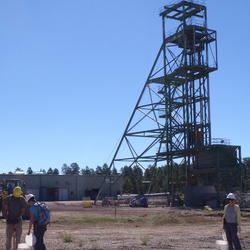
U.S. Geological Survey Develops Approach to Assess Baseline Chemical and Radiological Conditions Prior to Uranium Mining near Grand Canyon National Park

U.S. Geological Survey (USGS) scientists developed an approach and collected baseline data to quantitatively assess offsite migration of mine-related contaminants and to identify critical contaminant exposure pathways that could result from uranium mining activities in the Grand Canyon region.
U.S. Geological Survey Develops Approach to Assess Baseline Chemical and Radiological Conditions Prior to Uranium Mining near Grand Canyon National Park

U.S. Geological Survey Develops Approach to Assess Baseline Chemical and Radiological Conditions Prior to Uranium Mining near Grand Canyon National Park

U.S. Geological Survey (USGS) scientists developed an approach and collected baseline data to quantitatively assess offsite migration of mine-related contaminants and to identify critical contaminant exposure pathways that could result from uranium mining activities in the Grand Canyon region.
Learn More

North American and European Atmospheric Mercury Declines Explained by Local and Regional Emission Reductions

Recent findings from a consortium of university, State, and U.S. Geological Survey (USGS) scientists indicate that declining atmospheric concentrations of mercury (Hg) can be explained by the phaseout of mercury in many commercial products and by reduced emissions from utilities over the past two decades.
North American and European Atmospheric Mercury Declines Explained by Local and Regional Emission Reductions

North American and European Atmospheric Mercury Declines Explained by Local and Regional Emission Reductions

Recent findings from a consortium of university, State, and U.S. Geological Survey (USGS) scientists indicate that declining atmospheric concentrations of mercury (Hg) can be explained by the phaseout of mercury in many commercial products and by reduced emissions from utilities over the past two decades.
Learn More

Ethanol-Containing Fuel Spills Enhanced Natural Trace Element Release from Sediments in an Experimental Setting

Experimental field research simulating hydrocarbon spills by researchers from the U.S. Geological Survey (USGS), Virginia Tech, and the University of St. Thomas showed that mixed ethanol and petroleum-based fuels increased the rate by which arsenic and other natural trace elements are released from aquifer sediments to groundwater when compared to petroleum-based fuels alone.
Ethanol-Containing Fuel Spills Enhanced Natural Trace Element Release from Sediments in an Experimental Setting

Ethanol-Containing Fuel Spills Enhanced Natural Trace Element Release from Sediments in an Experimental Setting

Experimental field research simulating hydrocarbon spills by researchers from the U.S. Geological Survey (USGS), Virginia Tech, and the University of St. Thomas showed that mixed ethanol and petroleum-based fuels increased the rate by which arsenic and other natural trace elements are released from aquifer sediments to groundwater when compared to petroleum-based fuels alone.
Learn More
Was this page helpful?