



Natural Resources
Natural Resources
Filter Total Items: 8

Life History and Migration of Sturgeons in New England Waters
Sturgeons appear in the fossil record as early as the Triassic, 200 million years ago. Although most populations could once tolerate harvesting pressures, most populations have collapsed and nearly all of the 28 species alive today are listed as threatened or endangered. In New England, dams and water regulation challenge population recoveries of the two resident species, the shortnose and...
Groundwater Sustainability of the Long Island Aquifer System
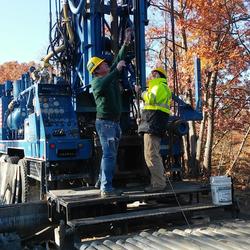
The U.S. Geological Survey (USGS) has partnered with the New York State Department of Environmental Conservation (NYSDEC) to conduct a comprehensive study of the Long Island aquifer system. The major findings of this investigation include: The location of the boundary between fresh and salty groundwater is much closer to the shoreline than previously thought. The historical onshore saltwater...

Fish Passage Design and Analysis at the S.O. Conte Research Laboratory
There are more than 92,000 dams in the United States, of which at least 3% of these produce hydropower. Hydropower projects create renewable energy but also can alter habitats, restrict upstream and downstream movements of fishes and other aquatic organisms, and may stress, injure or kill migrant fishes and other aquatic organisms. In addition, there are more than 5 million culverts and other road...

Embayment Monitoring to Support Nutrient Management Activities in Connecticut for Long Island Sound
The USGS, in cooperation with the Connecticut Department of Energy and Environmental Protection will be collecting water-quality and hydrologic data at six embayments from April 2021 to June 2027: Mystic, Norwalk, Saugatuck, Sasco-Southport complex, Farm, and Poquonnock.

Surface Water Quality Monitoring in Connecticut
The 2,983 miles of streams in Connecticut support a range of uses, including drinking water, recreation, and fish and shellfish habitat. The State is required by the Clean Water Act to assess the health of these waters every two years.

Flow Modeling at Dam Removal Sites Associated with Hurricane Sandy Resiliency Efforts
The purpose of this work is to better understand the effects of dam removal on local hydraulics, fish passage, and flooding. This study is part of a larger effort to monitor ecological resilience changes at nine Hurricane Sandy coastal resiliency aquatic connectivity restoration projects. It will contribute crucial knowledge that will be used to improve aquatic connectivity system cost...

The West Brook Story
Natural systems, like rivers and streams, are remarkably complex, with many interacting parts. Data visualization tools make understanding and communicating complex ecological processes easier. Effective visualizations help users learn about patterns in data and how models work. Interactive visualizations are particularly useful, as they let users explore data and develop a personal understanding...

Using Microbial Source Tracking to Identify Pollution Sources in Pathogen Impaired Embayments in Long Island, New York
Problem The presence of pathogens in Long Island marine embayments and the hazards they pose to marine resources and human health is of increasing concern. Many waterbodies on the New York State Section 303(d) List of Impaired Waters have pathogens listed as the primary pollutant that are suspected to originate from urban/storm runoff. There is neither a clear understanding of the...