



This female Rose-breasted Grosbeak was one out of six grosbeaks banded at the Bird Banding Lab's Fall Migration Station. Making it an irruption year at the station.
Images
Images of bird banding.
Filter Total Items: 112

Female Rose-breasted Grosbeak
This female Rose-breasted Grosbeak was one out of six grosbeaks banded at the Bird Banding Lab's Fall Migration Station. Making it an irruption year at the station.

Collecting weight data on a Black-billed Cuckoo
A Black-billed Cuckoo is weighed in a plastic pill canister, so that researchers can better understand the fluctuation of weight gain and loss during migration.
A Black-billed Cuckoo is weighed in a plastic pill canister, so that researchers can better understand the fluctuation of weight gain and loss during migration.

Black-billed Cuckoo wing
Scientists examine the wing of this cuckoo looking for signs of feather wear to age this bird.
Scientists examine the wing of this cuckoo looking for signs of feather wear to age this bird.

American Redstart wing
An American Redstart wing being examined in the hand, the bright contrasting orange and black indicate this bird is an after hatch year male.
An American Redstart wing being examined in the hand, the bright contrasting orange and black indicate this bird is an after hatch year male.
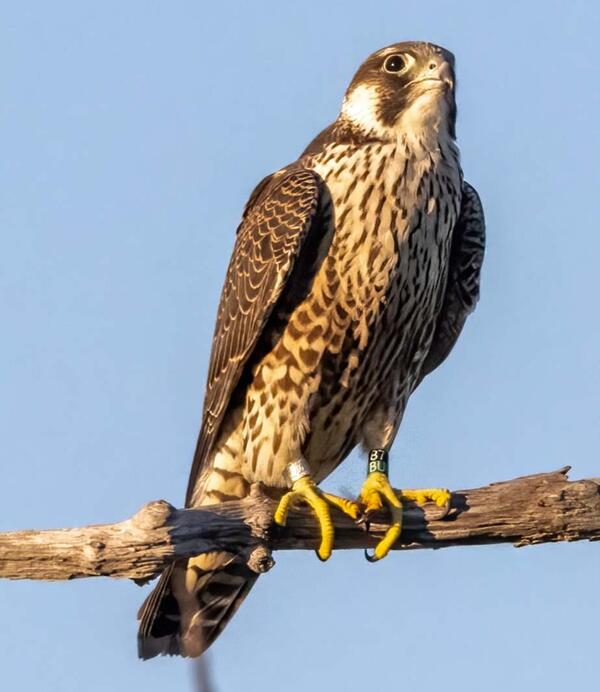
A banded Peregrine Falcon (1266-00837, 87/BU Silver on Black/Green)
A banded Peregrine Falcon (1266-00837, 87/BU Silver on Black/Green)A USGS federally banded Peregrine Falcon (band # 1266-00837, color marker 87/BU Silver on Black/Green) sitting on a branch at Duxbury Beach, Plymouth County, Massachusetts.
A banded Peregrine Falcon (1266-00837, 87/BU Silver on Black/Green)
A banded Peregrine Falcon (1266-00837, 87/BU Silver on Black/Green)A USGS federally banded Peregrine Falcon (band # 1266-00837, color marker 87/BU Silver on Black/Green) sitting on a branch at Duxbury Beach, Plymouth County, Massachusetts.

Prothonotary Warbler
This is the first Prothonotary Warbler since 2007 at the BBL's Fall Migration Station.
This is the first Prothonotary Warbler since 2007 at the BBL's Fall Migration Station.

Blue-gray Gnatcatcher
In the fall of 2022, the BBL's Fall Migration Station had a surprising number of early migrants pass through the station at the end of August, including an abundance of Blue-gray Gnatcatchers.
In the fall of 2022, the BBL's Fall Migration Station had a surprising number of early migrants pass through the station at the end of August, including an abundance of Blue-gray Gnatcatchers.

Tail of a Magnolia Warbler
To age and sex Magnolia Warbler's in the hand, scientists look for clues in the tail. These large square white patches are an excellent indication that this bird is an after hatch year, male Magnolia Warbler.
To age and sex Magnolia Warbler's in the hand, scientists look for clues in the tail. These large square white patches are an excellent indication that this bird is an after hatch year, male Magnolia Warbler.

Bird Banding Lab Table at Latino Conservation Week
Bird Banding Lab Table at Latino Conservation WeekElaine Nakash educates visitors and volunteers alike at the USGS Bird Banding Laboratory's display table, which was setup for the Latino Conservation Week event at the National Wildlife Visitor Center at Patuxent Research Refuge.
Bird Banding Lab Table at Latino Conservation Week
Bird Banding Lab Table at Latino Conservation WeekElaine Nakash educates visitors and volunteers alike at the USGS Bird Banding Laboratory's display table, which was setup for the Latino Conservation Week event at the National Wildlife Visitor Center at Patuxent Research Refuge.
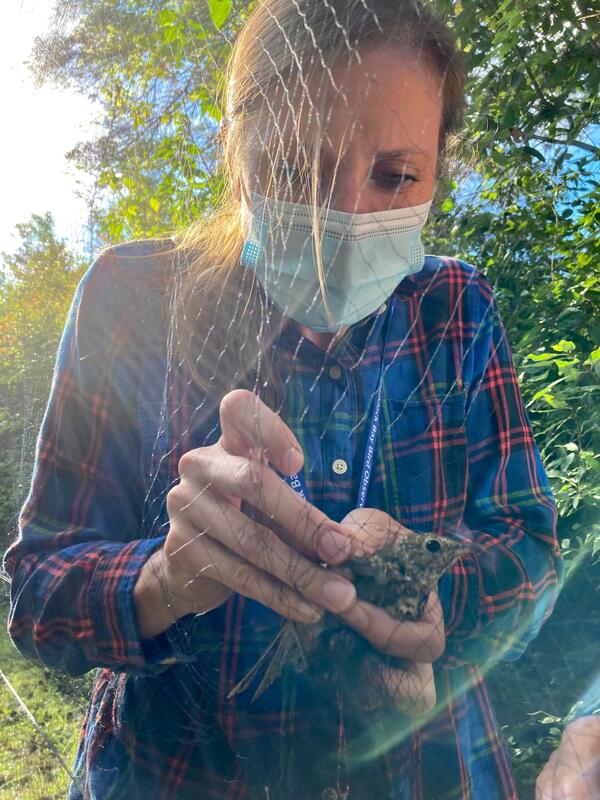
Biologist Stephanie Egger extracts a thrush from a mist net.
Biologist Stephanie Egger extracts a thrush from a mist net.Bird Banding Laboratory Biologist, Stephanie Egger, extracts a thrush from a mist net.
Biologist Stephanie Egger extracts a thrush from a mist net.
Biologist Stephanie Egger extracts a thrush from a mist net.Bird Banding Laboratory Biologist, Stephanie Egger, extracts a thrush from a mist net.

Stephanie Egger smiles for the camera with her Bird Safe Philly program supplies
Stephanie Egger smiles for the camera with her Bird Safe Philly program suppliesStephanie Egger smiles for the camera with her Bird Safe Philly program supplies.
Stephanie Egger smiles for the camera with her Bird Safe Philly program supplies
Stephanie Egger smiles for the camera with her Bird Safe Philly program suppliesStephanie Egger smiles for the camera with her Bird Safe Philly program supplies.

Bird Bandings from 2021
A map of where birds were banded in 2021, in blue, a total of over 600,000 banding records.
A map of where birds were banded in 2021, in blue, a total of over 600,000 banding records.

Bird Encounters from 2021
A map of where previously-banded birds were found in 2021, in pink, a total of almost 120,000 encounter and recapture records. An “encounter” is any observation of a previously-banded bird, of which a “recapture” is a special case where the bird is captured by a permitted bander, either the person who originally band
A map of where previously-banded birds were found in 2021, in pink, a total of almost 120,000 encounter and recapture records. An “encounter” is any observation of a previously-banded bird, of which a “recapture” is a special case where the bird is captured by a permitted bander, either the person who originally band

Wings of male Purple Finches
Banders compare the wings of two banded Purple Finches at the USGS Bird Banding Lab's Fall Migration Station.
Banders compare the wings of two banded Purple Finches at the USGS Bird Banding Lab's Fall Migration Station.

Sharp-shinned Hawk
A male Sharp-shinned Hawk banded at the USGS Bird Banding Lab's Fall Migration Station.
A male Sharp-shinned Hawk banded at the USGS Bird Banding Lab's Fall Migration Station.

Banding and Encounter of an Pacific Golden Plover
A Pacific Golden-Plover (Pluvialis fulva), like the one pictured, was originally banded with a USGS federal leg band in Alaska and then encountered in Japan several months later. Currently the BBL is working together with Japan's banding scheme to ensure bird movement data, like this, gets recorded from both schemes.
A Pacific Golden-Plover (Pluvialis fulva), like the one pictured, was originally banded with a USGS federal leg band in Alaska and then encountered in Japan several months later. Currently the BBL is working together with Japan's banding scheme to ensure bird movement data, like this, gets recorded from both schemes.

Tufted Titmouse in the Hand
A Tufted Titmouse recaptured at the Bird Banding Lab's Fall Migration Station in 2021, originally banded at the station in 2013.
A Tufted Titmouse recaptured at the Bird Banding Lab's Fall Migration Station in 2021, originally banded at the station in 2013.

A Yellow-bellied Sapsucker's wing and the "Identifiation Guide to North American Birds" by Peter Pyle
A Yellow-bellied Sapsucker's wing and the "Identifiation Guide to North American Birds" by Peter PyleA bander examine's the wing of a Yellow-bellied Sapsucker, using Peter Pyle's book "Identification Guide to North American Birds" to age and sex the individual.
A Yellow-bellied Sapsucker's wing and the "Identifiation Guide to North American Birds" by Peter Pyle
A Yellow-bellied Sapsucker's wing and the "Identifiation Guide to North American Birds" by Peter PyleA bander examine's the wing of a Yellow-bellied Sapsucker, using Peter Pyle's book "Identification Guide to North American Birds" to age and sex the individual.

Female House Finch in the hand
The first House Finch caught at the USGS Bird Banding Lab's Fall Migration Station since 1999.
The first House Finch caught at the USGS Bird Banding Lab's Fall Migration Station since 1999.

Banded Black-and-white Warbler
Black-and-white Warblers are one of the more common warbler species banded at the BBL's Fall Migration Banding Station.
Black-and-white Warblers are one of the more common warbler species banded at the BBL's Fall Migration Banding Station.

Cape May Warbler in the hand
Cape May Warbler banded at the USGS Bird Banding Lab's Fall Migration Station.
Cape May Warbler banded at the USGS Bird Banding Lab's Fall Migration Station.