



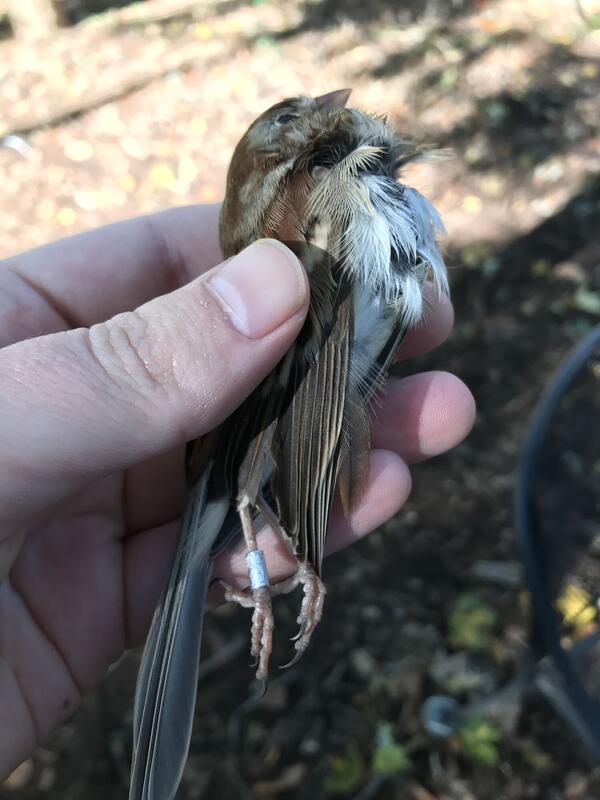
The buffy “teardrops” you see on some of the feathers indicate that this Swainson's Thrush hatched this summer and is making its first-ever migratory journey! This bird that was banded October 1, 2021 at the Bird Banding Lab’s fall migration banding station at Patuxent Research Refuge in Maryland.
Images
Images of bird banding.
Filter Total Items: 112

Swainson_thrush_hatchyear
The buffy “teardrops” you see on some of the feathers indicate that this Swainson's Thrush hatched this summer and is making its first-ever migratory journey! This bird that was banded October 1, 2021 at the Bird Banding Lab’s fall migration banding station at Patuxent Research Refuge in Maryland.

A Swainson's Thrush in the hand
A Swainson's Thrush banded at the Bird Banding Lab's Fall Migration Station.
A Swainson's Thrush banded at the Bird Banding Lab's Fall Migration Station.

EESC Bird Banding Lab at PRR on Sep 15 2021_Kyra Harvey
EESC Bird Banding Lab at PRR on Sep 15 2021_Kyra HarveyThe Eastern Ecological Science Center Bird Banding Lab at Patuxent Research Refuge on Sep 15 2021 Kyra Harvey.
EESC Bird Banding Lab at PRR on Sep 15 2021_Kyra Harvey
EESC Bird Banding Lab at PRR on Sep 15 2021_Kyra HarveyThe Eastern Ecological Science Center Bird Banding Lab at Patuxent Research Refuge on Sep 15 2021 Kyra Harvey.

EESC Bird Banding Lab_Team Photo_Sep 15 2021_Tom OConnell Credit
EESC Bird Banding Lab_Team Photo_Sep 15 2021_Tom OConnell CreditEESC Bird Banding Lab Team Photo Sep 15 2021_Tom O'Connell Credit. This photos show the team of banders at the bird banding station during fall migration at Patuxent Research Refuge
EESC Bird Banding Lab_Team Photo_Sep 15 2021_Tom OConnell Credit
EESC Bird Banding Lab_Team Photo_Sep 15 2021_Tom OConnell CreditEESC Bird Banding Lab Team Photo Sep 15 2021_Tom O'Connell Credit. This photos show the team of banders at the bird banding station during fall migration at Patuxent Research Refuge

EESC Bird Banding Lab_Matt Rogosky and Lauren Walker_Sep 15 2021
EESC Bird Banding Lab_Matt Rogosky and Lauren Walker_Sep 15 2021EESC Bird Banding Lab_Matt Rogosky and Lauren Walker_Sep 15 2021_Tom OConnell Credit
EESC Bird Banding Lab_Matt Rogosky and Lauren Walker_Sep 15 2021
EESC Bird Banding Lab_Matt Rogosky and Lauren Walker_Sep 15 2021EESC Bird Banding Lab_Matt Rogosky and Lauren Walker_Sep 15 2021_Tom OConnell Credit

A recently banded Canada Warbler
A Canada Warbler with new band at the Bird Banding Lab's fall station.
A Canada Warbler with new band at the Bird Banding Lab's fall station.

Conneticut Warbler
A Connecticut Warbler banded at the Bird Banding Lab's Fall Migration Station.
A Connecticut Warbler banded at the Bird Banding Lab's Fall Migration Station.

Downy Woodpecker tail molt
Downy Woodpecker's tail is spread to better view marking and two new tail feathers growing in, during banding at the USGS Bird Banding Lab's Fall Migration Station.
Downy Woodpecker's tail is spread to better view marking and two new tail feathers growing in, during banding at the USGS Bird Banding Lab's Fall Migration Station.

Blue-winged Warbler in the hand
An adult female Blue-winged Warbler at the USGS Bird Banding Lab's Fall Migration Station.
An adult female Blue-winged Warbler at the USGS Bird Banding Lab's Fall Migration Station.

Brown Thrasher with USGS band
A Brown Thrasher who has just received its unique 9-digt USGS band at the USGS Bird Banding Lab's Fall Migration Station.
A Brown Thrasher who has just received its unique 9-digt USGS band at the USGS Bird Banding Lab's Fall Migration Station.

Banding an American Woodcock
An American Woodcock receives its USGS metal band at the Bird Banding Lab's Fall Migration Station.
An American Woodcock receives its USGS metal band at the Bird Banding Lab's Fall Migration Station.

A Yellow-bellied Flycatcher in the hand
A Yellow-bellied Flycatcher banded at the Bird Banding Lab's Fall Migration Station.
A Yellow-bellied Flycatcher banded at the Bird Banding Lab's Fall Migration Station.
A banded Field Sparrow that was found as part of a bird collision survey at Prudential Tower in Newark, New Jersey in 2020.
A banded Field Sparrow that was found as part of a bird collision survey at Prudential Tower in Newark, New Jersey in 2020.A banded Field Sparrow that was found as part of a bird collision survey at Prudential Tower in Newark, New Jersey in 2020.
A banded Field Sparrow that was found as part of a bird collision survey at Prudential Tower in Newark, New Jersey in 2020.
A banded Field Sparrow that was found as part of a bird collision survey at Prudential Tower in Newark, New Jersey in 2020.A banded Field Sparrow that was found as part of a bird collision survey at Prudential Tower in Newark, New Jersey in 2020.

Old Banding Station
This is the banding station used by BBL for years before the recent upgrades.
This is the banding station used by BBL for years before the recent upgrades.

Banding pelican chick
Melissa Roach, biologist with the Patuxent Bird Banding Lab, bands a pelican chick on Smith Island in the Chesapeake Bay.
Melissa Roach, biologist with the Patuxent Bird Banding Lab, bands a pelican chick on Smith Island in the Chesapeake Bay.

Cormorant chicks in nest
Two double-crested cormorant chicks in their nest on Smith Island in the Chesapeake Bay, Maryland.
Two double-crested cormorant chicks in their nest on Smith Island in the Chesapeake Bay, Maryland.

Preparing for pelican banding.
Three biologists with the USGS Bird Banding Lab at Patuxent Wildlife Research Center prepare to band pelican chicks on Smith Island in the Chesapeake Bay.
Three biologists with the USGS Bird Banding Lab at Patuxent Wildlife Research Center prepare to band pelican chicks on Smith Island in the Chesapeake Bay.

Laysan Albatross Colony on Midway Atoll
Laysan Albatross nesting colony on Sand Island, Midway Atoll, Northwest Hawaiian Islands.
Laysan Albatross nesting colony on Sand Island, Midway Atoll, Northwest Hawaiian Islands.

BBL banding at Patuxent Research Refuge
Think habitat: not grass. Powerlines that run through the Patuxent Wildlife Research Refuge, near Laurel, MD are managed as shrub habitat instead of mowed, which provides stopover habitat for migratory birds.
Think habitat: not grass. Powerlines that run through the Patuxent Wildlife Research Refuge, near Laurel, MD are managed as shrub habitat instead of mowed, which provides stopover habitat for migratory birds.

Yellow-bellied Sapsucker
A Yellow-bellied Sapsucker on a cold winter day taken in Owings, Maryland, USA
A Yellow-bellied Sapsucker on a cold winter day taken in Owings, Maryland, USA

Peregrine Falcon "Ben" H/34
Peregrine Falcon 'Ben" was banded with a USGS auxiliary marker, black over red H/34 in 2013. He nested for years on a building ledge in Chicago until struck a window and died in November 2024.
Peregrine Falcon 'Ben" was banded with a USGS auxiliary marker, black over red H/34 in 2013. He nested for years on a building ledge in Chicago until struck a window and died in November 2024.