



Capabilities
The Pacific Northwest eDNA Laboratory partners with cooperators to provide technical expertise on eDNA ecological applications, project development, protocols, sampling design, molecular techniques, statistical analysis, interpretation, and reporting.

eDNA detection of aquatic and terrestrial species using quantitative polymerase chain reaction, or qPCR
PCR is a molecular laboratory technique that is capable of copying very small quantities of DNA in environmental samples so that we can use the sequence to determine what species were present. We use species-specific qPCR tests to detect DNA from mussels, fish, amphibians, insect pollinators and many other species, and are continually developing assays for additional species. We are also working on eDNA metabarcoding, where large suites of species can be detected in a sample. PCR is a molecular biology laboratory technique that is capable of amplifying very small quantities of DNA so that species can be detected in environmental samples. We use species-specific qPCR tests to detect DNA from amphibians, pollinators and fish, and the process can be adapted for other target organisms. qPCR is a quick and cost-effective way to get presence/absence data relative to traditional survey methods.
Singleplex or multi-plex analysis of samples for single or multi-species assessments
Environmental DNA samples can be tested for a single or a set of species of interest using qPCR. qPCR tests run at the PNW eDNA Laboratory are carefully designed and validated to target only DNA from the species of interest. Contact us to learn more about available assays, or to discuss developing an assay for your species of interest.
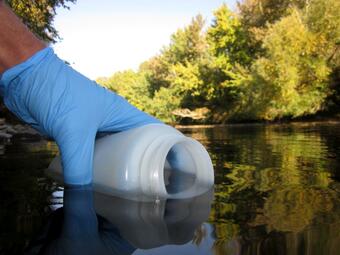
Field sampling protocol development and testing
Our team is experienced in developing methods for collecting samples for eDNA analysis in the field and optimizing protocols for qPCR to test those samples for DNA from species of interest. Our tools and protocols generate data that is repeatable, reliable, and useful to researchers and managers.
We suggest the use of ESRI Survey123 software for field data collection.
Study design and consultation
Study design must consider many important factors in order to generate useful data. The Pacific Northwest eDNA Laboratory has experience in designing studies for both aquatic and terrestrial species in diverse habitats.
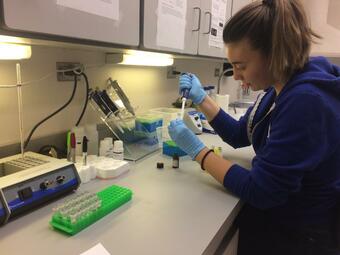
Quality Assurance, publication, and database management
Data generated by the Pacific Northwest eDNA Laboratory is subject to strict quality assurance guidelines and has been used in peer-review publications. We utilize an internal database for tracking eDNA samples from the point of collection through analysis and publication. Please browse the publications section of this website to learn more about our published studies.