



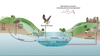
Per-and Polyfluoroalkyl Substances movement through the environment.



Detailed Description
Mechanisms of PFAS fate transport and exposure in the environment. Published in a USGS document Image created by Jacqueline Olsen at USGS for IPDS number is IP-120645
Sources/Usage
Public Domain.
Related

A National Predictive Model for PFAS Occurrence in Groundwater
In October of 2024, USGS Scientist’s published a study where they created a model to predict PFAS occurrence in groundwater at the depths of drinking water supplies. This model can help guide our partners to sample areas where PFAS in drinking water could be an issue for the public.
By
Ecosystems Mission Area, Water Resources Mission Area, Contaminant Biology, Environmental Health Program, Toxic Substances Hydrology, California Water Science Center, Eastern Ecological Science Center, Lower Mississippi-Gulf Water Science Center, New England Water Science Center, New Jersey Water Science Center, New Mexico Water Science Center, New York Water Science Center, Pennsylvania Water Science Center, South Atlantic Water Science Center (SAWSC), Western Ecological Research Center (WERC)

Per- and Polyfluoroalkyl (PFAS) Measurements in Tampa Bay Fish and Sediments Provide an Understanding of Potential Human Exposure
Scientists provide an understanding of per- and polyfluoroalkyl substances (PFAS) levels in sediments and the edible portions of fish within Florida’s Tampa Bay in a pilot study designed to understand the potential for human exposure and health risks through fish consumption.

PFAS Transport, Exposure, and Effects
The team is determining the movement and behavior of per- and poly-fluoroalkyl substances (PFAS) from their sources in the environment, as they move through exposure pathways in ecosystems including watersheds and aquifers, their incorporation into food webs, and molecular to population scale effects on fish and wildlife. These studies are accomplished at a variety of spatial scales from regional...
Related
A National Predictive Model for PFAS Occurrence in Groundwater
In October of 2024, USGS Scientist’s published a study where they created a model to predict PFAS occurrence in groundwater at the depths of drinking water supplies. This model can help guide our partners to sample areas where PFAS in drinking water could be an issue for the public.
By
Ecosystems Mission Area, Water Resources Mission Area, Contaminant Biology, Environmental Health Program, Toxic Substances Hydrology, California Water Science Center, Eastern Ecological Science Center, Lower Mississippi-Gulf Water Science Center, New England Water Science Center, New Jersey Water Science Center, New Mexico Water Science Center, New York Water Science Center, Pennsylvania Water Science Center, South Atlantic Water Science Center (SAWSC), Western Ecological Research Center (WERC)
Per- and Polyfluoroalkyl (PFAS) Measurements in Tampa Bay Fish and Sediments Provide an Understanding of Potential Human Exposure
Scientists provide an understanding of per- and polyfluoroalkyl substances (PFAS) levels in sediments and the edible portions of fish within Florida’s Tampa Bay in a pilot study designed to understand the potential for human exposure and health risks through fish consumption.
PFAS Transport, Exposure, and Effects
The team is determining the movement and behavior of per- and poly-fluoroalkyl substances (PFAS) from their sources in the environment, as they move through exposure pathways in ecosystems including watersheds and aquifers, their incorporation into food webs, and molecular to population scale effects on fish and wildlife. These studies are accomplished at a variety of spatial scales from regional...