



Helicopter overflight of Kīlauea Volcano's Lower East Rift Zone shows fountaining at Fissure 22.
Images
Images related to natural hazards.
Filter Total Items: 7275

Kīlauea Volcano — Lava Fountain (Fissure 22)
Helicopter overflight of Kīlauea Volcano's Lower East Rift Zone shows fountaining at Fissure 22.

By the end of the afternoon, only a single ocean entry was active. ...
By the end of the afternoon, only a single ocean entry was active. ...By the end of the afternoon, only a single ocean entry was active. The lava channel originates from fissure 22. This photo was taken during a late afternoon overflight of the lower East Rift Zone, Kīlauea Volcano.
By the end of the afternoon, only a single ocean entry was active. ...
By the end of the afternoon, only a single ocean entry was active. ...By the end of the afternoon, only a single ocean entry was active. The lava channel originates from fissure 22. This photo was taken during a late afternoon overflight of the lower East Rift Zone, Kīlauea Volcano.

Kīlauea Volcano — Laze
Lava continues to enter the sea at two locations this morning. During this morning's overflight, the wind was blowing the "laze" plumes along the shoreline toward the southwest.
Lava continues to enter the sea at two locations this morning. During this morning's overflight, the wind was blowing the "laze" plumes along the shoreline toward the southwest.

Kīlauea LERZ Fissures & Flows, May 21 at 8:00 a.m.
Kīlauea LERZ Fissures & Flows, May 21 at 8:00 a.m.Map as of 8:00 am HST, May 21. Shaded purple areas indicate lava flows erupted in 1840, 1955, 1960, and 2014-2015.
Kīlauea LERZ Fissures & Flows, May 21 at 8:00 a.m.
Kīlauea LERZ Fissures & Flows, May 21 at 8:00 a.m.Map as of 8:00 am HST, May 21. Shaded purple areas indicate lava flows erupted in 1840, 1955, 1960, and 2014-2015.
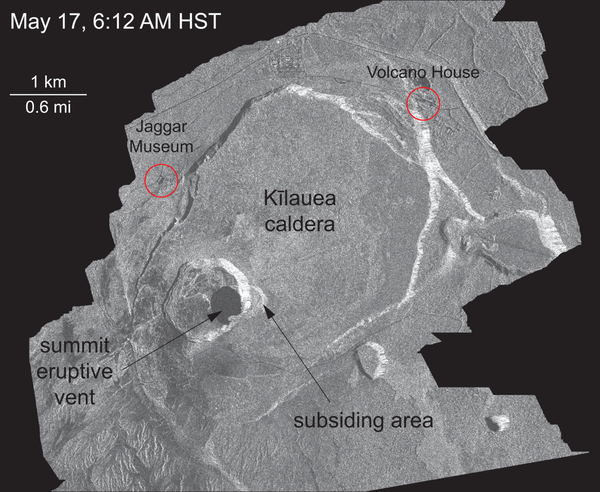
Radar images show enlargement of summit eruptive vent
Radar images show enlargement of summit eruptive ventThis animated GIF shows a sequence of radar amplitude images that were acquired by the Italian Space Agency's Cosmo-SkyMed satellite system. The series shows changes to the caldera area of Kīlauea Volcano that occurred over May 5 at 6:12 a.m. HST, May 17 at 6:12 a.m. HST, and May 21 at 6:12 a.m. HST.
Radar images show enlargement of summit eruptive vent
Radar images show enlargement of summit eruptive ventThis animated GIF shows a sequence of radar amplitude images that were acquired by the Italian Space Agency's Cosmo-SkyMed satellite system. The series shows changes to the caldera area of Kīlauea Volcano that occurred over May 5 at 6:12 a.m. HST, May 17 at 6:12 a.m. HST, and May 21 at 6:12 a.m. HST.

Thermal map of fissure system and lava flows
This thermal map shows the fissure system and lava flows as of 12:15 pm on Monday, May 21. The primary lava flows originate from the Fissure 20-22 area. The dominant ocean entry is marked. The black and white area is the extent of the thermal map.
This thermal map shows the fissure system and lava flows as of 12:15 pm on Monday, May 21. The primary lava flows originate from the Fissure 20-22 area. The dominant ocean entry is marked. The black and white area is the extent of the thermal map.

Lava Haze (Laze) from Fissure 20

Thermal map of fissure system and lava flows
This thermal map shows the fissure system and lava flows as of 12:15 pm on Saturday, May 19. The two primary lava flows originate from the Fissure 20-22 area, and crossed Pohoiki Road over the past day. The flow front position based on a 6:40 pm update is shown by the red circle. The black and white area is the extent of the thermal map.
This thermal map shows the fissure system and lava flows as of 12:15 pm on Saturday, May 19. The two primary lava flows originate from the Fissure 20-22 area, and crossed Pohoiki Road over the past day. The flow front position based on a 6:40 pm update is shown by the red circle. The black and white area is the extent of the thermal map.

Kīlauea Volcano — Lava Entering Ocean
Lava flows from the Fissure 20 complex move downslope and enter the ocean. Lava can be seen in the middle of the channel. A laze plume hides the point of ocean entry.
Lava flows from the Fissure 20 complex move downslope and enter the ocean. Lava can be seen in the middle of the channel. A laze plume hides the point of ocean entry.

Kīlauea Volcano — Lava from Fissure 20 Enters a Crack
Kīlauea Volcano — Lava from Fissure 20 Enters a CrackLava from the eastern channel of the Fissure 20 complex is flowing into a crack in the ground that opened on the morning of May 20, 2018. The crack is "robbing" the easternmost channel of lava and the eastern ocean entry is therefore less vigorous than the western entry point.
Kīlauea Volcano — Lava from Fissure 20 Enters a Crack
Kīlauea Volcano — Lava from Fissure 20 Enters a CrackLava from the eastern channel of the Fissure 20 complex is flowing into a crack in the ground that opened on the morning of May 20, 2018. The crack is "robbing" the easternmost channel of lava and the eastern ocean entry is therefore less vigorous than the western entry point.

Kīlauea LERZ Fissures and Flows, May 20 at 11:00 a.m
Kīlauea LERZ Fissures and Flows, May 20 at 11:00 a.mMap as of 11:00 am HST, May 20. Shaded purple areas indicate lava flows erupted in 1840, 1955, 1960, and 2014-2015. Site of active ocean entry is shown with dots.
Kīlauea LERZ Fissures and Flows, May 20 at 11:00 a.m
Kīlauea LERZ Fissures and Flows, May 20 at 11:00 a.mMap as of 11:00 am HST, May 20. Shaded purple areas indicate lava flows erupted in 1840, 1955, 1960, and 2014-2015. Site of active ocean entry is shown with dots.

Fissure 20 flow reaches the ocean
Late last night, the fissure 20 lava flow reached the ocean. Hot lava entering the ocean creates a dense white plume called "laze" (short for "lava haze"). Laze is formed as hot lava boils seawater to dryness.
Late last night, the fissure 20 lava flow reached the ocean. Hot lava entering the ocean creates a dense white plume called "laze" (short for "lava haze"). Laze is formed as hot lava boils seawater to dryness.

Slow moving lava flow front in Kīlauea's LERZ
Video of a slow moving lava flow in Kīlauea Volcano's lower East Rift Zone, taken May 20, 2018, at around 2:31 AM HST. The flow is ~3 m (9 ft) high. The HVO scientist mapping the flow is about ~15 m (50 ft) away from the flow front. The audio is the sound of burning vegetation and the call of coqui frogs.
Video of a slow moving lava flow in Kīlauea Volcano's lower East Rift Zone, taken May 20, 2018, at around 2:31 AM HST. The flow is ~3 m (9 ft) high. The HVO scientist mapping the flow is about ~15 m (50 ft) away from the flow front. The audio is the sound of burning vegetation and the call of coqui frogs.

Kīlauea Volcano — Lava from Fissure 20 Enters a Crack
Kīlauea Volcano — Lava from Fissure 20 Enters a CrackLava from the eastern channel of the Fissure 20 complex flows into a crack in the ground. The crack opened in the early morning hours of May 20, 2018. Prior to opening, lavawas flowing vigorously down a channel. After the crack formed, the lava began pouring into the ground.
Kīlauea Volcano — Lava from Fissure 20 Enters a Crack
Kīlauea Volcano — Lava from Fissure 20 Enters a CrackLava from the eastern channel of the Fissure 20 complex flows into a crack in the ground. The crack opened in the early morning hours of May 20, 2018. Prior to opening, lavawas flowing vigorously down a channel. After the crack formed, the lava began pouring into the ground.

Kīlauea Volcano — Laze Plume
Lava from the fissure complex erupting in Kīlauea's lower East Rift Zone entered the ocean in late evening on May 19, 2018. The active ocean entry is producing a white "laze" plume. Laze is formed when hot lava hits the ocean, forming a plume of hydrochloric acid and steam with fine glass particles.
Lava from the fissure complex erupting in Kīlauea's lower East Rift Zone entered the ocean in late evening on May 19, 2018. The active ocean entry is producing a white "laze" plume. Laze is formed when hot lava hits the ocean, forming a plume of hydrochloric acid and steam with fine glass particles.

Bald Eagle in Washington
I spy with my little (eagle-) eye . . .
After a successful beach survey and installation of remote-sensing cameras on a nearby island, scientists Shawn Harrison and Andrew Stevens spotted this bald eagle near the mouth of the Skagit River, Washington.
I spy with my little (eagle-) eye . . .
After a successful beach survey and installation of remote-sensing cameras on a nearby island, scientists Shawn Harrison and Andrew Stevens spotted this bald eagle near the mouth of the Skagit River, Washington.

Ocean entry point from helicopter overflight, May 20, 2018, at 6:45 AM
Ocean entry point from helicopter overflight, May 20, 2018, at 6:45 AMView of ocean entry point from helicopter overflight on May 20, 2018, at 6:45 AM HST.
Ocean entry point from helicopter overflight, May 20, 2018, at 6:45 AM
Ocean entry point from helicopter overflight, May 20, 2018, at 6:45 AMView of ocean entry point from helicopter overflight on May 20, 2018, at 6:45 AM HST.

The helicopter hovers above the ocean entry on May 20, 2018, around...
The helicopter hovers above the ocean entry on May 20, 2018, around...The helicopter hovers above the ocean entry on May 20, 2018, around 6:45 AM HST. Several braided lava channels (red) are visible on the right. The white plume is "laze," which forms when hot lava hits the ocean sending hydrochloric acid and steam with fine glass particles into the air.
The helicopter hovers above the ocean entry on May 20, 2018, around...
The helicopter hovers above the ocean entry on May 20, 2018, around...The helicopter hovers above the ocean entry on May 20, 2018, around 6:45 AM HST. Several braided lava channels (red) are visible on the right. The white plume is "laze," which forms when hot lava hits the ocean sending hydrochloric acid and steam with fine glass particles into the air.

Lava from the eastern channel of the Fissure 20 complex is flowing ...
Lava from the eastern channel of the Fissure 20 complex is flowing ...Lava from the eastern channel of the Fissure 20 complex is flowing into a crack in the ground that opened on the morning of May 20, 2018. The crack is "robbing" the easternmost channel of lava and the eastern ocean entry is therefore less vigorous than the western entry point (see photos above).
Lava from the eastern channel of the Fissure 20 complex is flowing ...
Lava from the eastern channel of the Fissure 20 complex is flowing ...Lava from the eastern channel of the Fissure 20 complex is flowing into a crack in the ground that opened on the morning of May 20, 2018. The crack is "robbing" the easternmost channel of lava and the eastern ocean entry is therefore less vigorous than the western entry point (see photos above).

Kīlauea Volcano — Overflight of Ocean Entry
The helicopter hovers above the ocean entry on May 20, 2018, around 6:45 AM HST. Several braided lava channels (red) are visible on the right. The white plume is "laze," which forms when hot lava hits the ocean sending hydrochloric acid and steam with fine glass particles into the air.
The helicopter hovers above the ocean entry on May 20, 2018, around 6:45 AM HST. Several braided lava channels (red) are visible on the right. The white plume is "laze," which forms when hot lava hits the ocean sending hydrochloric acid and steam with fine glass particles into the air.

Ocean entry photograph from Civil Air Patrol (CAP) overflight taken...
Ocean entry photograph from Civil Air Patrol (CAP) overflight taken...Ocean entry photograph from Civil Air Patrol (CAP) overflight taken at about 12:50PM. CAP operates to support the mission of both the USGS HVO and the Hawaii County Civil Defense. Hard to discern here, but there are two entries. The coastal area spanning the entry is about 1 km (0.6 mi) wide with an about 250 m (0.15 mi) Kīpuka separating the two.
Ocean entry photograph from Civil Air Patrol (CAP) overflight taken...
Ocean entry photograph from Civil Air Patrol (CAP) overflight taken...Ocean entry photograph from Civil Air Patrol (CAP) overflight taken at about 12:50PM. CAP operates to support the mission of both the USGS HVO and the Hawaii County Civil Defense. Hard to discern here, but there are two entries. The coastal area spanning the entry is about 1 km (0.6 mi) wide with an about 250 m (0.15 mi) Kīpuka separating the two.