



Volcano Awareness Month programs offered in January 2020 are depicted by these images. Clockwise from top left: ground cracks opened at HVO's former location atop Kīlauea in 2018; fissure erupting on Mauna Loa in March 1984; crater lake within Halema‘uma‘u at Kīlauea's summit; and visitors hiking a Kahuku trail in Hawai‘i Volcanoes National Park (NPS).
Images
Hawaiian Volcano Observatory images of eruptive activity, field work, and more.
Filter Total Items: 4171

Volcano Awareness Month 2020
Volcano Awareness Month programs offered in January 2020 are depicted by these images. Clockwise from top left: ground cracks opened at HVO's former location atop Kīlauea in 2018; fissure erupting on Mauna Loa in March 1984; crater lake within Halema‘uma‘u at Kīlauea's summit; and visitors hiking a Kahuku trail in Hawai‘i Volcanoes National Park (NPS).

USGS HVO geophysicist Jefferson Chang presenting
USGS Hawaiian Volcano Observatory geophysicist Jefferson Chang during his presentation at the 2019 National Diversity in STEM Conference in Honolulu. Chang and Kevan Kamibayashi (left) were two of four HVO scientists who spoke about their work monitoring Hawaiian volcanoes at the SACNAS conference.
USGS Hawaiian Volcano Observatory geophysicist Jefferson Chang during his presentation at the 2019 National Diversity in STEM Conference in Honolulu. Chang and Kevan Kamibayashi (left) were two of four HVO scientists who spoke about their work monitoring Hawaiian volcanoes at the SACNAS conference.

Jefferson Chang at meeting
Jefferson Chang (far left) was one of four USGS Hawaiian Volcano Observatory scientists who spoke about monitoring Hawaiian volcanoes and mentored students at the 2019 National Diversity in STEM Conference in Honolulu.
Jefferson Chang (far left) was one of four USGS Hawaiian Volcano Observatory scientists who spoke about monitoring Hawaiian volcanoes and mentored students at the 2019 National Diversity in STEM Conference in Honolulu.

Continued slow rise of water level at bottom of Halema‘uma‘u, November
Continued slow rise of water level at bottom of Halema‘uma‘u, NovemberPhotos taken two weeks apart show the rise of water in Halema‘uma‘u. A white arrow denotes a large rock along the edge of the lake for comparing water levels in the two images. The water continues to rise at a rate of approximately 15 cm (6 in) per day. USGS photos by M. Patrick.
Continued slow rise of water level at bottom of Halema‘uma‘u, November
Continued slow rise of water level at bottom of Halema‘uma‘u, NovemberPhotos taken two weeks apart show the rise of water in Halema‘uma‘u. A white arrow denotes a large rock along the edge of the lake for comparing water levels in the two images. The water continues to rise at a rate of approximately 15 cm (6 in) per day. USGS photos by M. Patrick.

PAINTING
The 1880-1881 eruption of Mauna Loa produced lava flows that came within 1.7 km (1.1 mi) of the Hilo Bay shoreline. This painting by Charles Furneaux, "Night View 1880–1881, Eruption from Hilo Bay," illustrates the first two flows as they would have been in November 1880. In reality, however, both flows would not have been visible from this vantage.
The 1880-1881 eruption of Mauna Loa produced lava flows that came within 1.7 km (1.1 mi) of the Hilo Bay shoreline. This painting by Charles Furneaux, "Night View 1880–1881, Eruption from Hilo Bay," illustrates the first two flows as they would have been in November 1880. In reality, however, both flows would not have been visible from this vantage.

Short-term Sulfur Dioxide Advisory Level Information table
Short-term Sulfur Dioxide Advisory Level Information tableThe "Short-term Sulfur Dioxide Advisory Level Information" table (http://www.hiso2index.info/assets/FinalSO2Exposurelevels.pdf) uses a six-tiered color-coded system to depict sulfur dioxide (SO2) concentrations and provide guidance for different groups of people exposed to SO2
Short-term Sulfur Dioxide Advisory Level Information table
Short-term Sulfur Dioxide Advisory Level Information tableThe "Short-term Sulfur Dioxide Advisory Level Information" table (http://www.hiso2index.info/assets/FinalSO2Exposurelevels.pdf) uses a six-tiered color-coded system to depict sulfur dioxide (SO2) concentrations and provide guidance for different groups of people exposed to SO2

Water collected from the lake at the bottom of Halema‘uma‘u
Water collected from the lake at the bottom of Halema‘uma‘uWater collected from the lake at the bottom of Halema‘uma‘u is prepared for laboratory analyses at the USGS California Volcano Observatory. Results thus far reveal chemistry indicative of complex reactions among the water, magmatic gases and Kīlauea's basaltic rocks.
Water collected from the lake at the bottom of Halema‘uma‘u
Water collected from the lake at the bottom of Halema‘uma‘uWater collected from the lake at the bottom of Halema‘uma‘u is prepared for laboratory analyses at the USGS California Volcano Observatory. Results thus far reveal chemistry indicative of complex reactions among the water, magmatic gases and Kīlauea's basaltic rocks.

Water collected from the lake at the bottom of Halema‘uma‘u
Water collected from the lake at the bottom of Halema‘uma‘uWater collected from the lake at the bottom of Halema‘uma‘u is prepared for laboratory analyses at the USGS California Volcano Observatory. Results thus far reveal chemistry indicative of complex reactions between the water, magmatic gases, and Kīlauea's basaltic rocks.
Water collected from the lake at the bottom of Halema‘uma‘u
Water collected from the lake at the bottom of Halema‘uma‘uWater collected from the lake at the bottom of Halema‘uma‘u is prepared for laboratory analyses at the USGS California Volcano Observatory. Results thus far reveal chemistry indicative of complex reactions between the water, magmatic gases, and Kīlauea's basaltic rocks.

Unoccupied Aircraft System is inspected by pilot just before take off
Unoccupied Aircraft System is inspected by pilot just before take offThe sampling mechanism (on blue tarp) is prepared and the Unoccupied Aircraft System (UAS) is inspected just before take off to collect water from the Halema‘uma‘u crater lake. Brightly colored flagging tape tied to a cable attached to the UAS indicated depth as the sampling tool was lowered into the water.
Unoccupied Aircraft System is inspected by pilot just before take off
Unoccupied Aircraft System is inspected by pilot just before take offThe sampling mechanism (on blue tarp) is prepared and the Unoccupied Aircraft System (UAS) is inspected just before take off to collect water from the Halema‘uma‘u crater lake. Brightly colored flagging tape tied to a cable attached to the UAS indicated depth as the sampling tool was lowered into the water.

Unoccupied Aircraft System returning with a water sample.
Unoccupied Aircraft System returning with a water sample.USGS-HVO scientists and DOI UAS team members collect samples of water from the Halema‘uma‘u crater lake.
Unoccupied Aircraft System returning with a water sample.
Unoccupied Aircraft System returning with a water sample.USGS-HVO scientists and DOI UAS team members collect samples of water from the Halema‘uma‘u crater lake.

HVO scientists prepare UAS for Kīlauea summit crater lake sampling
HVO scientists prepare UAS for Kīlauea summit crater lake samplingUSGS Hawaiian Volcano Observatory and DOI Office of Aviation staff prepare the sampling mechanism (on blue tarp) and inspect the Unmanned Aircraft System (UAS) just before it took off to collect water from the Halema‘uma‘u crater lake.
HVO scientists prepare UAS for Kīlauea summit crater lake sampling
HVO scientists prepare UAS for Kīlauea summit crater lake samplingUSGS Hawaiian Volcano Observatory and DOI Office of Aviation staff prepare the sampling mechanism (on blue tarp) and inspect the Unmanned Aircraft System (UAS) just before it took off to collect water from the Halema‘uma‘u crater lake.

Mauna Loa sulphur cone
Sulphur Cone (left), viewed toward southwest, from 3,480 m (11,420 ft) above sea level on Mauna Loa’s southwest rift zone. At right, an HVO geoscientist and technician rebuild volcanic gas monitoring equipment installed near an outgassing fissure.
Sulphur Cone (left), viewed toward southwest, from 3,480 m (11,420 ft) above sea level on Mauna Loa’s southwest rift zone. At right, an HVO geoscientist and technician rebuild volcanic gas monitoring equipment installed near an outgassing fissure.

Geophysicist Sarah Conway, USGS HVO geophysicist
Geophysicist Sarah Conway, a member of the USGS Hawaiian Volcano Observatory's deformation team, readies a temporary GPS station during a campaign survey of benchmarks on Kīlauea Volcano to monitor changes in the ground surface.
Geophysicist Sarah Conway, a member of the USGS Hawaiian Volcano Observatory's deformation team, readies a temporary GPS station during a campaign survey of benchmarks on Kīlauea Volcano to monitor changes in the ground surface.

Mountain Ararat
Glacier caps Greater Ararat, looking 30 km (19 miles) north through hotel window in Dogubeyazit, Turkey, September 16, 2019. Photo by Don Swanson.
Glacier caps Greater Ararat, looking 30 km (19 miles) north through hotel window in Dogubeyazit, Turkey, September 16, 2019. Photo by Don Swanson.
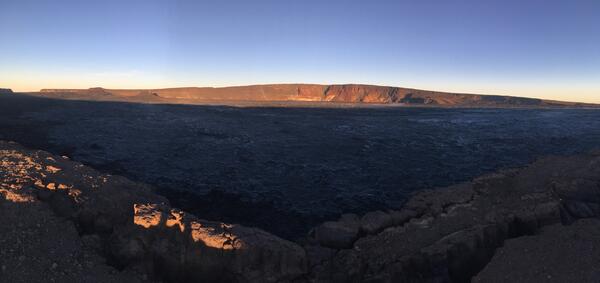
early morning view looking north across Moku‘āweoweo
early morning view looking north across Moku‘āweoweoAn early morning view looking north across Moku‘āweoweo, Mauna Loa's summit caldera, from a spot near the summit cabin on the volcano's south caldera rim. Frost covered much of the caldera floor that was still shadowed, and weak steaming issued from the usual areas. Overall, there were no significant changes observed at the summit.
early morning view looking north across Moku‘āweoweo
early morning view looking north across Moku‘āweoweoAn early morning view looking north across Moku‘āweoweo, Mauna Loa's summit caldera, from a spot near the summit cabin on the volcano's south caldera rim. Frost covered much of the caldera floor that was still shadowed, and weak steaming issued from the usual areas. Overall, there were no significant changes observed at the summit.

Water pond in Halema‘uma‘u 8-18-19
Water pond in Halema‘uma‘u August 18, 2019. The water level continues to slowly rise in Halema‘uma‘u, drowning many of the small rocks that were previously exposed in the center of the pond. Ripples across the water surface were evident today.
Water pond in Halema‘uma‘u August 18, 2019. The water level continues to slowly rise in Halema‘uma‘u, drowning many of the small rocks that were previously exposed in the center of the pond. Ripples across the water surface were evident today.

Aerial view of the Halema‘uma‘u water pond
The ponded water at the bottom of Halema‘uma‘u has continued to slowly rise. This wide view shows much of Halema‘uma‘u and the fumaroles on the upper walls of the pit.
The ponded water at the bottom of Halema‘uma‘u has continued to slowly rise. This wide view shows much of Halema‘uma‘u and the fumaroles on the upper walls of the pit.

What does water in Halema‘uma‘u mean
These images look east at the pond within Halema‘uma‘u on August 8 and 14, 2019. The pond widened mainly toward the south (right). The north-south width of the pond on August 14 was about 32 m (105 ft), about 10 m (35 ft) wider than on August 8. The pond has widened and deepened slowly and steadily rate since measurements began on August 3.
These images look east at the pond within Halema‘uma‘u on August 8 and 14, 2019. The pond widened mainly toward the south (right). The north-south width of the pond on August 14 was about 32 m (105 ft), about 10 m (35 ft) wider than on August 8. The pond has widened and deepened slowly and steadily rate since measurements began on August 3.

Two HVO geologists document road cutting activities on HWY 132
Two HVO geologists document road cutting activities on HWY 132Two HVO geologists document road cutting activities on HWY 132 on August 7, 2019. One geologist is taking visual photographs while another geologist is taking thermal photographs to make a tandem pair for comparison. The temperature of the solidified lava was measured to 425° C (800° F) at the digging site.
Two HVO geologists document road cutting activities on HWY 132
Two HVO geologists document road cutting activities on HWY 132Two HVO geologists document road cutting activities on HWY 132 on August 7, 2019. One geologist is taking visual photographs while another geologist is taking thermal photographs to make a tandem pair for comparison. The temperature of the solidified lava was measured to 425° C (800° F) at the digging site.

HVO now tracking ponds of water, not lava, at Kīlauea's summit
HVO now tracking ponds of water, not lava, at Kīlauea's summitA telephoto view of the ponded water at the bottom of Halema‘uma‘u on August 7, 2019. For scale, the largest pond is about 15 meters (50 feet) in diameter.
HVO now tracking ponds of water, not lava, at Kīlauea's summit
HVO now tracking ponds of water, not lava, at Kīlauea's summitA telephoto view of the ponded water at the bottom of Halema‘uma‘u on August 7, 2019. For scale, the largest pond is about 15 meters (50 feet) in diameter.

Aerial view of Halema‘uma‘u at the summit of Kīlauea
Aerial view of Halema‘uma‘u at the summit of KīlaueaAerial view of Halema‘uma‘u at the summit of Kīlauea taken during a USGS Hawaiian Volcano Observatory helicopter overflight on August 1, 2019. The small green patch visible at the bottom of Halema‘uma‘u is a new pond forming at the lowest point of the crater. The pond is at about 525 m (about 1722 ft) elevation.
Aerial view of Halema‘uma‘u at the summit of Kīlauea
Aerial view of Halema‘uma‘u at the summit of KīlaueaAerial view of Halema‘uma‘u at the summit of Kīlauea taken during a USGS Hawaiian Volcano Observatory helicopter overflight on August 1, 2019. The small green patch visible at the bottom of Halema‘uma‘u is a new pond forming at the lowest point of the crater. The pond is at about 525 m (about 1722 ft) elevation.