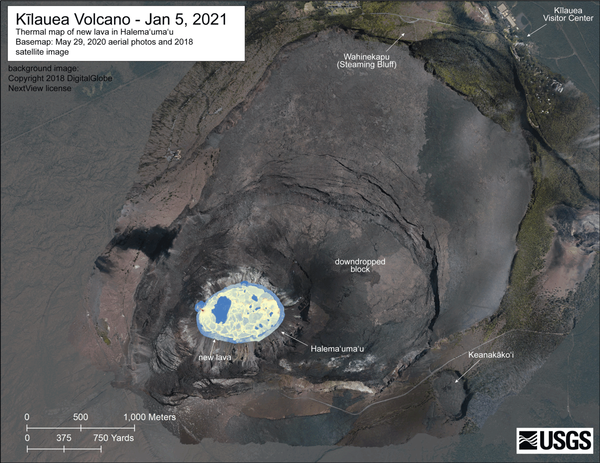
On February 11, 2021, no major changes were observed at the lava lake within Halema‘uma‘u crater, at the summit of Kīlauea. The inlet site where lava is entering the lake had a small upwelling zone raised slightly above the surrounding lake surface.
All Multimedia
Access all multimedia to include images, video, audio, webcams, before-after imagery, and more. Filter and explore with filtering options to refine search.
On February 11, 2021, no major changes were observed at the lava lake within Halema‘uma‘u crater, at the summit of Kīlauea. The inlet site where lava is entering the lake had a small upwelling zone raised slightly above the surrounding lake surface.
Photo Contest Winner | March 2021 | Honorable Mention
423441072170701 MA-ORW63 Winter Groundwater Site Inspection
Photo Contest Winner | March 2021 | Honorable Mention
423441072170701 MA-ORW63 Winter Groundwater Site Inspection
Crinoid fossil from northern Yellowstone National Park
Crinoid fossil from northern Yellowstone National ParkCrinoid fossil from a Paleozoic rock unit found in northern Yellowstone National Park.
Crinoid fossil from northern Yellowstone National Park
Crinoid fossil from northern Yellowstone National ParkCrinoid fossil from a Paleozoic rock unit found in northern Yellowstone National Park.
February 10, 2021 — Kīlauea View of lava lake in Halema‘uma‘u
February 10, 2021 — Kīlauea View of lava lake in Halema‘uma‘uTwilight view of the lava lake in Halema‘uma‘u at Kīlauea Volcano's summit. This photo, taken from the southern rim of Halema‘uma‘u crater and looking northward, shows the active western (left) portion of the lava lake, which has hot incandescent lava visible at boundaries between plates on the lava lake.
February 10, 2021 — Kīlauea View of lava lake in Halema‘uma‘u
February 10, 2021 — Kīlauea View of lava lake in Halema‘uma‘uTwilight view of the lava lake in Halema‘uma‘u at Kīlauea Volcano's summit. This photo, taken from the southern rim of Halema‘uma‘u crater and looking northward, shows the active western (left) portion of the lava lake, which has hot incandescent lava visible at boundaries between plates on the lava lake.
Ken Planty and Brian McDonald (USGS NYWSC Potsdam office) observing the ice pile up on the pier at USGS 04249071 LK ONTARIO (SELKIRK SHORES) NR DAYSVILLE CORNER NY. (Credit: Isabella Lucia, USGS NY WSC. Public domain.)
Halema‘uma‘u Crater Overflight—Kīlauea Volcano's Summit (Feb 9, 2021)
Halema‘uma‘u Crater Overflight—Kīlauea Volcano's Summit (Feb 9, 2021)An overflight today provided aerial views of Kīlauea's ongoing summit eruption. No major changes were observed at the lava lake in Halema‘uma‘u crater. Active surface lava is still largely limited to the western portion of the lake. Snow on Mauna Kea can be seen in the distance.
Halema‘uma‘u Crater Overflight—Kīlauea Volcano's Summit (Feb 9, 2021)
Halema‘uma‘u Crater Overflight—Kīlauea Volcano's Summit (Feb 9, 2021)An overflight today provided aerial views of Kīlauea's ongoing summit eruption. No major changes were observed at the lava lake in Halema‘uma‘u crater. Active surface lava is still largely limited to the western portion of the lake. Snow on Mauna Kea can be seen in the distance.
Halema‘uma‘u overflight—Kīlauea summit Feb. 9, 2021
Halema‘uma‘u overflight—Kīlauea summit Feb. 9, 2021A wide aerial photo of the active lava lake within Halema‘uma‘u crater taken during a Kīlauea summit overflight on February 9, 2021. This view, looking west, shows the active west vent degassing (center). Mauna Loa Volcano is visible in the background with a snow-covered summit. USGS photo taken by B. Carr.
Halema‘uma‘u overflight—Kīlauea summit Feb. 9, 2021
Halema‘uma‘u overflight—Kīlauea summit Feb. 9, 2021A wide aerial photo of the active lava lake within Halema‘uma‘u crater taken during a Kīlauea summit overflight on February 9, 2021. This view, looking west, shows the active west vent degassing (center). Mauna Loa Volcano is visible in the background with a snow-covered summit. USGS photo taken by B. Carr.
Overflight view of Halema‘uma‘u crater—Kīlauea summit eruption Feb. 9
Overflight view of Halema‘uma‘u crater—Kīlauea summit eruption Feb. 9An aerial view of the Halema‘uma‘u crater lava lake on Tuesday, February 9, 2021 as viewed from the south during a helicopter overflight of Kīlauea summit. Lava continues to erupt and enter into the lava lake from the inlet at the base of the west vent, which is visibly incandescent on the left in the photo.
Overflight view of Halema‘uma‘u crater—Kīlauea summit eruption Feb. 9
Overflight view of Halema‘uma‘u crater—Kīlauea summit eruption Feb. 9An aerial view of the Halema‘uma‘u crater lava lake on Tuesday, February 9, 2021 as viewed from the south during a helicopter overflight of Kīlauea summit. Lava continues to erupt and enter into the lava lake from the inlet at the base of the west vent, which is visibly incandescent on the left in the photo.
UAS photo of active western portion of Halema‘uma‘u lava lake, Feb. 9
UAS photo of active western portion of Halema‘uma‘u lava lake, Feb. 9This Unoccupied Aircraft Systems (UAS) photo from Tuesday, February 9 shows the active western portion of the Halema‘uma‘u lava lake. The western fissure continues to supply lava to the lava lake from an inlet at the base of the spatter cone (upper-left). For scale, the distance from the lava inlet to the edge of the main island is approximately 160 m (525 ft).
UAS photo of active western portion of Halema‘uma‘u lava lake, Feb. 9
UAS photo of active western portion of Halema‘uma‘u lava lake, Feb. 9This Unoccupied Aircraft Systems (UAS) photo from Tuesday, February 9 shows the active western portion of the Halema‘uma‘u lava lake. The western fissure continues to supply lava to the lava lake from an inlet at the base of the spatter cone (upper-left). For scale, the distance from the lava inlet to the edge of the main island is approximately 160 m (525 ft).
UAS photo of crusted-over eastern portion of Halema‘uma‘u lava lake
UAS photo of crusted-over eastern portion of Halema‘uma‘u lava lakeThis Unoccupied Aircraft Systems (UAS) photo from Tuesday, February 9, shows the stagnant, crusted-over eastern portion of the Halema‘uma‘u lava lake. This photo is looking to the east, towards the easternmost end of the lake, with the active western fissure behind and out-of-view.
UAS photo of crusted-over eastern portion of Halema‘uma‘u lava lake
UAS photo of crusted-over eastern portion of Halema‘uma‘u lava lakeThis Unoccupied Aircraft Systems (UAS) photo from Tuesday, February 9, shows the stagnant, crusted-over eastern portion of the Halema‘uma‘u lava lake. This photo is looking to the east, towards the easternmost end of the lake, with the active western fissure behind and out-of-view.
UAS photo of main island in Halema‘uma‘u lava lake, February 9, 2021
UAS photo of main island in Halema‘uma‘u lava lake, February 9, 2021This Unoccupied Aircraft Systems (UAS) photo from Tuesday, February 9, shows the main island in the Halema‘uma‘u lava lake. The lake surface on the eastern (lower-center) side of the island has been stagnant and crusted over recently. The western fissure that has been feeding the lava lake is visibly degassing in the background.
UAS photo of main island in Halema‘uma‘u lava lake, February 9, 2021
UAS photo of main island in Halema‘uma‘u lava lake, February 9, 2021This Unoccupied Aircraft Systems (UAS) photo from Tuesday, February 9, shows the main island in the Halema‘uma‘u lava lake. The lake surface on the eastern (lower-center) side of the island has been stagnant and crusted over recently. The western fissure that has been feeding the lava lake is visibly degassing in the background.
West vent in Halema‘uma‘u crater—Kīlauea summit eruption
West vent in Halema‘uma‘u crater—Kīlauea summit eruptionA zoomed-in aerial view of the active west vent in Halema‘uma‘u crater taken during the helicopter overflight on February 9. Lava erupted from the west vent continues to enter the active lava lake through an inlet at the base of the cone. SO2 emission rates remain elevated and were measured at 2,200 t/d on February 1. USGS photo taken by B. Carr.
West vent in Halema‘uma‘u crater—Kīlauea summit eruption
West vent in Halema‘uma‘u crater—Kīlauea summit eruptionA zoomed-in aerial view of the active west vent in Halema‘uma‘u crater taken during the helicopter overflight on February 9. Lava erupted from the west vent continues to enter the active lava lake through an inlet at the base of the cone. SO2 emission rates remain elevated and were measured at 2,200 t/d on February 1. USGS photo taken by B. Carr.
The St. Mary and Milk Rivers cross the U.S. and Canadian border and supply water to both countries. Managing that resource in the interest of both nations is a matter of international collaboration and cooperation, and Landsat data is helping offer objective information on water use.
Photo of the west vent in Halema‘uma‘u lava lake at Kīlauea summit. Photo taken from the west side of Kīlauea caldera rim taken at 3:04 p.m. HST. This photo shows the west vent feeding the active western part of the lava lake, as well as the inactive eastern part of the lava lake.
This photo shows an area near the center of Kīlauea's summit lava lake in Halema‘uma‘u, where lobes of lava from the western fissure (beyond the left edge of this photo) would episodically advance and stall.
This photo shows a close-up of the lava stream in the inlet at the western fissure, at Kīlauea's summit lava lake in Halema‘uma‘u. The flow velocity today was relatively sluggish, consistent with the overall reduction in lake activity over the preceding few days. USGS photo by M. Patrick.
No major changes were observed over the weekend at the lava lake within Halema‘uma‘u crater, at the summit of Kīlauea. On Saturday, February 6, the lake activity seemed slightly diminished, likely due to summit deflation. This photo shows the western fissure.
A close-up view of one of the smaller islands in the stagnant eastern portion of the Halema‘uma‘u lava lake at Kīlauea Volcano's summit. Debris from a partial collapse of this island is visible on the stagnant lake surface (lower right) which exposed the red oxidized interior.
A close view of the active western portion of the Halema‘uma‘u lava lake at Kīlauea summit on Friday, February 5, 2021. The active west side of the lake had numerous surface breakouts and foundering crust. Lava effusion continues into the lava lake from the base of the west vent (left). USGS photo taken by K. Lynn.
A zoomed-in view of a section of the western active lava lake within Halema‘uma‘u at Kīlauea summit. Several areas of crustal foundering on the lava lake surface were visible during the afternoon of Friday, February 5, 2021. USGS photo taken by K. Lynn.