Boulder Glacier in 1910 (Elrod photo, GNP Archives) and in 2007 (Fagre/Pederson photo, USGS). Matching the intersection of the peaks in the background helps the repeat photographer locate the photo point. USGS Public domain


Official websites use .gov
A .gov website belongs to an official government organization in the United States.

Secure .gov websites use HTTPS
A lock () or https:// means you’ve safely connected to the .gov website. Share sensitive information only on official, secure websites.

Access all multimedia to include images, video, audio, webcams, before-after imagery, and more. Filter and explore with filtering options to refine search.

Boulder Glacier in 1910 (Elrod photo, GNP Archives) and in 2007 (Fagre/Pederson photo, USGS). Matching the intersection of the peaks in the background helps the repeat photographer locate the photo point. USGS Public domain
Boulder Glacier in 1910 (Elrod photo, GNP Archives) and in 2007 (Fagre/Pederson photo, USGS). Matching the intersection of the peaks in the background helps the repeat photographer locate the photo point. USGS Public domain

Translate a Digital Map With GeMS, Part C1 - How to load map unit polygons, lines, and cross section data from another schema to GeMS.
Translate a Digital Map With GeMS, Part C1 - How to load map unit polygons, lines, and cross section data from another schema to GeMS.

Translate a Digital Map With GeMS, Part C2 - How to translate point features and non-spatial information from another schema to GeMS
Translate a Digital Map With GeMS, Part C2 - How to translate point features and non-spatial information from another schema to GeMS

Photographs and photomicrographs from an exotic duck. (A) Grossly, the spleen is enlarged, firm, and yellow (arrow). Throughout the liver are multifocal to coalescing firm tan nodules (arrowheads). (B) The liver contains multifocal granulomas (asterisk). H&E stain.
Photographs and photomicrographs from an exotic duck. (A) Grossly, the spleen is enlarged, firm, and yellow (arrow). Throughout the liver are multifocal to coalescing firm tan nodules (arrowheads). (B) The liver contains multifocal granulomas (asterisk). H&E stain.

The Earth As Art project began in the early 2000s, and its original intent remains the same: to produce images that do not look like satellite images at first glance.
The Earth As Art project began in the early 2000s, and its original intent remains the same: to produce images that do not look like satellite images at first glance.

The Earth As Art project began in the early 2000s, and its original intent remains the same: to produce images that do not look like satellite images at first glance.
The Earth As Art project began in the early 2000s, and its original intent remains the same: to produce images that do not look like satellite images at first glance.

Emily Wimmer (GLSC, Ann Arbor, Michigan) collects Cladophora growing at 6m depth in Lake Michigan.
Emily Wimmer (GLSC, Ann Arbor, Michigan) collects Cladophora growing at 6m depth in Lake Michigan.

Grinnell, Gem & Salamander Glaciers: 8/9/1910 M Elrod, U of M Library – 9/27/2016 L McKeon, USGS
View the full collection at USGS Photographic Library
Grinnell, Gem & Salamander Glaciers: 8/9/1910 M Elrod, U of M Library – 9/27/2016 L McKeon, USGS
View the full collection at USGS Photographic Library

On Thursday, March 18, lava continued to erupt from the west vent in Halema‘uma‘u crater at Kīlauea Volcano's summit. Two lava inlets near the base of the west vent (center) supply lava into the lava lake. This photo was taken around 7:15 a.m.
On Thursday, March 18, lava continued to erupt from the west vent in Halema‘uma‘u crater at Kīlauea Volcano's summit. Two lava inlets near the base of the west vent (center) supply lava into the lava lake. This photo was taken around 7:15 a.m.

On March 18, 2021, morning light illuminated the west vent in Halema‘uma‘u crater at Kīlauea Volcano's summit. Small collapses of the cone have accumulated into a loose pile of rubble (left) on the stagnant crust at its base—adjacent to the active lava lake (lower-right). USGS photo by K. Lynn.
On March 18, 2021, morning light illuminated the west vent in Halema‘uma‘u crater at Kīlauea Volcano's summit. Small collapses of the cone have accumulated into a loose pile of rubble (left) on the stagnant crust at its base—adjacent to the active lava lake (lower-right). USGS photo by K. Lynn.

The Volcano Disaster Assistance Program (VDAP) is a team of USGS scientists funded by USAID and the USGS Volcano Hazards Program to help volcano observatories around the world.
The Volcano Disaster Assistance Program (VDAP) is a team of USGS scientists funded by USAID and the USGS Volcano Hazards Program to help volcano observatories around the world.

On St. Patrick's Day, March 17, 2021, a rainbow was observed adjacent to the active lava lake at the summit of Kīlauea Volcano. This photo was taken around 11:00 a.m. HST from the south rim of Halema‘uma‘u crater.
On St. Patrick's Day, March 17, 2021, a rainbow was observed adjacent to the active lava lake at the summit of Kīlauea Volcano. This photo was taken around 11:00 a.m. HST from the south rim of Halema‘uma‘u crater.

This is a chart recorder similar to the one installed inside the USGS streamgage on the South Fork of the Ogden River in 1921.
This is a chart recorder similar to the one installed inside the USGS streamgage on the South Fork of the Ogden River in 1921.

USGS hydrologist Adam Birken cleans and inspects the water height reference staff at the USGS streamgage site on the South Fork of the Ogden River near Hunstville, Utah. This streamgage has been monitoring water levels and flow since March 21, 1921, making it one of 25 centennial gauges in Utah.
USGS hydrologist Adam Birken cleans and inspects the water height reference staff at the USGS streamgage site on the South Fork of the Ogden River near Hunstville, Utah. This streamgage has been monitoring water levels and flow since March 21, 1921, making it one of 25 centennial gauges in Utah.

USGS hydrologist Adam Birken prepares to measure streamflow on the South Fork of the Ogden River near Hunstville, Utah. This streamgage has been monitoring water levels and flow since March 21, 1921, making it one of 25 centennial gauges in Utah.
USGS hydrologist Adam Birken prepares to measure streamflow on the South Fork of the Ogden River near Hunstville, Utah. This streamgage has been monitoring water levels and flow since March 21, 1921, making it one of 25 centennial gauges in Utah.

Outline of the Steamboat and Cistern plumbing systems, with two viewing angles. The structure, color-coded by depth, delineates the observed seismically active area during eruption cycles of Steamboat Geyser. The solid star, solid square, and open triangles denote Steamboat Geyser, Cistern Spring, and seismic station locations on the surface, respectively.
Outline of the Steamboat and Cistern plumbing systems, with two viewing angles. The structure, color-coded by depth, delineates the observed seismically active area during eruption cycles of Steamboat Geyser. The solid star, solid square, and open triangles denote Steamboat Geyser, Cistern Spring, and seismic station locations on the surface, respectively.

Outline of the Steamboat and Cistern plumbing systems. The structure, color-coded by depth, delineates the observed seismically active area during eruption cycles of Steamboat Geyser. The solid star, solid square, and open triangles denote Steamboat Geyser, Cistern Spring, and seismic station locations on the surface, respectively.
Outline of the Steamboat and Cistern plumbing systems. The structure, color-coded by depth, delineates the observed seismically active area during eruption cycles of Steamboat Geyser. The solid star, solid square, and open triangles denote Steamboat Geyser, Cistern Spring, and seismic station locations on the surface, respectively.
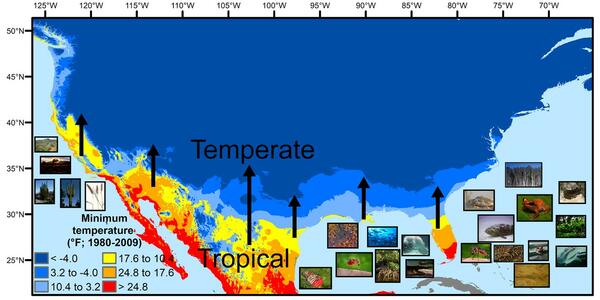
A map showing North America's tropical-to-temperate transition zone. Red, orange, and yellow depict the more tropical zones, and blues depict the more temperate zones, based on to the coldest recorded temperature for each area between 1980 and 2009.
A map showing North America's tropical-to-temperate transition zone. Red, orange, and yellow depict the more tropical zones, and blues depict the more temperate zones, based on to the coldest recorded temperature for each area between 1980 and 2009.

USGS hydrologist Adam Birken conducts equipment maintenance at the USGS streamgage on the South Fork of the Ogden River near Hunstville, Utah. This streamgage has been monitoring water levels and flow since March 21, 1921, making it one of 25 centennial gauges in Utah.
USGS hydrologist Adam Birken conducts equipment maintenance at the USGS streamgage on the South Fork of the Ogden River near Hunstville, Utah. This streamgage has been monitoring water levels and flow since March 21, 1921, making it one of 25 centennial gauges in Utah.

A U.S. Geological Survey streamgage near Hunstville, Utah is celebrating 100 years of monitoring streamflow on the south fork of the Ogden River. The streamgage has been monitoring water levels and flow since March 21, 1921, making it one of 25 centennial gauges in Utah.
A U.S. Geological Survey streamgage near Hunstville, Utah is celebrating 100 years of monitoring streamflow on the south fork of the Ogden River. The streamgage has been monitoring water levels and flow since March 21, 1921, making it one of 25 centennial gauges in Utah.

A U.S. Geological Survey streamgage near Hunstville, Utah is celebrating 100 years of monitoring streamflow on the south fork of the Ogden River. The streamgage has been monitoring water levels and flow since March 21, 1921, making it one of 25 centennial gauges in Utah.
A U.S. Geological Survey streamgage near Hunstville, Utah is celebrating 100 years of monitoring streamflow on the south fork of the Ogden River. The streamgage has been monitoring water levels and flow since March 21, 1921, making it one of 25 centennial gauges in Utah.