



The Unmanned Aircraft Systems (UAS) team assessed conditions at the fissure 8 cone and upper lava channel on August 17, 2018. At the time of the flight, the lava pond within the cone had crusted over with no observed incandescence.
Videos
Explore a diverse collection of engaging videos showcasing the latest research, discoveries, and educational content from the U.S. Geological Survey. Dive into the fascinating world of geology, hydrology, ecology, and natural hazards as we bring science to life. Stay informed and inspired by our visual storytelling that highlights the vital work of USGS scientists and their impact on the planet.
Filter Total Items: 2905

View Into Fissure 8 Cinder Cone
The Unmanned Aircraft Systems (UAS) team assessed conditions at the fissure 8 cone and upper lava channel on August 17, 2018. At the time of the flight, the lava pond within the cone had crusted over with no observed incandescence.

3D Model of Fissure 8 Cone
This 3-dimensional computer model shows the structure of the fissure 8 cone on Kīlauea Volcano's lower East Rift Zone. The model was created from thermal images acquired during a helicopter overflight on August 15, 2018. The cone is currently about 30 m (100 ft) tall with a broad base.
This 3-dimensional computer model shows the structure of the fissure 8 cone on Kīlauea Volcano's lower East Rift Zone. The model was created from thermal images acquired during a helicopter overflight on August 15, 2018. The cone is currently about 30 m (100 ft) tall with a broad base.

Image of the Week - Mendocino Fire
Landsat 8 captured satellite views of California’s largest wildfire on record in the summer of 2018. The Mendocino Complex Fire in northern California is a combination of two fires: the Ranch Fire and the River Fire.
Landsat 8 captured satellite views of California’s largest wildfire on record in the summer of 2018. The Mendocino Complex Fire in northern California is a combination of two fires: the Ranch Fire and the River Fire.

Lava Entering Ocean Near Isaac Hale Beach Park
Lava continues to enter the ocean near the Isaac Hale Beach Park on Kīlauea Volcano's lower East Rift Zone. Although lava output from fissure 8 remains low, the ocean entry was still active during HVO's helicopter overflight on August 9, 2018.
Lava continues to enter the ocean near the Isaac Hale Beach Park on Kīlauea Volcano's lower East Rift Zone. Although lava output from fissure 8 remains low, the ocean entry was still active during HVO's helicopter overflight on August 9, 2018.

Image of the Week - 8 Million Landsat Scenes!
The Landsat archive has added its 8 millionth scene.
This stunning image was captured by Landsat 8 on July 28, 2018. It shows the coastline of Nordaustlandet, the second-largest island in Norway’s Svalbard archipelago.
The Landsat archive has added its 8 millionth scene.
This stunning image was captured by Landsat 8 on July 28, 2018. It shows the coastline of Nordaustlandet, the second-largest island in Norway’s Svalbard archipelago.

Lava Fountaining at Fissure 8
During this morning's overflight, HVO geologists observed low levels of lava fountaining within the fissure 8 spatter cone and crusted lava in the spillway and channel downstream. The significance of this change is not yet clear. Eruptions can wax and wane or pause for days to weeks before returning to high levels of lava discharge.
During this morning's overflight, HVO geologists observed low levels of lava fountaining within the fissure 8 spatter cone and crusted lava in the spillway and channel downstream. The significance of this change is not yet clear. Eruptions can wax and wane or pause for days to weeks before returning to high levels of lava discharge.

Overflight of Kīlauea Summit
Between mid-May and early August, 2018, the depth of Halema‘uma‘u more than tripled and its diameter more than doubled as magma from Kīlauea's shallow summit reservoir moved into the lower East Rift Zone. Evidence of subsidence is visible in this video, taken during an early morning helicopter overflight on August 6, 2018.
Between mid-May and early August, 2018, the depth of Halema‘uma‘u more than tripled and its diameter more than doubled as magma from Kīlauea's shallow summit reservoir moved into the lower East Rift Zone. Evidence of subsidence is visible in this video, taken during an early morning helicopter overflight on August 6, 2018.

Pāhoehoe Breakout
This lava, erupted from fissure 8 on Kīlauea Volcano's lower East Rift Zone, shows classic pāhoehoe behavior. Exposed to the air, the surface of the flow chills to form a thin crust that can be stretched or broken apart, forming pieces of crust that are "subducted" back into the molten interior.
This lava, erupted from fissure 8 on Kīlauea Volcano's lower East Rift Zone, shows classic pāhoehoe behavior. Exposed to the air, the surface of the flow chills to form a thin crust that can be stretched or broken apart, forming pieces of crust that are "subducted" back into the molten interior.

Handheld Underwater Suction Sampler
The patented “Handheld Underwater Suction Sampler” is shown here with a sample collection net attached. The sampler was initially called the "Vasco Explorer." USGS biologists from Flagstaff, Arizona, are researching food sources for fish such as the rainbow trout, which are stocked in the Glen Canyon stretch of the Colorado River.
The patented “Handheld Underwater Suction Sampler” is shown here with a sample collection net attached. The sampler was initially called the "Vasco Explorer." USGS biologists from Flagstaff, Arizona, are researching food sources for fish such as the rainbow trout, which are stocked in the Glen Canyon stretch of the Colorado River.

Image of the Week - RBV and Alaska Glaciers
Landsat sensor technology has come a long way since the days of the Return Beam Vidicon cameras on the first three Landsat satellites. Known as the RBV, it wasoriginally intended to be the satellites’ primary sensor. But the Multispectral
Scanner, or MSS, became the more stable and superior instrument.
Landsat sensor technology has come a long way since the days of the Return Beam Vidicon cameras on the first three Landsat satellites. Known as the RBV, it wasoriginally intended to be the satellites’ primary sensor. But the Multispectral
Scanner, or MSS, became the more stable and superior instrument.

PubTalk 7/2018— Extreme acid mine drainage at Iron Mountain California
PubTalk 7/2018— Extreme acid mine drainage at Iron Mountain CaliforniaTitle: Iron Mountain, California: An Extreme Acid Mine Drainage Environment
PubTalk 7/2018— Extreme acid mine drainage at Iron Mountain California
PubTalk 7/2018— Extreme acid mine drainage at Iron Mountain CaliforniaTitle: Iron Mountain, California: An Extreme Acid Mine Drainage Environment

Collapse at Kīlauea (July 24, 2018)
A collapse event occurred at the summit of Kīlauea this morning (July 24, 2018) at 6:41 a.m. HST, releasing energy equivalent to a magnitude-5.3 earthquake, which is similar to that released by previous collapse events. In this video, watch as today's event unfolds from the perspective of HVO's live-stream camera.
A collapse event occurred at the summit of Kīlauea this morning (July 24, 2018) at 6:41 a.m. HST, releasing energy equivalent to a magnitude-5.3 earthquake, which is similar to that released by previous collapse events. In this video, watch as today's event unfolds from the perspective of HVO's live-stream camera.

Image of the Week - Deadly Mudslides in Japan
Torrential rainfall swamped western Japan in July of 2018. The rain caused mudslides that flooded cities, damaged buildings and rattled the
nation’s infrastructure. More than 170 people died.
Torrential rainfall swamped western Japan in July of 2018. The rain caused mudslides that flooded cities, damaged buildings and rattled the
nation’s infrastructure. More than 170 people died.

Ocean Entry of Lava Near Ahalanui
During HVO's early morning helicopter overflight along the coastline, orange streams of lava were entering the ocean in the vicinity of Ahalanui. Strong trade winds were pushing the white laze plumes inland.
During HVO's early morning helicopter overflight along the coastline, orange streams of lava were entering the ocean in the vicinity of Ahalanui. Strong trade winds were pushing the white laze plumes inland.

Drilling an Ice Core
Researchers start drilling an ice core in the Greater Yellowstone Ecosystem.
Researchers start drilling an ice core in the Greater Yellowstone Ecosystem.

July 14, 2018, Kīlauea fissure 8 video captured by UAS
July 14, 2018, Kīlauea fissure 8 video captured by UASIn this July 14, 2018, video captured by the UAS (Unmanned Aircraft Systems) team, lava was erupting from within the 120-foot-high fissure 8 cinder cone built of chilled lava fragments. Lava emerging from the cone was traveling about 13-16 miles per hour, flowing freely over a small set of cascades (rapids) and into a perched
July 14, 2018, Kīlauea fissure 8 video captured by UAS
July 14, 2018, Kīlauea fissure 8 video captured by UASIn this July 14, 2018, video captured by the UAS (Unmanned Aircraft Systems) team, lava was erupting from within the 120-foot-high fissure 8 cinder cone built of chilled lava fragments. Lava emerging from the cone was traveling about 13-16 miles per hour, flowing freely over a small set of cascades (rapids) and into a perched

Kīlauea Volcano's summit (DEM)
Since early May 2018, the floor of Halema‘uma‘u Crater has dropped 450 m (about 1480 ft). Extensive cracking and faulting around the crater, along with inward slumping of the crater rim, has more than doubled its diameter.
Since early May 2018, the floor of Halema‘uma‘u Crater has dropped 450 m (about 1480 ft). Extensive cracking and faulting around the crater, along with inward slumping of the crater rim, has more than doubled its diameter.

Kīlauea Volcano's lower East Rift Zone compilation video
Kīlauea Volcano's lower East Rift Zone compilation videoThis compilation of video from HVO's early morning overflight of Kīlauea Volcano's lower East Rift Zone shows (1) lava from fissure 8 moving through a perched channel toward the northeast, (2) the diverted channelized ‘a‘ā flow west of Kapoho Crater, and (3) a vigorous ocean entry along the southern coastline in the vicinity of Ahalanui Beach Park (Warm Ponds).
Kīlauea Volcano's lower East Rift Zone compilation video
Kīlauea Volcano's lower East Rift Zone compilation videoThis compilation of video from HVO's early morning overflight of Kīlauea Volcano's lower East Rift Zone shows (1) lava from fissure 8 moving through a perched channel toward the northeast, (2) the diverted channelized ‘a‘ā flow west of Kapoho Crater, and (3) a vigorous ocean entry along the southern coastline in the vicinity of Ahalanui Beach Park (Warm Ponds).

Rockfalls and Sounds
Listen to the sounds of rockfalls at Kīlauea Volcano's summit in this short video taken from the northeast rim of the caldera. At 2:42 p.m. HST on July 12, 2018, a collapse/explosion event at Kīlauea's summit released energy equivalent to a magnitude-5.3 earthquake.
Listen to the sounds of rockfalls at Kīlauea Volcano's summit in this short video taken from the northeast rim of the caldera. At 2:42 p.m. HST on July 12, 2018, a collapse/explosion event at Kīlauea's summit released energy equivalent to a magnitude-5.3 earthquake.
Timelapse video of Halema'uma'u and Kīlauea Caldera
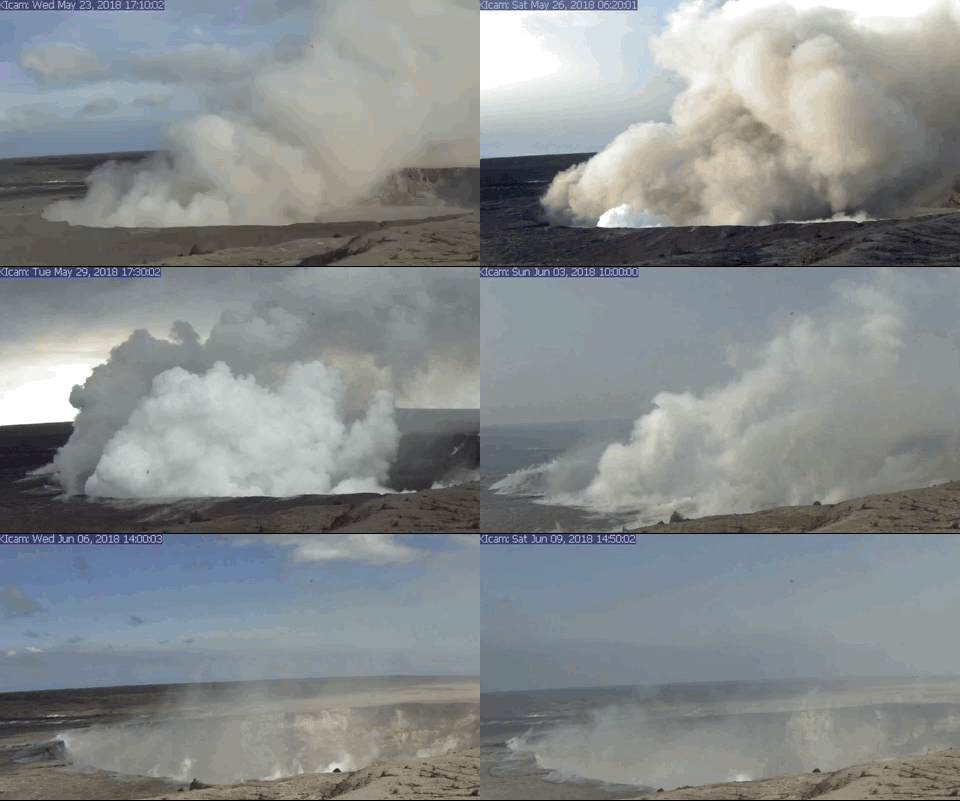
Timelapse video of Halema'uma'u and Kīlauea CalderaThis time-lapse video shows Halema‘uma‘u and Kīlauea Caldera as seen from the USGS Hawaiian Volcano Observatory. It includes roughly one image for every day between April 14, 2018, and July 11, 2018.
Timelapse video of Halema'uma'u and Kīlauea Caldera
Timelapse video of Halema'uma'u and Kīlauea CalderaThis time-lapse video shows Halema‘uma‘u and Kīlauea Caldera as seen from the USGS Hawaiian Volcano Observatory. It includes roughly one image for every day between April 14, 2018, and July 11, 2018.

Four Examples of Nest Predation by Rats - Hawaii Volcanoes National
Four Examples of Nest Predation by Rats - Hawaii Volcanoes NationalBlack rats were unintentionally introduced to Hawai’i in the late 1800s, most likely as hitchhikers on trading vessels. Since their introduction, they have disrupted native ecosystems by destroying native plants, eating native arthropods, and depredating bird nests.
Four Examples of Nest Predation by Rats - Hawaii Volcanoes National
Four Examples of Nest Predation by Rats - Hawaii Volcanoes NationalBlack rats were unintentionally introduced to Hawai’i in the late 1800s, most likely as hitchhikers on trading vessels. Since their introduction, they have disrupted native ecosystems by destroying native plants, eating native arthropods, and depredating bird nests.