
U.S. flag

An official website of the United States government

Videos

Explore a diverse collection of engaging videos showcasing the latest research, discoveries, and educational content from the U.S. Geological Survey. Dive into the fascinating world of geology, hydrology, ecology, and natural hazards as we bring science to life. Stay informed and inspired by our visual storytelling that highlights the vital work of USGS scientists and their impact on the planet.

Filter Total Items: 2905
Color image of eruption in caldera Color image of eruption in caldera
Kīlauea summit eruption overflight video - September 11, 2023

The new eruption at the summit of Kīlauea volcano continues. Numerous fountains remain active on the downdropped block east of Halema‘uma‘u crater, with lava pouring west onto the crater floor.

The new eruption at the summit of Kīlauea volcano continues. Numerous fountains remain active on the downdropped block east of Halema‘uma‘u crater, with lava pouring west onto the crater floor.

Color photograph of scientist and lava Color photograph of scientist and lava
Kīlauea summit eruption sampling - September 11, 2023

During the morning of September 11, Hawaiian Volcano Observatory geologists conducted an overflight of the new eruption within the Kīlauea summit caldera. The eruption is occurring in the east portion of Halemaʻumaʻu crater and on the downdropped block to the east, which formed during the 2018 summit collapse.

During the morning of September 11, Hawaiian Volcano Observatory geologists conducted an overflight of the new eruption within the Kīlauea summit caldera. The eruption is occurring in the east portion of Halemaʻumaʻu crater and on the downdropped block to the east, which formed during the 2018 summit collapse.

Lava erupting from the caldera Lava erupting from the caldera
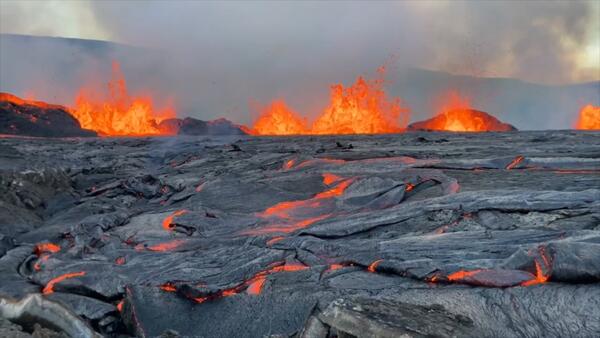
New vents erupting at Kīlauea volcano summit - September 11, 2023

During an HVO eruption monitoring overflight on September 11, 2023, HVO geologist were able to land on the downdropped block within Kīlauea's summit caldera. They observed the line of erupting vents, several of which are visible in this video, as they searched for a safe location to collect a lava sample.

During an HVO eruption monitoring overflight on September 11, 2023, HVO geologist were able to land on the downdropped block within Kīlauea's summit caldera. They observed the line of erupting vents, several of which are visible in this video, as they searched for a safe location to collect a lava sample.

Lava erupting from the caldera Lava erupting from the caldera
B1cam captures the onset of Kīlauea summit eruption - September 10, 2023

The B1cam, located on the east margin of the down-dropped block within Kīlauea caldera, captured the start of another eruption at the summit of Kīlauea volcano that began at 3:13 p.m. on September 10, 2023. This video shows a lava fountain bursting from a degassing area in the eastern portion of Halemaʻumaʻu crater, with the downdropped block in the foreground.

The B1cam, located on the east margin of the down-dropped block within Kīlauea caldera, captured the start of another eruption at the summit of Kīlauea volcano that began at 3:13 p.m. on September 10, 2023. This video shows a lava fountain bursting from a degassing area in the eastern portion of Halemaʻumaʻu crater, with the downdropped block in the foreground.

Lava erupting from the side of the screen just off-camera. Lava erupting from the side of the screen just off-camera.
B2cam captures the onset of Kīlauea summit eruption - September 10, 2023

Another eruption at the summit of Kīlauea volcano began at 3:13 p.m. on September 10, 2023. This video, captured by the Hawaiian Volcano Observatory's B2cam on the east rim of Halemaʻumaʻu crater, shows the opening phase of the eruption. A lava fountain bursts from a degassing area in the eastern portion of Halemaʻumaʻu crater.

Another eruption at the summit of Kīlauea volcano began at 3:13 p.m. on September 10, 2023. This video, captured by the Hawaiian Volcano Observatory's B2cam on the east rim of Halemaʻumaʻu crater, shows the opening phase of the eruption. A lava fountain bursts from a degassing area in the eastern portion of Halemaʻumaʻu crater.

Lava erupting in the dark Lava erupting in the dark
Lava fountaining at Kīlauea summit - September 10, 2023

This video, captured the evening of September 10, 2023, from near the Uēkahuna overlook within Hawai'i Volcanoes National Park, shows the new eruption within Kīlauea caldera. After approximately an hour of elevated earthquake and ground deformation, the eruption began at 3:13 p.m. on September 10, 2023.

This video, captured the evening of September 10, 2023, from near the Uēkahuna overlook within Hawai'i Volcanoes National Park, shows the new eruption within Kīlauea caldera. After approximately an hour of elevated earthquake and ground deformation, the eruption began at 3:13 p.m. on September 10, 2023.

Color photograph of erupting lava Color photograph of erupting lava
Timelapse video of initial day of September 2023 Kīlauea eruption

This timelapse video shows the first two days of the recent eruption at Kīlauea summit, which was active September 10 to 16, 2023. Over this initial period, the fountaining at either end of the fissure system gradually shuts down as activity focuses on the central portion. 

This timelapse video shows the first two days of the recent eruption at Kīlauea summit, which was active September 10 to 16, 2023. Over this initial period, the fountaining at either end of the fissure system gradually shuts down as activity focuses on the central portion. 

River and Thermals — Yellowstone National Park

The Gibbon River, named for Colonel (later General) John Gibbon, who was a member of an early exploring survey of the Yellowstone region, starts near the Center of Yellowstone National Park. All of the outflow from Norris Geyser Basin drains into the river, which merges with the Firehole River in the west part of the park to become the Madison River.

The Gibbon River, named for Colonel (later General) John Gibbon, who was a member of an early exploring survey of the Yellowstone region, starts near the Center of Yellowstone National Park. All of the outflow from Norris Geyser Basin drains into the river, which merges with the Firehole River in the west part of the park to become the Madison River.

Steam rising from a hole within rocks Steam rising from a hole within rocks
Beryl Springs — Yellowstone National Park

Beryl Spring, in the Gibbon River Canyon, is chemically complex—it has a pool with a basic composition and a steam vent with an acidic composition! It’s location next to the highway has caused numerous problems for the road, requiring some creative engineering solutions and a lot of geological expertise!

Beryl Spring, in the Gibbon River Canyon, is chemically complex—it has a pool with a basic composition and a steam vent with an acidic composition! It’s location next to the highway has caused numerous problems for the road, requiring some creative engineering solutions and a lot of geological expertise!

A small hole containing grayish muddy water, bubbling up from the center A small hole containing grayish muddy water, bubbling up from the center
Blue Mud Steam Vent — Yellowstone National Park

In Yellowstone, a clue about whether a thermal feature is acidic or basic is the style of the feature. Pools of water are generally basic, while mud pots are acidic. Blue Mud Steam Vent is a classic example of an acidic mud pot.

In Yellowstone, a clue about whether a thermal feature is acidic or basic is the style of the feature. Pools of water are generally basic, while mud pots are acidic. Blue Mud Steam Vent is a classic example of an acidic mud pot.

Cinnamon Spouter — Yellowstone National Park

Cinnamon Spouter, in Black Sand Basin, has long stretches of bubbling activity. A “sizziling fracture” was first noticed at this location in 1933, but little more was noted until the current spouting pool developed in 1988–1989.

Cinnamon Spouter, in Black Sand Basin, has long stretches of bubbling activity. A “sizziling fracture” was first noticed at this location in 1933, but little more was noted until the current spouting pool developed in 1988–1989.

Small area of gray mud bubbling with steam Small area of gray mud bubbling with steam
Congress Pool — Yellowstone National Park

Named for a visit in 1891 by members of the Fifth International Geological Congress, the feature in Norris Geyser Basin has behaved as a quiet pool, geyser, and roiling mud pot.

Named for a visit in 1891 by members of the Fifth International Geological Congress, the feature in Norris Geyser Basin has behaved as a quiet pool, geyser, and roiling mud pot.

Bubbling mud with steam rising Bubbling mud with steam rising
Mudpot at Artists' Paintpots — Yellowstone National Park

Mud Pool is located near the Daisy Geyser complex, not far from Old Faithful. Since the 1980s it has acted as a perpetual spouter.

Steamboat Geyser — Yellowstone National Park

The tallest geyser in the world, with eruptions that exceed 120 meters (400 feet), Steamboat Geyser is known for experiencing years of frequent eruptions followed by years to decades of very few eruptions. The geyser has been in a more active period since 2018.

The tallest geyser in the world, with eruptions that exceed 120 meters (400 feet), Steamboat Geyser is known for experiencing years of frequent eruptions followed by years to decades of very few eruptions. The geyser has been in a more active period since 2018.

Bubbling water in a small pond Bubbling water in a small pond
Terrace Springs — Yellowstone National Park

Although Terrace Spring may appear to be boiling, but it’s temperature is a relatively cool 140 F (60 C). The roiling in the pol is caused by carbon dioxide bubbles. Thousands of years ago, when Yellowstone’s climate was wetter, the water of the springs had a different composition, allowing travertine to form—just like that seen today at Mammoth Hot Spring

Although Terrace Spring may appear to be boiling, but it’s temperature is a relatively cool 140 F (60 C). The roiling in the pol is caused by carbon dioxide bubbles. Thousands of years ago, when Yellowstone’s climate was wetter, the water of the springs had a different composition, allowing travertine to form—just like that seen today at Mammoth Hot Spring

East Chinaman Spring — Yellowstone National Park

This feature, not far from Old Faithful, has never been known to truly erupt. It gets its name from adjacent Chinaman Spring, which received its name because a concessioner (who might have been of Japanese descent) in the early days of the park used that spring as a laundry.

This feature, not far from Old Faithful, has never been known to truly erupt. It gets its name from adjacent Chinaman Spring, which received its name because a concessioner (who might have been of Japanese descent) in the early days of the park used that spring as a laundry.

A very tall waterfall in the distance behind trees in the foreground. A very tall waterfall in the distance behind trees in the foreground.
Kepler Cascades — Yellowstone National Park

The Firehole River drops 150 feet over three tiers in this cascade, or falls, located 2.5 miles upstream of Old Faithful.  The name refers to Kepler Hoyt, the 12-year-old son of Wyoming’s territorial governor, who visited Yellowstone National Park in 1881. Philetus Norris, second superintendent of Yellowstone National Park, named the cascade.

The Firehole River drops 150 feet over three tiers in this cascade, or falls, located 2.5 miles upstream of Old Faithful.  The name refers to Kepler Hoyt, the 12-year-old son of Wyoming’s territorial governor, who visited Yellowstone National Park in 1881. Philetus Norris, second superintendent of Yellowstone National Park, named the cascade.

A waterfall flows from right to left of the screen. A waterfall flows from right to left of the screen.
Rustic Falls — Yellowstone National Park

This waterfall on Glen Creek is in the Golden Gate area of Yellowstone National Park. The high cliffs on the west side of the canyon are ash deposits from a massive volcanic eruption 2.1 million years ago, while the massif (Bunsen Peak) on the east side is a block of magma that solidified in the shallow subsurface tens of millions of years ago.

This waterfall on Glen Creek is in the Golden Gate area of Yellowstone National Park. The high cliffs on the west side of the canyon are ash deposits from a massive volcanic eruption 2.1 million years ago, while the massif (Bunsen Peak) on the east side is a block of magma that solidified in the shallow subsurface tens of millions of years ago.

A muddy, flat area with small bubbling water. A muddy, flat area with small bubbling water.
Frying Pan Spring — Yellowstone National Park

Sizzling ground, which is hot and has a small amount of water, resembles a frying pan. These features are acidic and can be found throughout Yellowstone National Park, although one of the best and most accessible examples is along the road just north of Norris Geyser Basin.

Sizzling ground, which is hot and has a small amount of water, resembles a frying pan. These features are acidic and can be found throughout Yellowstone National Park, although one of the best and most accessible examples is along the road just north of Norris Geyser Basin.

August Public Lecture Thumbnail video slide image August Public Lecture Thumbnail video slide image
PubTalk-08/2023: Indigenous Communities in the United States: Leaders in Climate Adaptation

Indigenous Communities in the United States: Leaders in Climate Adaptation

By Aparna Bamzai-Dodson, USGS Physical Scientist,

Nicole Herman-Mercer, USGS Social Scientist

and Sheree Watson, USGS Ecologist

Learn About:

USGS EROS: Celebrating 50 Years of Excellence

For 50 years, the people of EROS have overcome difficulties and celebrated triumphs together, always centered on providing a perspective of the Earth that helps us better understand its condition. This video, timed with the 50th anniversary celebration at EROS in August of 2023, explores the center's history.

For 50 years, the people of EROS have overcome difficulties and celebrated triumphs together, always centered on providing a perspective of the Earth that helps us better understand its condition. This video, timed with the 50th anniversary celebration at EROS in August of 2023, explores the center's history.

Was this page helpful?