



Elastic rebound is what happens to the crustal material on either side of a fault during an earthquake. The idea is that a fault is stuck until the strain accumulated in the rock on either side of the fault has overcome the friction making it stick.
Videos
Explore a diverse collection of engaging videos showcasing the latest research, discoveries, and educational content from the U.S. Geological Survey. Dive into the fascinating world of geology, hydrology, ecology, and natural hazards as we bring science to life. Stay informed and inspired by our visual storytelling that highlights the vital work of USGS scientists and their impact on the planet.
Filter Total Items: 2905

Elastic Rebound
Elastic rebound is what happens to the crustal material on either side of a fault during an earthquake. The idea is that a fault is stuck until the strain accumulated in the rock on either side of the fault has overcome the friction making it stick.

Foreshocks, Mainshocks, and Aftershocks
Aftershocks are earthquakes that follow the largest shock of an earthquake sequence. They are smaller than the mainshock and within 1-2 fault lengths distance from the mainshock fault. Aftershocks can continue over a period of weeks, months, or years.
Aftershocks are earthquakes that follow the largest shock of an earthquake sequence. They are smaller than the mainshock and within 1-2 fault lengths distance from the mainshock fault. Aftershocks can continue over a period of weeks, months, or years.

Great Circle
The shortest path between two points on the surface of a sphere lies along a great circle. On a 2-dimensional map, this looks like a line, but when it's on a 3-dimensional sphere, it's an arc... part of a circle.
The shortest path between two points on the surface of a sphere lies along a great circle. On a 2-dimensional map, this looks like a line, but when it's on a 3-dimensional sphere, it's an arc... part of a circle.

Horst and Graben
A horst is an upthrown block lying between two steep-angled fault blocks. A graben is a down-dropped block of the earth's crust resulting from extension, or pulling, of the crust.
A horst is an upthrown block lying between two steep-angled fault blocks. A graben is a down-dropped block of the earth's crust resulting from extension, or pulling, of the crust.

Liquefaction
Liquefaction is a process by which water-saturated sediment temporarily loses strength and acts like a fluid... like when you wiggle your toes in the wet sand near the water at the beach. This effect can be caused by earthquake shaking.
Liquefaction is a process by which water-saturated sediment temporarily loses strength and acts like a fluid... like when you wiggle your toes in the wet sand near the water at the beach. This effect can be caused by earthquake shaking.

Normal Fault
Normal, or Dip-slip, faults are inclined fractures where the blocks have mostly shifted vertically. If the rock mass above an inclined fault moves down, the fault is termed normal, whereas if the rock above the fault moves up, the fault is termed a Reverse fault.
Normal, or Dip-slip, faults are inclined fractures where the blocks have mostly shifted vertically. If the rock mass above an inclined fault moves down, the fault is termed normal, whereas if the rock above the fault moves up, the fault is termed a Reverse fault.

Shadow Zone
The shadow zone is the area of the earth from angular distances of 104 to 140 degrees that, for a given earthquake, that does not receive any direct P waves. The shadow zone results from S waves (not shown in animation) being stopped entirely by the liquid core and P waves being bent (refracted) by the liquid core.
The shadow zone is the area of the earth from angular distances of 104 to 140 degrees that, for a given earthquake, that does not receive any direct P waves. The shadow zone results from S waves (not shown in animation) being stopped entirely by the liquid core and P waves being bent (refracted) by the liquid core.

Strike-Slip Fault
Strike-slip faults are vertical (or nearly vertical) fractures where the blocks have mostly moved horizontally. If the block opposite an observer looking across the fault moves to the right, the slip style is termed right-lateral; if the block moves to the left, the motion is termed left-lateral.
Strike-slip faults are vertical (or nearly vertical) fractures where the blocks have mostly moved horizontally. If the block opposite an observer looking across the fault moves to the right, the slip style is termed right-lateral; if the block moves to the left, the motion is termed left-lateral.

Thrust Fault
A thrust fault is a reverse fault with a dip of 45° or less, a very low angle. This animation shows a reverse fault which is a steeper-angle fault, but it moves the same way.
A thrust fault is a reverse fault with a dip of 45° or less, a very low angle. This animation shows a reverse fault which is a steeper-angle fault, but it moves the same way.

Wavefront
The wavefront is the instantaneous boundary between the seismic waves in the earth material, and the material that the seismic energy has not yet reached. As a seismic wave propagates through the earth, the wavefront moves.
The wavefront is the instantaneous boundary between the seismic waves in the earth material, and the material that the seismic energy has not yet reached. As a seismic wave propagates through the earth, the wavefront moves.

Aerial Overview of Active Flow Front
This Quicktime movie provides a brief aerial overview of the active flow front.
This Quicktime movie provides a brief aerial overview of the active flow front.

Grand Canyon High Flow Monitoring
The USGS monitors sediment loads during Grand Canyon's beach-building high flow releases.
The USGS monitors sediment loads during Grand Canyon's beach-building high flow releases.

Overflight of Flow Front
This Quicktime movie provides a brief aerial overview of the active flow front.
This Quicktime movie provides a brief aerial overview of the active flow front.

PubTalk 12/2014 — Ten Years After the 2004 Indian Ocean Tsunami
PubTalk 12/2014 — Ten Years After the 2004 Indian Ocean TsunamiHow geology is reducing tsunami risk
by Bruce Jaffe, USGS Research Oceanographer
PubTalk 12/2014 — Ten Years After the 2004 Indian Ocean Tsunami
PubTalk 12/2014 — Ten Years After the 2004 Indian Ocean TsunamiHow geology is reducing tsunami risk
by Bruce Jaffe, USGS Research Oceanographer

USGS on Campus
In a documentary style, this video discusses the close relationship between the USGS Arizona Water Science Center and the University of Arizona. Students and Scientists collaborating for the future development of each other.
In a documentary style, this video discusses the close relationship between the USGS Arizona Water Science Center and the University of Arizona. Students and Scientists collaborating for the future development of each other.

Visualizing Flow Through the Brandon Road Lock & Dam
Visualizing Flow Through the Brandon Road Lock & DamThis video portrays two areas near the Brandon Road Lock and Dam, a US Army Corps of Engineers facility in Joliet, IL. This video was collected as the lock was emptied through the downstream valves, refilled with water, and then emptied again. This data collection is supporting efforts to combat the spread of invasive Asian carp into the Great Lakes Basin.

Climate Change Impacts on Aquatic Ecosystems in PNW
Climate Change Impacts on Aquatic Ecosystems in PNWThis webinar was held as a part of the Climate Change Science and Management Webinar Series, a partnership between the USGS National Climate Change and Wildlife Science Center and the FWS National Conservation Training Center.
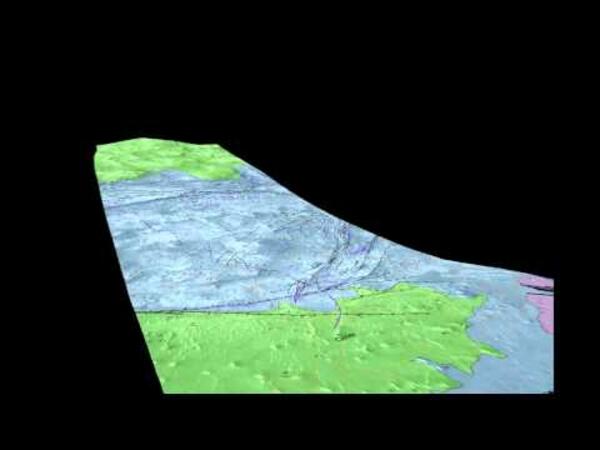
Geologic Map Flyover of Western Candor Colles Region of Mars
Geologic Map Flyover of Western Candor Colles Region of MarsThis map of the Candor Colles region of Mars depicts the most high-resolution geologic and structural mapping ever completed of another planet.
Geologic Map Flyover of Western Candor Colles Region of Mars
Geologic Map Flyover of Western Candor Colles Region of MarsThis map of the Candor Colles region of Mars depicts the most high-resolution geologic and structural mapping ever completed of another planet.

PubTalk 11/2014 — Water, Nuts, and the Nation's Fruit Bowl
PubTalk 11/2014 — Water, Nuts, and the Nation's Fruit BowlCalifornia's Central Valley Hydrologic Science
by Claudia Faunt, USGS Hydrologist
PubTalk 11/2014 — Water, Nuts, and the Nation's Fruit Bowl
PubTalk 11/2014 — Water, Nuts, and the Nation's Fruit BowlCalifornia's Central Valley Hydrologic Science
by Claudia Faunt, USGS Hydrologist

PubTalk 10/2014 — Wolf and Elk Diseases in Yellowstone
PubTalk 10/2014 — Wolf and Elk Diseases in Yellowstoneby Paul Cross, USGS Research Wildlife Biologist
- What can diseases of wildlife tell us about the emergence of human pandemics?
- Why is a bacterial disease expanding to animals beyond the Greater Yellowstone area?
- How are diseases affecting Yellowstone wolves?

Overflight of Flow Front
An aerial overview of the position of the flow front
An aerial overview of the position of the flow front