U.S. flag

An official website of the United States government

Images

Volcano Hazard Program images.

Filter Total Items: 6273
Map of flow field...
Map of flow field
Map of flow field
Map of flow field

This map shows recent changes to Kīlauea's East Rift Zone lava flow field. The area of the active flow field as of May 31 is shown in pink, while widening and advancement of the active flow as of June 21 is shown in red. Older Pu‘u ‘Ō‘ō lava flows (1983-2016) are shown in gray. The yellow line is the trace of the active lava tube (dashed where uncertain).

This map shows recent changes to Kīlauea's East Rift Zone lava flow field. The area of the active flow field as of May 31 is shown in pink, while widening and advancement of the active flow as of June 21 is shown in red. Older Pu‘u ‘Ō‘ō lava flows (1983-2016) are shown in gray. The yellow line is the trace of the active lava tube (dashed where uncertain).

HVO logs renewed seismic activity at Lō‘ihi...
HVO logs renewed seismic activity at Lō‘ihi

Left: A color-shaded bathymetry map of Lō‘ihi, a submarine volcano located southeast of the Island of Hawai‘i. The summit region is marked by pit craters formed in connection with an eruption and earthquake swarm in July-August 1996.

Left: A color-shaded bathymetry map of Lō‘ihi, a submarine volcano located southeast of the Island of Hawai‘i. The summit region is marked by pit craters formed in connection with an eruption and earthquake swarm in July-August 1996.

Thermal image shows crack across lava delta...
Thermal image shows crack across lava delta

Thermal images collected during the overflight on Wednesday, June 21, show a hot crack spanning much of the width of the lava delta at the Kamokuna ocean entry. These cracks are common on lava deltas, and suggest sagging and instability at the front of the delta.

Thermal images collected during the overflight on Wednesday, June 21, show a hot crack spanning much of the width of the lava delta at the Kamokuna ocean entry. These cracks are common on lava deltas, and suggest sagging and instability at the front of the delta.

Active surface breakouts continue near the 61g vent...
Active surface breakouts continue near 61g vent

On June 13 at about 6:00 am, there was a new pāhoehoe breakout along the episode 61g tube system approximately 1.1 km (0.7 miles) from the vent. Today (June 21), geologists visiting the site found that the ground had been cracked and uplifted about 2 m (6.6 feet) where the breakout originated (center).

On June 13 at about 6:00 am, there was a new pāhoehoe breakout along the episode 61g tube system approximately 1.1 km (0.7 miles) from the vent. Today (June 21), geologists visiting the site found that the ground had been cracked and uplifted about 2 m (6.6 feet) where the breakout originated (center).

The ocean entry remains active and continues to increase the size o...

The ocean entry remains active and continues to increase the size of the Kamokuna lava delta. Today, activity was concentrated towards the western side of the delta (left center), and building outward in a narrow lobe. Surface flows on the delta over the past few weeks have covered most of the delta with new lava.

The ocean entry remains active and continues to increase the size of the Kamokuna lava delta. Today, activity was concentrated towards the western side of the delta (left center), and building outward in a narrow lobe. Surface flows on the delta over the past few weeks have covered most of the delta with new lava.

The episode 61g flow continues to enter the ocean and build the del...

The episode 61g flow continues to enter the ocean and build the delta at the Kamokuna ocean entry. Small streams of lava along the front of the delta interact with the ocean and produce a large steam plume and occasional littoral bursts.

The episode 61g flow continues to enter the ocean and build the delta at the Kamokuna ocean entry. Small streams of lava along the front of the delta interact with the ocean and produce a large steam plume and occasional littoral bursts.

No visible breakouts on the coastal plain...
No visible breakouts on the coastal plain

The scattered breakouts that have been active on the steep part of the pali and at the base over the past few weeks were not visible this afternoon. The recent surface breakouts (pictured) were still warm, but no longer actively flowing.

The scattered breakouts that have been active on the steep part of the pali and at the base over the past few weeks were not visible this afternoon. The recent surface breakouts (pictured) were still warm, but no longer actively flowing.

HVO's masked geologist heads north to Alaska...
HVO's masked geologist heads north to AK

A masked Tim Orr, on his last day of field work as a USGS Hawaiian Volcano Observatory geologist, collected a sample from Kīlauea Volcano's active lava flow on May 31, 2017. The face mask and heavy glove on his left hand provide protection from the intense radiant heat of molten lava.

A masked Tim Orr, on his last day of field work as a USGS Hawaiian Volcano Observatory geologist, collected a sample from Kīlauea Volcano's active lava flow on May 31, 2017. The face mask and heavy glove on his left hand provide protection from the intense radiant heat of molten lava.

Latest upgrade of seismic stations at Kīlauea summit completed...
Latest upgrade of seismic stations at Kīlauea summit completed

USGS Hawaiian Volcano Observatory broadband-seismic stations located at the summit of Kīlauea have been significantly upgraded over the past three years. During the upgrades, HVO field engineers (inset) complete the wiring connections of the solar power and telemetry systems at each site, which are about 10 m (33 ft) from the seismometer.

USGS Hawaiian Volcano Observatory broadband-seismic stations located at the summit of Kīlauea have been significantly upgraded over the past three years. During the upgrades, HVO field engineers (inset) complete the wiring connections of the solar power and telemetry systems at each site, which are about 10 m (33 ft) from the seismometer.

Satellite image shows location of breakouts on flow field...
Satellite image shows location of breakouts on flow field

This satellite image was captured on Friday, June 2, by the Sentinel-2 satellite operated by the European Space Agency. Although this is a false-color image, the color map has been chosen to mimic what the human eye would expect to see. Bright red pixels depict areas of very high temperatures and show active lava. White areas are clouds.

This satellite image was captured on Friday, June 2, by the Sentinel-2 satellite operated by the European Space Agency. Although this is a false-color image, the color map has been chosen to mimic what the human eye would expect to see. Bright red pixels depict areas of very high temperatures and show active lava. White areas are clouds.

Steaming Pavlof volcano and Pavlof Sister as viewed from the west s...

Steaming Pavlof volcano and Pavlof Sister as viewed from the west shore of Unga Island, Alaska. View is to the west.

Different textures on the surface of the summit lava lake...
Different textures on the surface of the summit lava lake

The activity in the summit lava lake in Halema‘uma‘u has been typical in recent weeks, with the normal fluctuations in lava level. The low sun angle during the late afternoon provided good views of the different surface textures on the lake.

The activity in the summit lava lake in Halema‘uma‘u has been typical in recent weeks, with the normal fluctuations in lava level. The low sun angle during the late afternoon provided good views of the different surface textures on the lake.

Subtle folds are common on the lake surface, suggesting that the cr...

Subtle folds are common on the lake surface, suggesting that the crust on the lake surface is thin and flexible. In addition, small "blisters" cover large portions of the lake surface. HVO geologists have seen these blisters form, and they appear to be small bubbles that rise and push up the thin crust, without breaking it.

Subtle folds are common on the lake surface, suggesting that the crust on the lake surface is thin and flexible. In addition, small "blisters" cover large portions of the lake surface. HVO geologists have seen these blisters form, and they appear to be small bubbles that rise and push up the thin crust, without breaking it.

A clearer picture of the folding on the lake surface, which resembl...

A clearer picture of the folding on the lake surface, which resemble folds in a piece of thin fabric. The field of view in this photo is roughly 50 meters (yards) wide.

A view of the northern Overlook crater wall, through passing fume. ...
northern Overlook crater wall, through passing fume. The lake surf...

A view of the northern Overlook crater wall, through passing fume. The lake surface (lower left in photo) was about 22 meters (72 feet) below the crater rim (upper right in photo). The uppermost section of the crater wall is formed by stacks of thin overflows from mid-2015.

A view of the northern Overlook crater wall, through passing fume. The lake surface (lower left in photo) was about 22 meters (72 feet) below the crater rim (upper right in photo). The uppermost section of the crater wall is formed by stacks of thin overflows from mid-2015.

Tracking the latest moves of Kīlauea and Mauna Loa...
Tracking the latest moves of Kīlauea and Mauna Loa

Interferometric Synthetic Aperture Radar (InSAR) images of Kīlauea (left) and Mauna Loa (right) spanning the past several years. Concentric patterns of colored fringes indicate magma accumulation centered near the summit calderas of both volcanoes.

Interferometric Synthetic Aperture Radar (InSAR) images of Kīlauea (left) and Mauna Loa (right) spanning the past several years. Concentric patterns of colored fringes indicate magma accumulation centered near the summit calderas of both volcanoes.

Lava spatters into the air
Lava Spattering
Lava Spattering
Lava Spattering

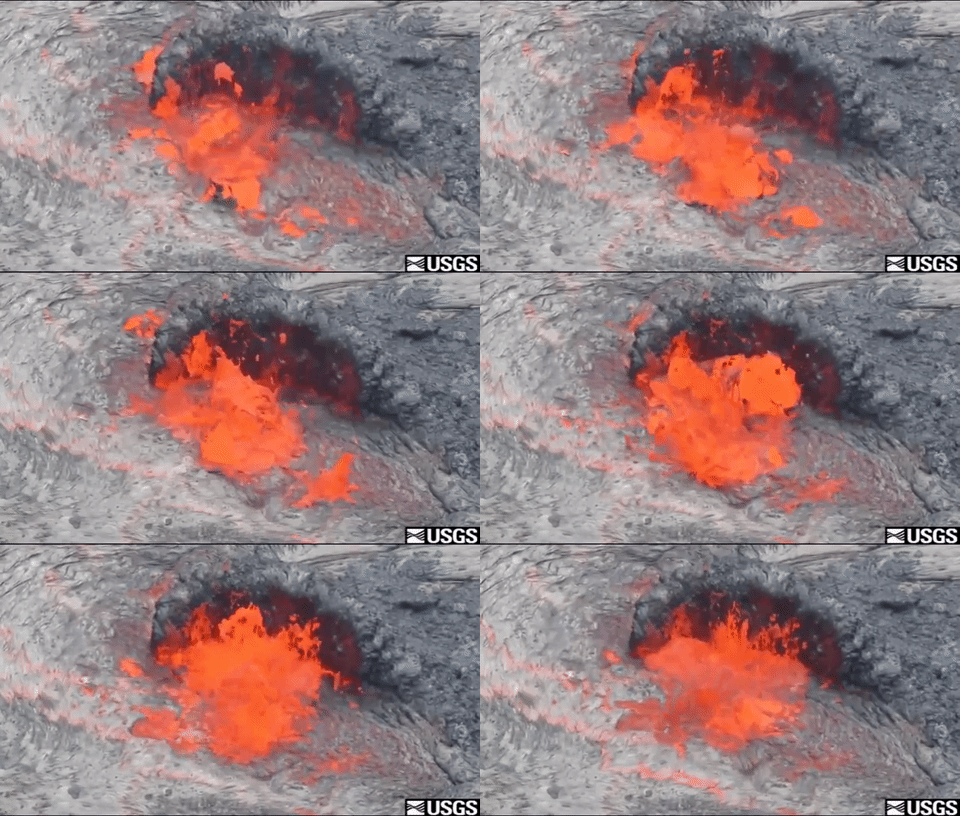
An animated GIF of lava spattering at  Pu'u 'O 'o crater pulled from the Pu'u 'O'o Producing Spattering video.

The Kamokuna ocean entry and lava delta...
The Kamokuna ocean entry and lava delta

Kīlauea Volcano's Kamokuna ocean entry is fed by lava that erupts from the east flank of the Pu‘u ‘Ō‘ō cone, visible on the skyline at upper left. It travels from the vent to the ocean via a lava tube, marked in places by fume emanating from the tube roof.

Kīlauea Volcano's Kamokuna ocean entry is fed by lava that erupts from the east flank of the Pu‘u ‘Ō‘ō cone, visible on the skyline at upper left. It travels from the vent to the ocean via a lava tube, marked in places by fume emanating from the tube roof.

Map of flow field...
Map of flow field
Map of flow field
Map of flow field

This map shows recent changes to Kīlauea's East Rift Zone lava flow field. The area of the active flow field as of May 3 is shown in pink, while widening and advancement of the active flow as of May 31 is shown in red. Older Pu‘u ‘Ō‘ō lava flows (1983-2016) are shown in gray. The yellow line is the trace of the active lava tube (dashed where uncertain).

This map shows recent changes to Kīlauea's East Rift Zone lava flow field. The area of the active flow field as of May 3 is shown in pink, while widening and advancement of the active flow as of May 31 is shown in red. Older Pu‘u ‘Ō‘ō lava flows (1983-2016) are shown in gray. The yellow line is the trace of the active lava tube (dashed where uncertain).

Was this page helpful?