



Two HVO geologists document road cutting activities on HWY 132 on August 7, 2019. One geologist is taking visual photographs while another geologist is taking thermal photographs to make a tandem pair for comparison. The temperature of the solidified lava was measured to 425 ° C (800 ° F) at the digging site. Photograph by USGS geologist K.
Images
Volcano Hazard Program images.
Filter Total Items: 6273

Why is the 2018 lava still so hot?
Two HVO geologists document road cutting activities on HWY 132 on August 7, 2019. One geologist is taking visual photographs while another geologist is taking thermal photographs to make a tandem pair for comparison. The temperature of the solidified lava was measured to 425 ° C (800 ° F) at the digging site. Photograph by USGS geologist K.

Still image from November 1, 2019, YVO video monthly update.
Still image from November 1, 2019, YVO video monthly update.Still image from November 1, 2019, YVO video monthly update.
Still image from November 1, 2019, YVO video monthly update.
Still image from November 1, 2019, YVO video monthly update.Still image from November 1, 2019, YVO video monthly update.

Horse trek to GPS station HVWY.
Transportation takes many forms; this horse trek to GPS station HVWY in Hayden Valley complies with wilderness regulations, reduces impact to sensitive areas, and enables teams to upgrade equipment to keep the site operational year-round. Site maintenance was completed under permit YELL-2019-SCI-5546, in close coordination with Park staff, on September 18, 2019.
Transportation takes many forms; this horse trek to GPS station HVWY in Hayden Valley complies with wilderness regulations, reduces impact to sensitive areas, and enables teams to upgrade equipment to keep the site operational year-round. Site maintenance was completed under permit YELL-2019-SCI-5546, in close coordination with Park staff, on September 18, 2019.

Map of monitoring instruments in and around Yellowstone National Park as of Octo
Map of monitoring instruments in and around Yellowstone National Park as of OctoMap of monitoring instruments in and around Yellowstone National Park as of October 31, 2019. To view the interactive version of this map, go to the Yellowstone Volcano Observatory website.
Map of monitoring instruments in and around Yellowstone National Park as of Octo
Map of monitoring instruments in and around Yellowstone National Park as of OctoMap of monitoring instruments in and around Yellowstone National Park as of October 31, 2019. To view the interactive version of this map, go to the Yellowstone Volcano Observatory website.

This video shows a close-up of the unmanned aerial system collecting a water sam
This video shows a close-up of the unmanned aerial system collecting a water samThis video shows a close-up of the unmanned aerial system collecting a water sample in Halema‘uma‘u. USGS video by M. Patrick, 26 Oct 2019.
This video shows a close-up of the unmanned aerial system collecting a water sam
This video shows a close-up of the unmanned aerial system collecting a water samThis video shows a close-up of the unmanned aerial system collecting a water sample in Halema‘uma‘u. USGS video by M. Patrick, 26 Oct 2019.

Video of the water sampling at Kīlauea summit with unmanned aerial system
Video of the water sampling at Kīlauea summit with unmanned aerial systemThis video shows the unmanned aerial system collecting a water sample from Halema‘uma‘u. This wider view shows the scale of the UAS relative to the water pond. USGS video by M. Patrick, 26 Oct 2019.
Video of the water sampling at Kīlauea summit with unmanned aerial system
Video of the water sampling at Kīlauea summit with unmanned aerial systemThis video shows the unmanned aerial system collecting a water sample from Halema‘uma‘u. This wider view shows the scale of the UAS relative to the water pond. USGS video by M. Patrick, 26 Oct 2019.

Pre-flight inspection
USGS and OAS team prepares the sampling mechanism and inspects the unmanned aerial system a few minutes before mission start and takeoff. All safety precautions were taken to ensure the aircraft and sampling mechanism were sterile, and would return safely from the pond.
USGS and OAS team prepares the sampling mechanism and inspects the unmanned aerial system a few minutes before mission start and takeoff. All safety precautions were taken to ensure the aircraft and sampling mechanism were sterile, and would return safely from the pond.

Civil Air Patrol captured this aerial image of Mauna Loa's summit caldera, Moku&
Civil Air Patrol captured this aerial image of Mauna Loa's summit caldera, Moku&Civil Air Patrol captured this aerial image of Mauna Loa's summit caldera, Moku‘āweoweo, on Sunday, October 20, 2019. The true summit of Mauna Loa is located just to the right of the center of the image, at the highest location above the caldera wall in the background.
Civil Air Patrol captured this aerial image of Mauna Loa's summit caldera, Moku&
Civil Air Patrol captured this aerial image of Mauna Loa's summit caldera, Moku&Civil Air Patrol captured this aerial image of Mauna Loa's summit caldera, Moku‘āweoweo, on Sunday, October 20, 2019. The true summit of Mauna Loa is located just to the right of the center of the image, at the highest location above the caldera wall in the background.
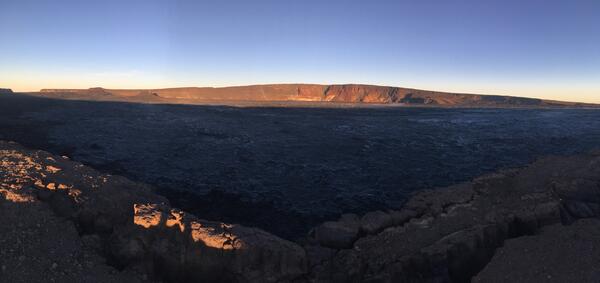
early morning view looking north across Moku‘āweoweo
early morning view looking north across Moku‘āweoweoAn early morning view looking north across Moku‘āweoweo, Mauna Loa's summit caldera, from a spot near the summit cabin on the volcano's south caldera rim. Frost covered much of the caldera floor that was still shadowed, and weak steaming issued from the usual areas. Overall, there were no significant changes observed at the summit.
early morning view looking north across Moku‘āweoweo
early morning view looking north across Moku‘āweoweoAn early morning view looking north across Moku‘āweoweo, Mauna Loa's summit caldera, from a spot near the summit cabin on the volcano's south caldera rim. Frost covered much of the caldera floor that was still shadowed, and weak steaming issued from the usual areas. Overall, there were no significant changes observed at the summit.

Continued slow rise of water level at bottom of Halema‘uma‘u
Continued slow rise of water level at bottom of Halema‘uma‘uThe water level at Kīlauea summit continues to slowly rise, with the size of the pond gradually enlarging. The pond today was at least 140 m (460 ft) in the east-west direction (from bottom to top of image). This length is a minimum estimate as the west end of the pond is now partially blocked from view by the crater walls. USGS photo by D. Swanson.
Continued slow rise of water level at bottom of Halema‘uma‘u
Continued slow rise of water level at bottom of Halema‘uma‘uThe water level at Kīlauea summit continues to slowly rise, with the size of the pond gradually enlarging. The pond today was at least 140 m (460 ft) in the east-west direction (from bottom to top of image). This length is a minimum estimate as the west end of the pond is now partially blocked from view by the crater walls. USGS photo by D. Swanson.

High Altitude Station Maintenance on Mauna Loa
Sulphur Cone (left), viewed toward southwest, from 3,480 m (11,420 ft) above sea level on Mauna Loa's southwest rift zone. At right, an HVO geoscientist and technician rebuild volcanic gas monitoring equipment installed near an outgassing fissure.
Sulphur Cone (left), viewed toward southwest, from 3,480 m (11,420 ft) above sea level on Mauna Loa's southwest rift zone. At right, an HVO geoscientist and technician rebuild volcanic gas monitoring equipment installed near an outgassing fissure.
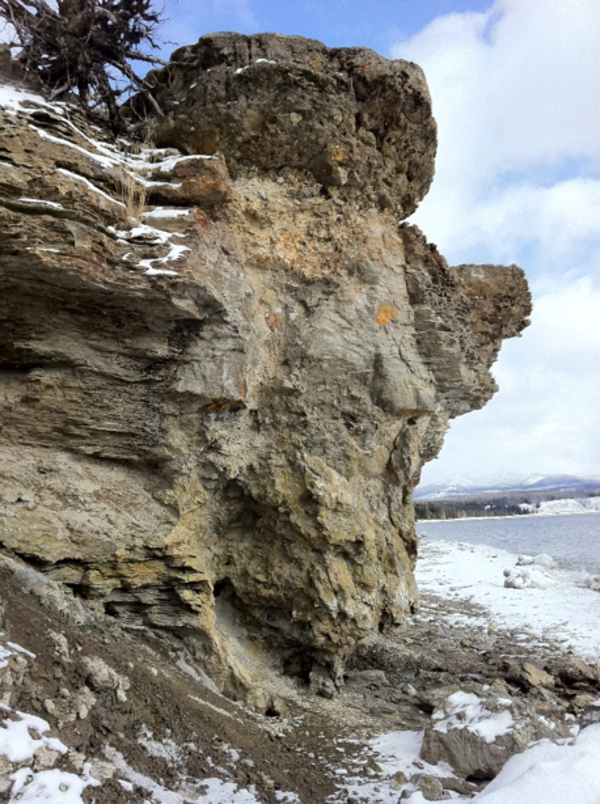
Black Dog breccia pipe is the remnant of an inactive hydrothermal vent system fo
Black Dog breccia pipe is the remnant of an inactive hydrothermal vent system foBlack Dog breccia pipe is the remnant of an inactive hydrothermal vent system fo
Black Dog breccia pipe is the remnant of an inactive hydrothermal vent system fo
Black Dog breccia pipe is the remnant of an inactive hydrothermal vent system foBlack Dog breccia pipe is the remnant of an inactive hydrothermal vent system fo

Breccia pipes forming within existing fractures along the western shore of Yello
Breccia pipes forming within existing fractures along the western shore of YelloMaterial filling the dissolved voids includes clasts of wall rock as well as beach sediments being washed into the voids. The lower structure on the left is about 0.7 m (2 ft) wide and 1.5 m (5 ft) high. Note the fracture alignment above the void structure on the right.
Breccia pipes forming within existing fractures along the western shore of Yello
Breccia pipes forming within existing fractures along the western shore of YelloMaterial filling the dissolved voids includes clasts of wall rock as well as beach sediments being washed into the voids. The lower structure on the left is about 0.7 m (2 ft) wide and 1.5 m (5 ft) high. Note the fracture alignment above the void structure on the right.

A closer look at the water surface. While most of the surface has a yellow-gree
A closer look at the water surface. While most of the surface has a yellow-greeA closer look at the water surface. While most of the surface has a yellow-green color, portions along the shoreline have a blue color and seem to correspond to areas of water upwelling. USGS photo by M. Patrick.
A closer look at the water surface. While most of the surface has a yellow-gree
A closer look at the water surface. While most of the surface has a yellow-greeA closer look at the water surface. While most of the surface has a yellow-green color, portions along the shoreline have a blue color and seem to correspond to areas of water upwelling. USGS photo by M. Patrick.

Another timelapse view of the summit water pond
This timelapse video covers about 30 minutes of activity at the water pond in Halema‘uma‘u at the summit of Kīlauea. Water appears to be flowing into the pond from several locations, including the southern boundary (right side in this image). A small amount of material is also seen floating on the surface at the eastern end of the pond (top of image).
This timelapse video covers about 30 minutes of activity at the water pond in Halema‘uma‘u at the summit of Kīlauea. Water appears to be flowing into the pond from several locations, including the southern boundary (right side in this image). A small amount of material is also seen floating on the surface at the eastern end of the pond (top of image).

HVO measures water table at Keller Well
HVO field engineers and staff conducted quarterly work at a deep borehole, known as the Keller Well, at the summit of Kīlauea Volcano today (Sept. 24). They lowered a sensor into the well to measure the distance between the ground surface and the top of the water table, which was 505 m (1657 ft) below the ground surface today.
HVO field engineers and staff conducted quarterly work at a deep borehole, known as the Keller Well, at the summit of Kīlauea Volcano today (Sept. 24). They lowered a sensor into the well to measure the distance between the ground surface and the top of the water table, which was 505 m (1657 ft) below the ground surface today.

Video of circulation in the Halema‘uma‘u water pond
Video of circulation in the Halema‘uma‘u water pondThis timelapse video covers about 25 minutes and shows the circulation in the water pond in Halema‘uma‘u. There appears to be an influx of water along the southern shoreline (right side in this image). A broader eastward flow of water (towards the top of the image) is evident. The video is shown twice.
Video of circulation in the Halema‘uma‘u water pond
Video of circulation in the Halema‘uma‘u water pondThis timelapse video covers about 25 minutes and shows the circulation in the water pond in Halema‘uma‘u. There appears to be an influx of water along the southern shoreline (right side in this image). A broader eastward flow of water (towards the top of the image) is evident. The video is shown twice.

This video is shown at 30x speed and highlights the changing activity on the sur
This video is shown at 30x speed and highlights the changing activity on the surThis video is shown at 30x speed and highlights the changing activity on the surface of the water pond. Steaming shifts in the wind, and circulation of the water is evident in areas of sharp color boundaries.
This video is shown at 30x speed and highlights the changing activity on the sur
This video is shown at 30x speed and highlights the changing activity on the surThis video is shown at 30x speed and highlights the changing activity on the surface of the water pond. Steaming shifts in the wind, and circulation of the water is evident in areas of sharp color boundaries.

Images taken on September 10 and 14 show the slight rise in water level, most ob
Images taken on September 10 and 14 show the slight rise in water level, most obImages taken on September 10 and 14 show the slight rise in water level, most obvious by comparing the rock marked with an arrow in each photo. USGS photos by M. Patrick.
Images taken on September 10 and 14 show the slight rise in water level, most ob
Images taken on September 10 and 14 show the slight rise in water level, most obImages taken on September 10 and 14 show the slight rise in water level, most obvious by comparing the rock marked with an arrow in each photo. USGS photos by M. Patrick.

Mauna Loa: Early morning view of Moku‘āweoweo
An early morning view looking north across Moku‘āweoweo, Mauna Loa's summit caldera, from a spot near the summit cabin on the volcano's south caldera rim. Frost covered much of the caldera floor that was still shadowed, and weak steaming issued from the usual areas. Overall, there were no significant changes observed at the summit.
An early morning view looking north across Moku‘āweoweo, Mauna Loa's summit caldera, from a spot near the summit cabin on the volcano's south caldera rim. Frost covered much of the caldera floor that was still shadowed, and weak steaming issued from the usual areas. Overall, there were no significant changes observed at the summit.

Aerial view of new thermal area near Tern Lake, Yellowstone.
Aerial view of new thermal area near Tern Lake, Yellowstone.Aerial view of the new thermal area, in the center left. The existing Tern Lake thermal area is the bright white patch of ground in the upper middle part of the image. West Tern Lake is in the lower right. Research conducted under NPS Geology Programs Milestones Permit 2016-9.
Aerial view of new thermal area near Tern Lake, Yellowstone.
Aerial view of new thermal area near Tern Lake, Yellowstone.Aerial view of the new thermal area, in the center left. The existing Tern Lake thermal area is the bright white patch of ground in the upper middle part of the image. West Tern Lake is in the lower right. Research conducted under NPS Geology Programs Milestones Permit 2016-9.