



253-year coral record reveals Maui reef’s long history of land-use impacts
Study traces changes in sediment and nutrient delivery from Maui’s watershed to Olowalu reef, linking a mid-20th-century increase in terrestrial inputs to declining coral growth.
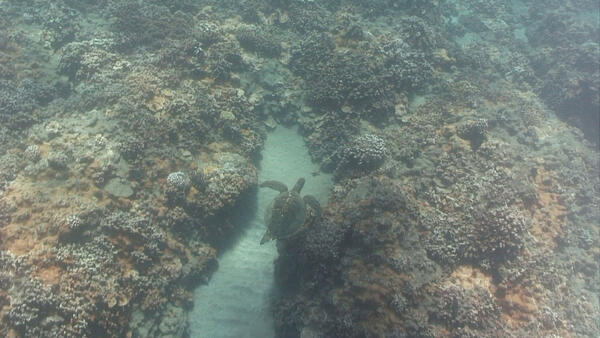
A coral reef on Maui's northwest shore preserves more than two centuries of environmental history, including evidence of how land-use changes have affected the nearshore environment.
In a new study, scientists from the University of Hawai’i at Manoa and USGS analyzed a single Porites lobata coral core collected from Olowalu reef on Maui. By measuring specific elements in the core’s chemical composition, the researchers show how sediment and nutrient inputs to the reef changed from 1760 through 2013. The 253-year record spans major transitions in Maui’s history, from the pre-colonial period through the expansion and decline of sugarcane agriculture, water diversion, and modern coastal development.
The findings provide the first long-term baseline for understanding ridge-to-reef connectivity on Maui—the ways materials and water move from watersheds through coastal areas and ultimately to coral reefs.
Coral skeletons record changes on land
Hard corals can act as natural archives of their environment. As they grow, they incorporate chemical components from surrounding seawater into their skeletons. By measuring trace elements and coral growth through time, scientists can reconstruct changes in the conditions experienced by a reef.
For the Olowalu coral core examined in this study, researchers measured the ratios of elements including barium, yttrium, phosphorus, iron, and strontium relative to calcium. Some of these chemical signatures can indicate increases in material coming from land, allowing scientists to distinguish terrestrial influences from natural variability.
The coral record showed pronounced fluctuations at annual to decadal timescales that correspond with patterns associated with El Niño–Southern Oscillation and the Pacific Decadal Oscillation.
These patterns can influence rainfall and other processes that affect runoff and groundwater delivery from watersheds to coastal waters. Their signatures in the coral core indicate that natural climate variability has long played an important role in regulating the amount of land-derived material reaching Olowalu reef.
But natural climate variability was only part of the story.


Sugarcane era leaves a chemical fingerprint
Superimposed on the climate-driven fluctuations was a much longer-term change in the coral’s chemistry.
Between the 18th century and the late 20th century, barium-to-calcium, phosphorus-to-calcium and iron-to-calcium ratios increased by about 17% to 55%. The most pronounced increases occurred during the mid-1900s, when sugarcane plantations covered much of Maui’s landscape.
The changes indicate a prolonged increase in sediment and nutrient delivery from land to the reef.
Sugarcane cultivation involved extensive alteration of the watershed, including changes to vegetation, soil and water movement. Irrigation and water diversion also changed how water and sediment moved toward the coast.
Results from the coral record suggests that those landscape changes were reflected downstream in the reef environment. Coral calcification—the process by which hard corals build their calcium-carbonate skeletons—increased by about 30% before roughly 1970, but then declined. The decrease coincided with the period of peak sugarcane production and the highest levels of several indicators of terrestrial material.
Researchers found a negative relationship between coral calcification and terrestrial-input indicators such as barium, yttrium, phosphorus, iron, and strontium relative to calcium. The relationship suggests that episodic inputs of material from the watershed, particularly during the sugarcane era, depressed coral growth.

A baseline for reef restoration and management
The Olowalu coral core provides something that modern monitoring alone cannot: a picture of nearshore environment conditions before major human-driven changes to the landscape.
That pre-colonial baseline allows scientists to distinguish natural fluctuations from changes associated with agriculture and subsequent development. It also provides context for evaluating current reef conditions and understanding how land management may influence reef health. Studies like this demonstrate how human changes to the watershed can leave a lasting chemical and biological signature in downstream marine ecosystems.
Read the study, Effect of land-use change and climate on coral calcification and geochemistry: A 253-year time series from west Maui, in Coral Reefs.
Related
Developing a USGS Digital Coral Growth Archive using Rotating X-Ray Computerized Tomography - The ACTS Project

Coral Reef Project
Related
Developing a USGS Digital Coral Growth Archive using Rotating X-Ray Computerized Tomography - The ACTS Project